
Uncanny Correspondences
The radical choreography of Trisha Brown
The Uncanny Choreography of Trisha Brown
After a career spanning five decades, and 10 years after her passing, the choreographer and dancer is having a moment.
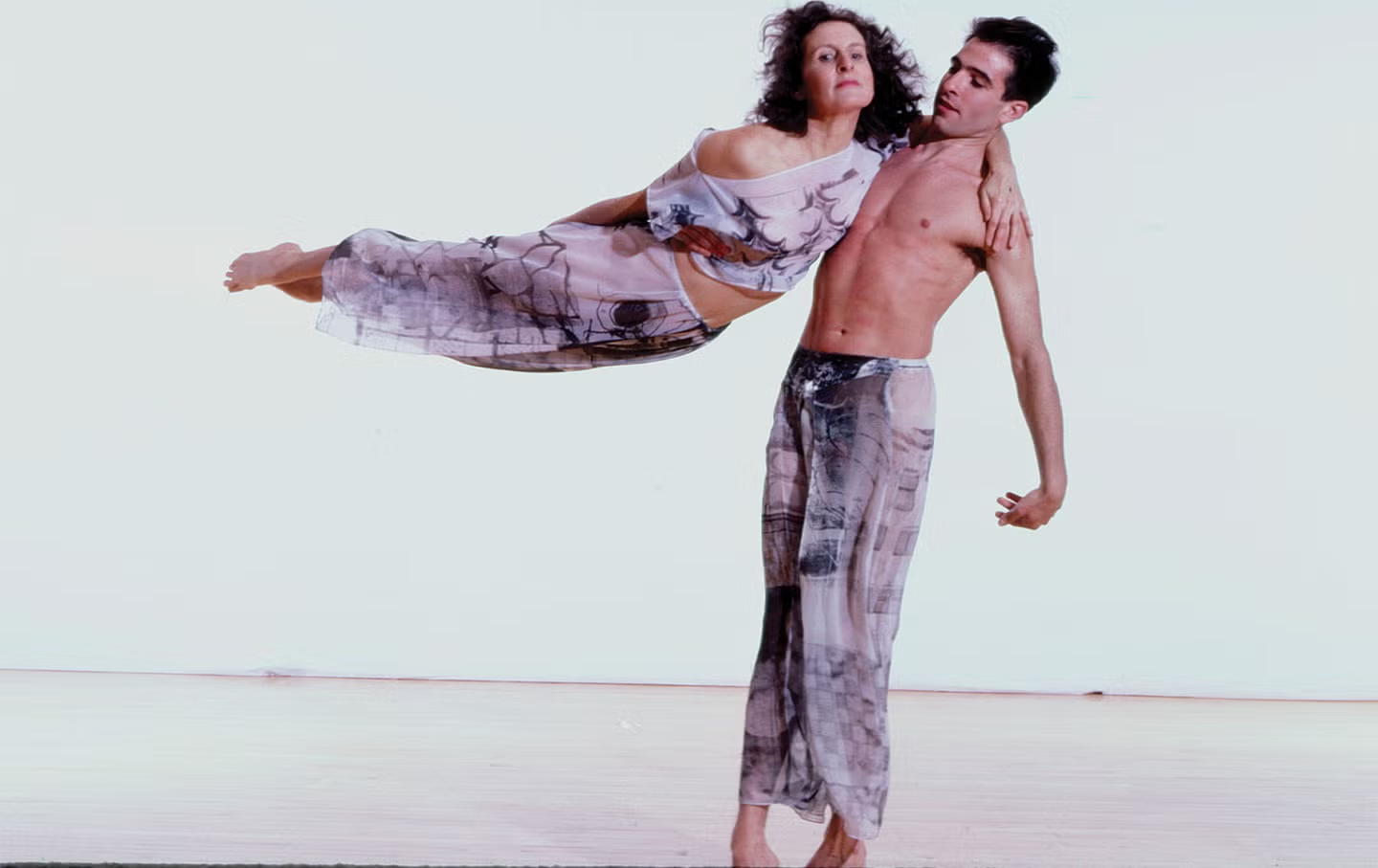
Trisha Brown and Lance Gries, 1984.
(Jack Mitchell / Getty)
In 1982, the dancer Trisha Brown started an unorthodox correspondence with the musician and performance artist Laurie Anderson. Anderson’s debut studio album, Big Science, had just been released, and Brown, emerging as one of the leading dance artists of her generation, had choreographed a 10-minute duet to the song “Sweaters.” She sent it to Anderson by videotape without sound. Anderson then composed a new score for Brown’s dance and mailed back a cassette with the music. And with that, Brown set in motion the latest in a series of multimedia collaborations, not just with Anderson but with the artist Robert Rauschenberg, that would result in her masterwork, Set and Reset.
In October 1983, Set and Reset premiered at the Brooklyn Academy of Music’s Next Wave festival. The dance opens on Rauschenberg’s sculptural set Elastic Carrier (Shiner), a rectangular prism flanked by two pyramids. The first movements are projections of newsreel-style found footage—traffic, baseball, a monkey—shifting onto the fabric forms that rise to make way for the performers as they appear. Two stagehands enter holding a dancer horizontally overhead, charting the stage perimeter as she walks on a wall that isn’t there. It’s a witty quotation of one of her earlier works, 1971’s Walking on the Wall. Meanwhile, Anderson’s score—part sci-fi, part groovy rhythm—keeps the dancers in motion. They break away in different directions, each doing a variation of the piece’s basic movement phrases. Straight limbs slice the air, punctuating slinky hip swivels with geometric precision. Individuals relate to one another like a Fibonacci sequence in nature, in mathematical patterns so seamless that one doesn’t register the equation behind the pine cone’s spiral. This cascading energy, simultaneously fluid and structured, epitomizes Brown’s movement language.
This past February, the Trisha Brown Dance Company performed Set and Reset on the BAM stage of its premiere—a reprise that marked a major stop in the company’s ongoing “Dancing With Bob” tour celebrating Rauschenberg’s centennial. The double bill includes Merce Cunningham’s Travelogue and is taking Brown’s dance company all over the world, from Beverly Hills to Chicago, Vienna to Paris.
Much has changed since Set and Reset’s debut four decades ago. In the early 1980s, Brown benefited from substantial federal funding. In 2025, as part of the Trump administration’s attack on cultural institutions, the National Endowment for the Arts revoked a major grant intended for the tour. Now her company must lean more heavily on private funds, such as from the French jewelry company Van Cleef and Arpels. But so deep-seated is Brown’s choreography in the postmodern canon that watching the piece today, one can sense its constancy, as though Brown were in the translucent wings of Rauschenberg’s set directing it. When Anderson’s voice proclaims “Long time no see” over her electronic score, it is now a greeting to these old friends. No worries that neither Brown nor Rauschenberg are alive; Set and Reset reaches them as a séance of sorts, made easier by the staying power of their legacies.
Born in 1936 in Aberdeen, Washington, Trisha Brown graduated from Mills College in 1958 with a degree in dance. She learned improvisation techniques from Anna Halprin in San Francisco before making the inevitable crossing to New York City. When she arrived in the early 1960s, Brown took classes at the Merce Cunningham studio and worked answering phones there. That’s how she met Rauschenberg: “This man used to call named Bob Rauschenberg, and I had the greatest conversations with him,” she told David Sears in a 1982 interview for Ballet Review. It would be another decade before they officially collaborated, but Brown admired Rauschenberg’s dynamic stage designs for Cunningham and others, as well as his exhibitions pushing the limits of sculpture and painting. (“I was bowled over that anyone would put a bed on the wall and put some paint on it,” she said of one of the artist’s early “combines,” Bed.)
Brown eventually graduated from Cunningham’s reception desk and matriculated into the street school broadly referred to as New York’s downtown art scene. She was a founding member of the Judson Dance Theater—the now-legendary avant-garde collective that rejected the drama of early modern dance and championed a democratic, pedestrian form of movement. Under the roof of Judson Memorial Church, Brown trail-blazed what we now refer to as postmodern dance along with people like Yvonne Rainer, Steve Paxton, and Simone Forti. By the 1970s, Brown wasn’t under the roof so much as outside or even on top of it. Her 1971 Roof Piece and her “equipment pieces,” such as Man Walking Down the Side of a Building (1970), liberated dance from theaters and set it loose in galleries, lofts, parks, and in front of buildings. When Brown’s Walking on the Wall was performed on the exterior of the Whitney, it was Rauschenberg who supplied the equipment.
As the 1980s approached, Brown’s work began to change. A transition from site-specific dances to a cycle of proscenium pieces posed new questions of perspective and audience. While Brown’s dances were welcomed by mainstream concert venues like BAM and backed by conventional art-funding sources, they retained their experimental edge. It was in this era that Brown opened her company to men and began documenting not just her finished pieces but her creative process on video. It was also in this period that she developed Set and Reset.
At once wild and precise, playful and deadpan, Set and Reset respects the choreographic categories that came before it even as it defies them. The veteran critic Deborah Jowitt once noted that “it’s always been one of the high aspirations of modern dance not to move like the person you started with.” Martha Graham broke away from her teachers at the Denishawn school in the 1920s. Graham’s disciples—the generation of Merce Cunningham and Paul Taylor—then distinguished themselves in turn against their inherited gospel. In Set and Reset, as the name implies, Brown marked herself out as one of the true innovators of dance movement in the 20th century. By that point, it seemed like her movement came, as Brown once put it, from “Heaven.”
The heaven that Brown may have had in mind, as Susan Rosenberg expertly shows in her book Trisha Brown: Choreography as Visual Art, was her childhood in the rural beauty of Washington State. Of course, the inspiration might have come from somewhere else, too. But Brown’s work was, as Rauschenberg once noted, “just about as personal” as one can get: “She’s right on the edge—I mean if she weren’t so eccentric, it would be too autobiographical, but she is such an unpredictable person, actually, that even if it is autobiographical, it looks abstract.”
It’s this personal quality that fed Brown’s artistic relationships, including in the making of Set and Reset. Despite privileging structure, logic, and mathematical precision, her principles of motion had at their core a collaborative element—one born out of her interactions with others. The paradigmatic example is what Brown called “memorized improvisation,” which she used to create Set and Reset. Generating spontaneous building blocks of movement from her body and engineering them into a choreographic flow, she then had her dancers execute the material in the studio, down to the last square inch, before encouraging them to improvise from it—“play with visibility and invisibility”—over and over until a new set of movements emerged. “Brown felt that instinctual behavior brought up tenderness and sort of a sabotage aspect to the work. You get all kinds of things happening outside the confines of the original, rigorously organized material. [Set and Reset] was really one of the first times that humor was an element of the work—high jinks, exuberance all showed up and were then committed [to the choreography],” recalled Carolyn Lucas, a former dancer with the company and its current associate artistic director. “She said at one point of the dancers, ‘I couldn’t keep them out of the work.’”
With her outside collaborators, Brown also cultivated equally intimate exchanges, such as her VHS-for-cassette-tape dialogue with Anderson that prompted the making of Set and Reset. The composer dubbed it “electronic closeness,” a kind of Snapchat ahead of its time. Brown got just as close with others, like Rauschenberg, but each time through different means. In Brown’s own words: “In Set and Reset, the communication between [Bob and me] was direct, almost as if he lived inside of me, or me inside of him. There were correspondences that were uncanny.” Brown was not just aware that her collaborative demands ran deep; it was her consciously imposed condition, her sine qua non of the artistic relationship. “One factor in all of my collaborations is that I work with friends of mine,” Brown told The Brooklyn Rail in 2005. “You need to know if they’re going to go ballistic at the drop of a hat or not. You have to know if they’ll be able to deal with it.”
Brown did not completely blur the borders of music, visual art, and dance in her work. Nor did she insist on the complete autonomy of each of these art forms the way Cunningham, Cage, and Rauschenberg had done. What she did do was bring each discipline into a quasi-familial relationship characterized by both proximity and distance. In Set and Reset, Brown would send Anderson weekly videos of new movement phrases as Anderson worked on the score. Rauschenberg labored over the set and costumes at a greater distance from the other two, insisting that “the sturdiest kind of collaboration happens when you allow all the participants as much freedom as they can absorb.” Out of this practice came Elastic Carrier (Shiner) and his silk-screened city images on the dancers’ costumes. Grayscale, they are in contrast with Rauschenberg’s projected moving images, forming the kind of two-way flow that characterized Brown’s practice.
After a career spanning five decades, and 10 years after her passing, Trisha Brown is having a moment. The reprise of Set and Reset, in a tour honoring one of her closest artistic partners, stands as a testament to her legacy, not by imparting it to those around her but by pulling them into it. Her work is powerful enough to jump generations. Her set of movements are still in motion, and her collaborators—some alive, others now dead—span nearly half a century of American art, music, and dance. Some of her collaborators will need to be reached by séance; others are immediately accessible. But their sheer number is both the proof of Brown’s achievement as a choreographer and the reason why Set and Reset feels as fresh today as it did back in 1983.
More from The Nation


The Genius of Charli XCX The Genius of Charli XCX
On her new album, Music, Fashion, Film, the musician embraces rock.

The Architectural Follies of Trump’s Washington, DC The Architectural Follies of Trump’s Washington, DC
The president plans to remake the capital in his own image, but is all he is doing destroying what’s already there?

