
Why the Democrats’ Path Back to Power Runs Through the Kitchen Table
A unique new messaging study underscores the supremacy of economic populism in rural America and beyond.
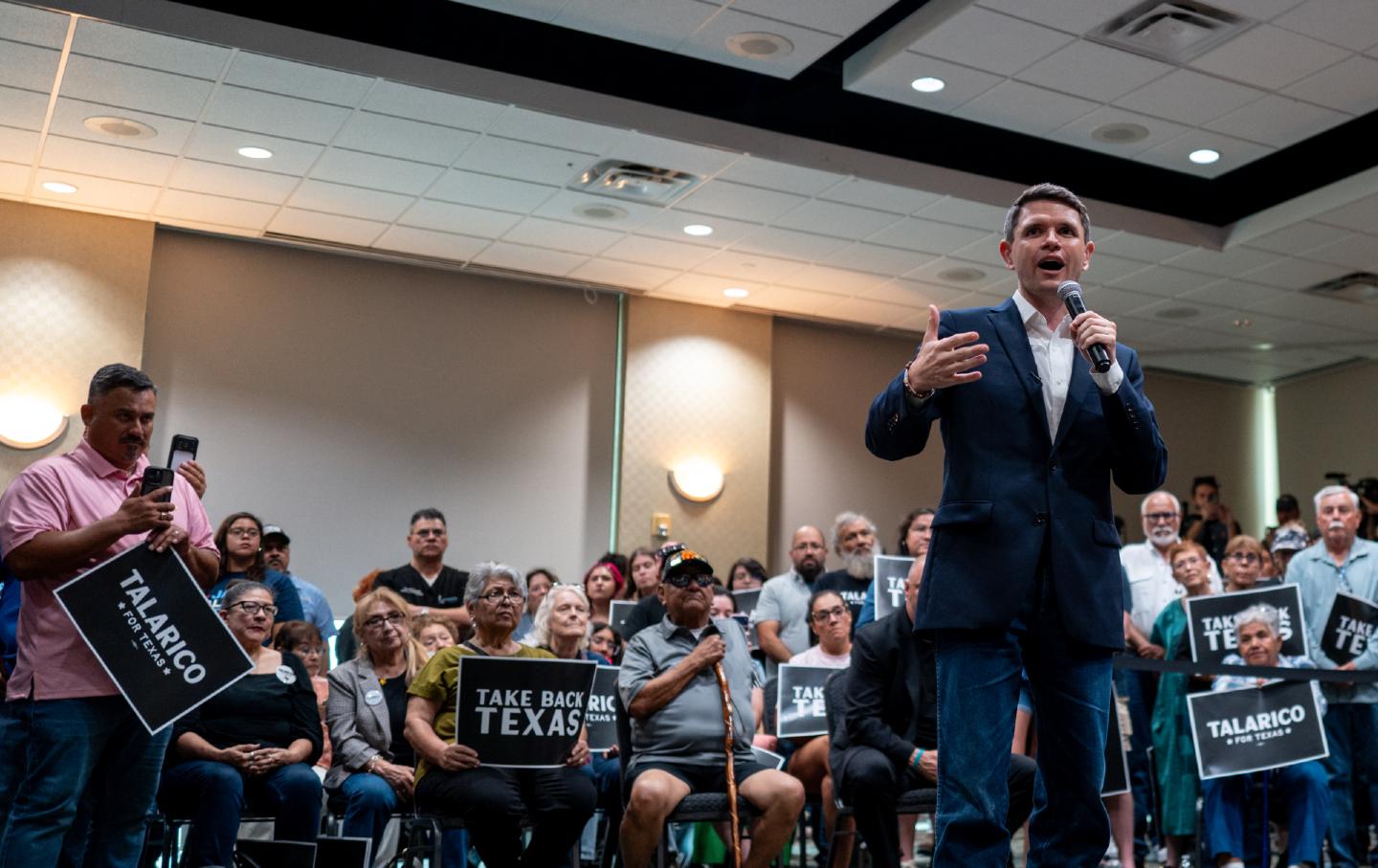
James Talarico speaks during a “Talarico for Texas: Frontera Tour” campaign rally at the International Center for Trade Convention Center on July 13, 2026, in Eagle Pass, Texas.
(Brandon Bell / Getty Images)
Democratic politicians seem to have finally gotten the memo: More than anything, people want their economic grievances addressed and their hard work rewarded. Nothing else comes close to mattering as much as earning enough money to pay the bills and having a shot at the American Dream.
From Pete Buttigieg deploring a political system that allows corporations to squeeze farmers and consumers to Senator Chris Murphy’s bill banning private equity ownership of hospitals and nursing homes, Democrats are showing signs of reclaiming their party’s New Deal–era legacy.
They’re wise to do so. In June, our respective organizations, the Rural Urban Bridge Initiative (RUBI) and the Center for Working-Class Politics, surveyed 6,100 people, more than a thousand of them rural, about their reactions to political messaging. We asked them to compare two GOP opposition messages and 13 different kinds of messages either written by us or frequently heard on the campaign trail or in content by groups such as Indivisible, Showing Up for Racial Justice, and the Movement Voter Project. We have now compiled our findings in a new study, “Kitchen Table Messaging for the Populist Era.”
The results are clear. We found that people said they were substantially more likely to vote for Democrats who deploy populist economic messaging than for Democrats with messaging that criticizes Trump, warns about fascism and oligarchy, or exposes elites’ divide-and-conquer playbook. (Divide-and-conquer rhetoric scapegoats marginalized groups so that working people blame them—rather than elites—for their hard times.) The preference for kitchen-table populism held true with our respondents across the board and with key subgroups, including rural voters.
Our kitchen-table populist messages all do four things in various ways: They acknowledge that wages aren’t keeping pace with rising costs; affirm that people are working hard and deserve a decent standard of living; recognize that economic elites are doing well while ordinary people are struggling; and lay out clear material solutions such as making corporations and billionaires pay their fair share in taxes and refusing corporate PAC donations.
All seven of these messages beat both GOP messages. In some cases, the gap was modest, but our top performers absolutely trounced the GOP opposition.
When it came to the divide-and-conquer set, Texas senatorial candidate James Talarico’s message below did a little better than the Race-Class Narrative (a messaging approach that frames racial division as an elite tactic to divide working people) but lagged far behind the kitchen-table populist winners. Talarico is edging his opponent out in recent polls and, we suggest, could do better still, especially with rural voters, by doubling down on his more resonant messages rather than the one below:
Unity Adapted from James Talarico
“The billionaires want to keep us from seeing all that we have in common. They divide us by party, by race, by gender, by religion so we don’t notice they’re defunding our schools, gutting our healthcare, and cutting taxes for themselves and their rich friends. It’s the oldest strategy in the world: divide and conquer. They want to keep us from realizing there’s far more that unites us than divides us. Because once we do, we’ll come together to fix what’s broken in our country and take back power for ourselves and our communities.”Race-Class Narrative… Adapted from ASO Communications
“Every family, of every color and background, deserves to have what we need. But today, Republicans spread lies to keep us divided while they abduct our neighbors, start wars abroad and jack up prices. If you want to know who took your money, it’s the people with all the money. And if billionaires and Republicans can talk you into thinking anyone else is to blame for your hard times, they will keep getting away with it. The many can take on the money by voting for leaders who will fund our futures and respect our freedoms.”
Given the popularity of divide-and-conquer rhetoric on the progressive left, we created our own unique divide-and-conquer message called “Immigrant Solidarity.” It fared better than the others in this category but, again, lagged behind the kitchen-table champs.
Immigrant Solidarity Original message by study authors
“So many people are struggling financially—and the question is why. As far as I’m concerned, immigrants who are here to work and feed their families aren’t the problem. The problem is politicians and their lobbyist buddies who hand tax breaks to the rich and then turn around and say: ‘Sorry we don’t have enough money for schools and health care, and it’s immigrants’ fault.’ That’s BS. Most of us have more in common with an immigrant who works paycheck to paycheck than with a CEO that gets paid a big bonus for moving their factories overseas. The government should go after the people who rig our economy, not the ones who build it.”
For key persuadable segments of the electorate, the preference for kitchen-table populism over divide-and-conquer and anti-Trump narratives was even more pronounced. Rural respondents and Trump waverers (who voted for him in 2024 and are not planning to vote Republican in 2028) unequivocally rejected the Race-Class Narrative and anti-Trump messages. Independents and undecided likely 2026 voters were mildly positive toward anti-Trump and Race-Class messages but liked Kitchen Table Populist messages far better, especially this one:
American Way…
“Most people just want to work hard, get ahead, and give their kids a better shot—and they should be able to. But the cost of rent, groceries, and health care keeps going up faster than working families can keep up, and paychecks just aren’t stretching the way they used to. I’m going to bring those costs down for working people, make sure the biggest corporations pay their fair share, and crack down on corruption and the people who game the system for themselves. Hard work should pay off again—that’s the American way.”
Our data crowns the message above as the clear winner (to the extent that any single survey can). That was fairly predictable: Voters have for years been telling pollsters that the cost of living is their number-one concern—no surprise when half the country struggles to pay for gas and groceries. Messages that keep these financial woes front and center obviously resonate. For rural voters with a strong work ethic, acknowledgement that they work hard and deserve a decent standard of living goes a long way.
Anti-Trump attacks, even those that link Trump’s malfeasance to pocketbook pain, fail because they try to get voters to focus their attention on what is, to them, a matter of less importance. Whereas kitchen-table populism dwells in concrete reality, Trump attacks veer into abstractions (fascism, abuse of power, the end of democracy, etc). Trump’s abuses of power are matters of grave importance, but, when your car’s broken down and the rent’s overdue, they can feel somewhat beside the point.
The Talarico and Race-Class Narrative divide-and-conquer messages present a different set of pitfalls: They suggest that elites have successfully duped “you” or “us” into supporting their xenophobic, jingoistic agenda against your own best interests. This comes across as condescending, implying that the speaker knows better than the hapless voter what’s really going on. This accentuates liberals’ reputation for self-righteousness and lands particularly badly with rural voters who already feel stung by liberal disdain.
Politics 101 requires politicians to meet voters where they’re at, not where political consultants and activists wish they were at. Where they’re at is the kitchen table, sorting through stacks of bills. Candidates who meet them there, with empathy, bold solutions, and a dash of anger toward the winner-take-all system, will be given a fair hearing.
More from The Nation
This November, Vote Like Alito Is on the Ballot This November, Vote Like Alito Is on the Ballot
In this week’s Elie v. U.S., our justice correspondent gives Democrats another reason to vote in November. Plus: How Sarah Huckabee Sanders’s Medicaid unmasked the racists.
Does America First Really Mean Israel First? Does America First Really Mean Israel First?
Mike Huckabee’s aide shows how an extremist agenda dominates Trump’s Middle East policy.

Trump’s Die-Hards Are Taking Their Cultishness to New Lows Trump’s Die-Hards Are Taking Their Cultishness to New Lows
I’m finally starting to understand why Jim Jones’s lieutenants didn’t try to stop him.
Harlan Crow’s Portrait of SCOTUS Under Trump Harlan Crow’s Portrait of SCOTUS Under Trump
Clarence Thomas, the picture of corruption.

