Hegseth’s Testosterone Program Is a Disservice to Men
By measuring manliness by muscle and testosterone levels, the defense secretary is peddling damaging stereotypes and legitimizing a narrow view of masculinity.
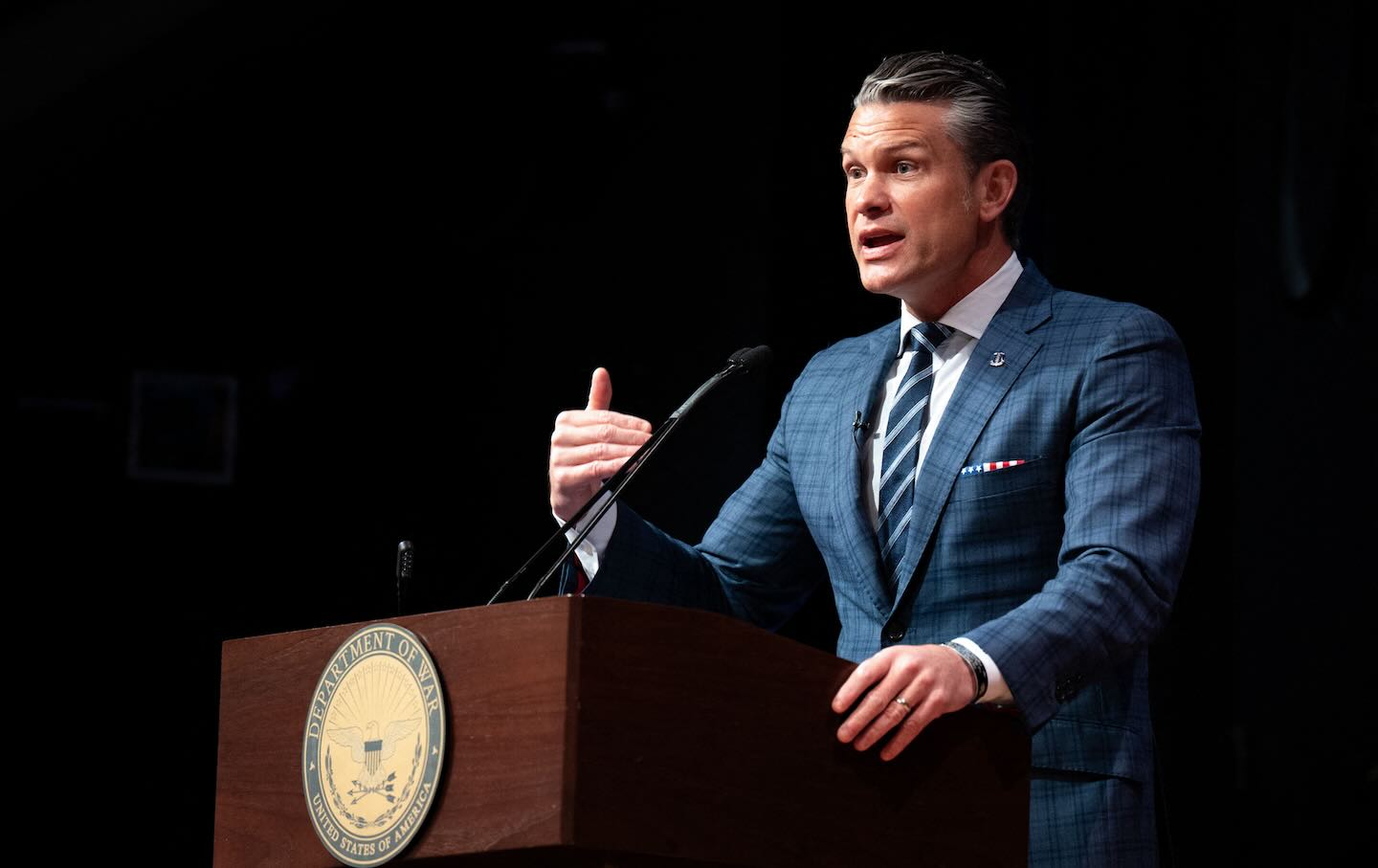
US Secretary of Defense Pete Hegseth speaks at the Pentagon in Washington, DC, on July 27, 2026.
(Annabelle Gordon / AFP)Last month, Defense Secretary Pete Hegseth announced a new program to add testosterone testing to regular health checkups for “war fighters” and to offer testosterone replacement therapy (TRT) for anyone with low levels. Proper testosterone levels, he argued, would “optimize” performance and preserve America’s “lethality” on the battlefield. “We have a sacred duty to maintain that advantage,” he said in the July 15 video, which was titled “High T Department of War.”
In the days following, journalists and scientists questioned the medical soundness of this new initiative. Measuring testosterone is notoriously tricky, and there is disagreement on when TRT is needed. But whether this testosterone program will tangibly enhance performance is almost beside the point. Instead, this announcement indicates the arrival of a particular politic of testosterone at the highest rungs of power within the US government.
Rebecca Jordan-Young, a professor at Barnard College and the author of Testosterone: An Unauthorized Biography, called Hegseth’s new program “another chapter in a very long love affair with the idea that testosterone can solve any perceived crisis of masculinity,” in an e-mail to me.
By rolling out a testosterone program using this language, the Pentagon is legitimizing ideological beliefs about biology, bodies, and masculinity that are deeply harmful. There’s already been a long-standing cultural link between testosterone and violence, including sexual violence. Now political pundits are saying the quiet part out loud. In a Fox News segment discussing the new program, host Jesse Watters issued a warning to women “on base” or at port calls in Asia: “These guys are gonna be wild animals, and you better watch out.”
Under Trump, this language is particularly disturbing, as allegations of abuse and misogyny persist against many of the officials and lawmakers he has lifted into power, not to mention those against Hegseth and the president himself.
Associating testosterone with “lethality” is “a damaging narrative,” Carole Hooven, evolutionary biologist lecturer at Harvard and author of T: The Story of Testosterone, the Hormone that Dominates and Divides Us, told me. “That’s not what testosterone is about. It’s not about killing other humans or killing other animals.”
This rhetoric didn’t happen overnight. Although right-leaning podcasters like Joe Rogan have proudly announced their TRT use, and even RFK Jr. and Dax Shepard have openly discussed their testosterone use to bulk up and slow down aging, the idea that men’s behavior can be explained by testosterone actually goes back thousands of years.
The idea that a man’s “vigor” resides in the testes dates back to ancient Rome, when castration was regularly used to influence (human and animal) male behavior and the ingestion of animal testes was a recommended medical treatment. These early efforts fueled decades of scientific experiments—some involving rooster testicles—to try to find the essence of masculinity. Once testosterone was chemically isolated and named (with the root for testes) in the 1930s, false ideas about testosterone and masculinity took firm roots within culture and science alike. Ever since, testosterone has been commonly viewed as the chemical responsible for a man’s strength, energy, bravery, aggression, and virility, despite women’s bodies also producing and needing testosterone. Researchers across disciplines, from biology and physiology to psychology to anthropology, have continued to publish studies to try to identify a biological source for masculinity, and to understand how much of men’s behavior can be explained by testosterone.
A bulk of this science is animated by a desire to postpone the aging process. In perhaps the earliest experiment on record, in 1889, French physiologist Charles-Édouard Brown-Séquard injected himself with testicular blood and seminal fluids from dogs and guinea pigs in an effort to rejuvenate himself and his libido. His auto-experiment is largely discredited, but it is nonetheless an apt metaphor for testosterone science. It also captures the present moment, in which Hegseth wants to “optimize” the strength of the military by increasing its soldiers’ testosterone, at the same time that the telehealth space is seeing a huge expansion of men’s clinics and individual prescriptions for testosterone are skyrocketing, increasingly among younger men.
The expansion of men’s telehealth clinics, including Ro and Hims, have transformed testosterone into a consumer product marketed as a solution for a vague set of symptoms—fatigue, erectile dysfunction, reduced libido, and osteoporosis—which could be attributed to any number of causes, such as obesity, diabetes, poor sleep or diet, or simply aging. However, through advertising, including the coining of the term “Low-T,” these symptoms have become associated with a deficit of testosterone and masculinity, which could be fixed through medicine. The same medicine, I should add, the administration has sought to make more accessible, by easing its FDA restrictions.
And now, in a political climate where masculinity is often front and center, and where essentialist ideas about sex and gender, including a cultural obsession with ovulation and “natural womanhood,” are increasingly mainstream, the government is granting legitimacy to a largely ideological understanding of men and masculinity.
There are some clear medical benefits to expanding access to healthcare. Relative to women, men are much less likely to get routine medical testing and generally have lower life expectancies as a result, so encouraging more male engagement with providers could be good.
Dr. Tobias Kohler, a urologist and expert in this area, told me he views the risks of this program as “minimal.” He thinks all men, military or not, aged 25 and up should have their testosterone levels tested regularly; without testing in their younger years, providers are unable to develop a comprehensive understanding of their patients’ individual T levels over their life course. Yet he did mention potential side effects of using testosterone to keep in mind, such as decreased sperm and infertility issues, a possibility for thickened blood, and the body’s ceasing to produce its own testosterone. Similarly, urologist Dr. Helen Bernie told me, “Greater awareness [about men’s health] is a really positive development. The challenge is ensuring these conversations remain grounded in evidence-based care.”
This challenge is particularly stark given long-standing disagreements among medical doctors, anthropologists, evolutionary biologists, and sociologists about the importance of testosterone on human behavior. For some, testosterone is nothing without social conditioning; for others, the power of testosterone far outpaces the social world.
Popular
“swipe left below to view more authors”Swipe →Biological facts aside, testosterone can act as the conduit through which to promote a masculine-centric ideology. Particularly because discussions about sex hormones sound scientific—and thus, objective—hormone talk has the power to peddle cultural beliefs about men and women in the guise of the language of science.
Because of this, misconceptions about testosterone have long dominated the public imagination. Leftist men have been denigrated by folks on the right as “soy boys,” to indicate an excess in estrogen in their bodies. Far-right pundits also claim there is a global decrease in testosterone levels, which they seem to link to an increase in women’s status or the rise of feminism. In reality, decreases in testosterone levels are more likely due to a global increase in obesity, sedentary lifestyles, and environmental endocrine disruptors, such as BPA or even pesticides.
“More testosterone does not equal more manliness unless muscle is your only measure of manliness,” Hooven told me.“It doesn’t make you act more dominant, and lower testosterone doesn’t mean you’re submissive.”
Individual military personnel probably won’t be gravely harmed by this program, but the cultural messaging it sends is enduringly damaging. Cisgender men in the military will now be prescribed hormones while transgender troops continue to be removed from service. Even a federal judge is ordering the defense secretary to explain the discrepancy; Trump’s announcement barring transgender troops in February of 2025 was titled “gender dysphoria is incompatible with military.” But this is not a contradiction to the administration. Rather, it’s a continuation of the underlying ideology that fuels Hegseth’s decisions—one that is rooted in a narrow view of biology, masculinity, and strength.
When we perpetuate the myth that masculinity equals strength, bravery—or worse, lethality—we also do a disservice to men by reducing their humanity to a set of stereotypes.
Become a Sustaining Donor This September
Between the reemergence of right-wing red-baiting and Donald Trump’s use of the chilling National Security Presidential Memorandum–7 to criminalize left political organizing, we’re seeing McCarthyism reborn before our eyes.
This assault on democracy cannot be ignored or wished away. Resisting it requires bravery in the face of threats and repression, a steadfast commitment to the truth, and the unwavering belief that we can—and will—overcome this darkness.
We must have an independent media that sets the record straight, unearths corruption and abuses of power, and advances a politics of justice and dignity for all if we’re to win this fight.
That’s why I’m writing to you today. This September, The Nation needs to add 100 monthly donors to sustain our progressive journalism. Your contribution makes the next investigative report, the next truth-speaking column, and the next pathbreaking essay all possible.
I hope you’ll support our work with a recurring donation today. If you donate $10 or more a month, we’ll send you a brand new “Hands Off the Free Press!” sticker to recognise your commitment to our cause. Please, donate today.
Onward,
Katrina vanden Heuvel
Editor and Publisher, The Nation