
The War on the UAW
The United Auto Workers called for a ceasefire in Gaza. The union’s federal monitor didn’t like it—and now he’s investigating Shawn Fain, just weeks before union elections.
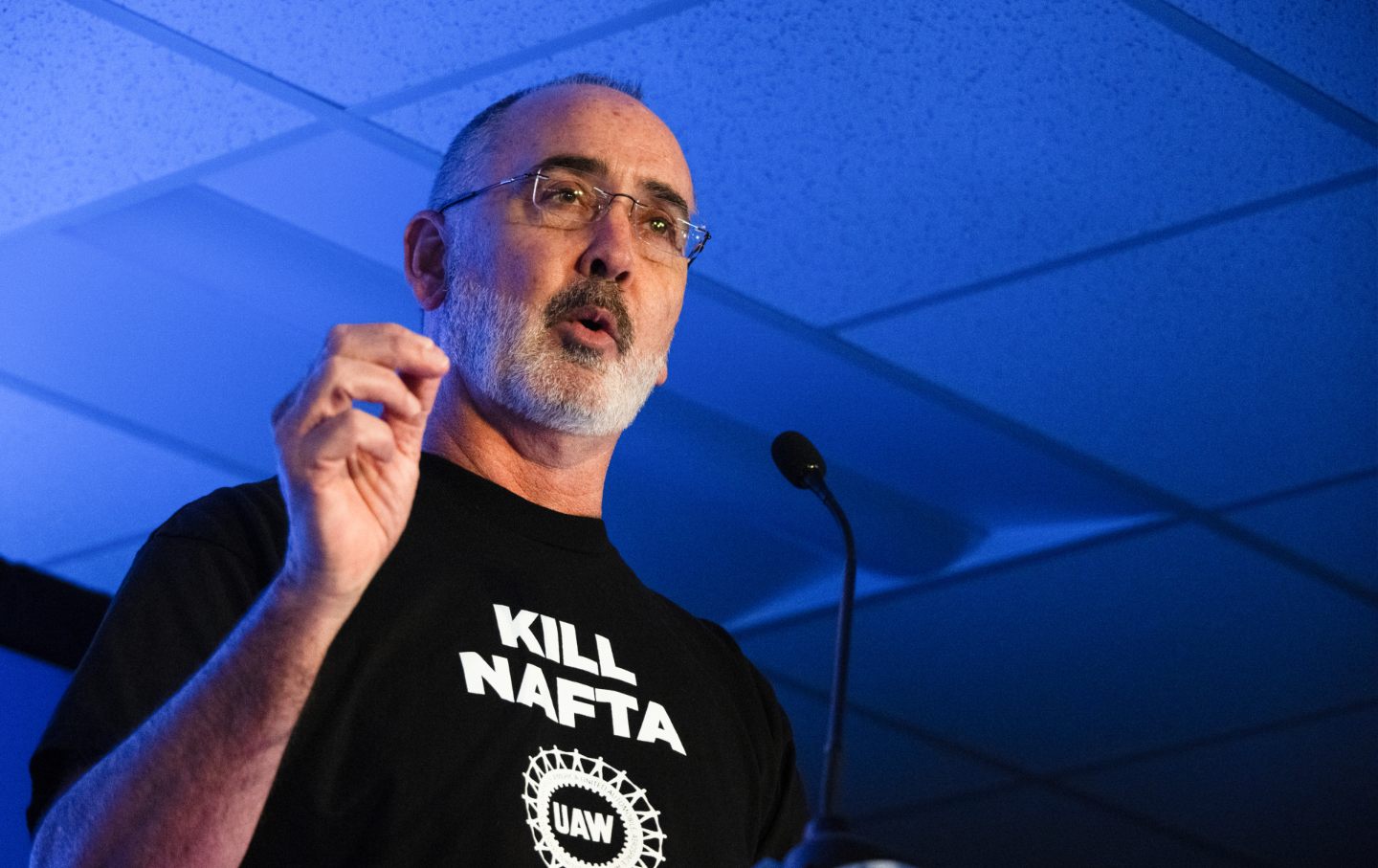
UAW president Shawn Fain at a rally in Philadelphia in 2024.
(Laura Brett / Sipa USA via AP Images)Over the past few years, the United Auto Workers, a union representing workers at auto plants, aerospace manufacturers, universities, and more across the United States, Canada, and Puerto Rico, has undergone a transformation from a demoralized, shrinking union to the vanguard of the fighting wing of the labor movement. Led by president Shawn Fain and his slate of reformers, the union has taken on bold, member-led organizing projects from the historic Stand Up Strike at the Big Three automakers in 2023 to unionizing Southern auto plants, including workers at Volkswagen in Chattanooga, Tennessee, in 2024. This dramatic shift was precipitated by a 2020 corruption probe by the Justice Department that resulted in convictions of more than a dozen union officials and three Fiat Chrysler executives on charges including racketeering, embezzlement, and tax evasion, and ushered in a democratic revolution that put Fain at the helm of the 400,000-member union.
The federal investigation also prompted the district court appointment of a federal monitor to oversee union finances and operations and root out corruption. The court put Neil Barofsky, who co-chairs the monitorship practice at the white-collar firm Jenner & Block but has no prior experience working with unions, in that role. It’s less common for courts to impose monitorships on unions than on corporations, but previous monitorships at the Teamsters and other unions have supervised democratic elections and safeguarded against corruption. Between 2021 and 2025, Jenner & Block billed the UAW more than $25 million for the monitorship.
Fain is currently running for reelection along with the “United UAW” slate of 13 International Executive Board candidates. Fain is favored to win, but has faced bruising opposition from candidates including Rich Boyer, the vice president of the Stellantis Department who ran on Fain’s slate in the last election. In 2024, Fain stripped Boyer of some of his responsibilities after finding that he had been too conciliatory in negotiations with the company. Fain’s letter removing Boyer alleged that he had “agreed to concessions on absenteeism” and agreed to delay the implementation of a profit-sharing agreement, among other strategic disagreements. This prompted Boyer to file a complaint with the monitor, who last month released a report accusing Fain of removing Boyer for retaliatory reasons.
But now Fain claims that the monitor’s inquiry actually stems from a conflict between union leaders and the monitor over the union’s stance on Gaza that has played out quietly over the last two years. Fain and other union leaders had not spoken publicly about this conflict, pursuing a strategy of appeasement with the monitor and fearing legal sanction—until two weeks ago, when Fain issued a blistering statement accusing the monitor of election interference for releasing his latest report accusing Fain of improper actions just six weeks before ballots drop in the union’s presidential election. “I’m done being silent,” said Fain. “Neil Barofsky has a political grudge against me because the UAW took an anti-war stance about what was happening in Gaza.”
Also by Ella Fanger
Fain’s issues with Boyer stem from a core disagreement over how the union should engage with the company, and how to fulfill the reform movement’s promise to reject backroom deals with the bosses. “The truth when it comes to Boyer is that I didn’t want him running the Stellantis Department because he wasn’t doing a good job for our members,” said Fain in the statement. “I wouldn’t let him hire family members into UAW positions, and I wouldn’t stand by while he bargained concessions with Stellantis and failed to enforce our contract.” Barofsky, however, concluded in the report that Fain did not sufficiently establish that Boyer was “derelict in his duty,” and thus that his removal was justified. He instead found that Fain retaliated against Boyer, abused the authority of his office in matters involving his fiancée and her family, and should face possible further disciplinary proceedings. Fain entirely denies these findings.
Union leadership now alleges that Barofsky is overreaching because of a personal political vendetta over the UAW’s call for a ceasefire in Gaza. That conflict dates back to December 2023, when Barofsky called Fain to express his concerns over a statement in which he said, “I am proud that the UAW International Union is calling for a ceasefire in Israel and Palestine. From opposing fascism in WWII to mobilizing against apartheid South Africa and the CONTRA war, the UAW has consistently stood for justice across the globe.” According to an audio recording of that call obtained by The Nation, Barofsky told Fain, “Comparing Israel to the Nazis, to say that they’re acting and engaging in acts of genocide…that does potentially cross the line into the area of antisemitism.” Michigan Representative Rashida Tlaib has now called on the monitor to resign, saying in a statement, “Neil Barofsky’s personal support for genocide is irreparably interfering with his duties.”
The upcoming presidential election is a referendum on not just how UAW members interpret the drama that has burst into public view in recent weeks but also their faith in the reform movement that has promised to make their union more democratic and more militant. During a Facebook Live stream last week, Fain spoke directly to members. “If Rich Boyer is your next president, I can assure you one thing. The company will be in heaven,” he said. “The choice here is between a union that fights or a union that fails.”
Barofsky was appointed as the UAW’s federal monitor in 2020 after the DOJ’s corruption probe cleared out the leadership bench of the union. For years, union leaders enriched themselves with freebies from automakers and lucrative kickback schemes from vendors producing UAW merchandise. A federal court ordered a referendum in which union members voted overwhelmingly to implement “one-member, one vote,” allowing them to directly elect their leadership. In the union’s first-ever direct elections, Fain and the “Members United” slate, which included Boyer, won office on a platform of “No Concessions, No Corruption, No Tiers.”
Beyond his mandate to investigate corruption, the recently surfaced recording of Barofsky’s call to Fain and his subsequent actions show that he took issue with the positions on Gaza that the union came to democratically. In November 2023, the UAW’s International Executive Board passed a resolution calling for a ceasefire in Gaza, making it the largest national union to do so at that point. A couple of weeks later, Barofsky called Fain, emphasizing that he was reaching out in a personal capacity. “In the statement, when you made comparisons to the UAW’s prior statements against fascism in World War II, against apartheid in South Africa and the Contras, it unintentionally—I believe, unintentionally—drew a parallel between the actions of Israel after it was attacked by Hamas,” Barofsky said on the call. Fain said he disagreed with this characterization. “My problem with this is they’re killing tens of thousands of innocent fucking civilians in the process, and it’s complete bullshit,” he told Barofsky. “OK, so that is what your intent was, to compare it to the Nazis,” Barofsky replied.
Later in the call, Barofsky disputed Fain’s claim about Israel’s targeting of civilians. “As you would say, wholesale killing of tens of thousands of people—which, I think that number is not not accurate—but a lot of innocent people have been killed for sure. Much like you know, 100,000 people were killed in the bombing of Dresden during World War II by the Allies. And that’s not to excuse it, but it is an aspect of war,” said Barofsky. By the end of December 2023, the Palestinian Health Ministry in Gaza reported that approximately 21,800 Palestinians had been killed in Israeli strikes. “Whatever you want to say about Israel, if they wanted to commit genocide, it wouldn’t look like this,” Barofsky continued. “Genocide looks like what Hamas did, right?” He told Fain that his children had been traumatized by Students for Justice in Palestine protesters on college campuses in New York City “chanting ‘gas the Jews.’” “And if you look at the photographs, they’re holding UAW signs while they’re chanting that.”
“When you use language like that and are making those types of comparisons, you risk crossing a line,” Barofsky said. Before ending the call, he added, “This is not a monitorship thing. I just want to make that any more clear.”
In February 2024, Barofsky forwarded to the union’s board a letter he had received from the Anti-Defamation League expressing concerns about a pro-BDS statement issued by UAW 7902 in New York, composed of NYU and New School lecturers and teaching assistants. Barofsky acknowledged that the issue was outside of his jurisdiction, but said that he felt it was important to send along “given the serious concerns raised here.” Benjamin Dictor, an attorney working with the UAW, said in an email to Barofsky that same month that he was improperly inserting himself into the union’s political stances. Barofsky’s firm, Jenner & Block, is listed by the ADL as one of its “Corporate Partners Against Hate.”
While the initial call was calm in tone, if politically charged, tensions between Barofsky and Fain erupted at a February 2024 International Executive Board meeting in Detroit, which Barofsky dialed into from Switzerland. According to previous reporting on the meeting by The Detroit News, Barofsky denied that he had used the word antisemitic or suggested as much about Fain during the phone call. As the now-public recording of the call shows, Barofsky did in fact say that Fain’s statement “potentially [crossed] the line into the area of antisemitism.” During the board meeting, Fain took offense to Barofsky’s mischaracterization of their call, and replied forcefully. He said, “For anybody to ever fucking say I’m antisemitic, brother, I’ll fight your ass in front of this building in a heartbeat.” Barofsky replied, “I don’t think that you’re antisemitic.… I have no reason to think that you’re antisemitic.… And if you heard that or perceived that, I’m really sorry that that happened. But I’m very careful in my wording, and I would never have said something like that, even if I did believe it, and I did not.”
Fain said during the meeting that he had been rattled by Barofsky’s call. “You’re the monitor over us,” he said. “You have a realm of power over us. So yeah, it concerned me greatly.” Cathy Highet, a board member of the Association for Union Democracy who represented Teamsters members during their union’s federal monitorship, said Barofsky’s promises that he was calling in a personal capacity were hollow. “This is someone who has the power to investigate officers and try to tee them up for removal,” she said. “So if somebody with that sort of power ‘suggests’ that you do something, that is exercising his power. You can’t take that hat off.”
Days after the February board meeting, Barofsky opened his first investigation into Fain over a complaint from the union’s secretary-treasurer, Margaret Mock, who alleged that Fain had stripped her of some of her responsibilities for retaliatory reasons. Mock ran on Fain’s slate in 2022, but had since chafed with the union’s new leadership. According to a thorough account by labor historian Nelson Lichtenstein in the New Labor Forum, Mock angered Fain’s staff by delaying approvals for organizing-related expenses, and denying reimbursements for petty charges like a $151 pizza bill. Mock told Fain she was running a tight ship to avoid even the appearance of corruption. But comments she has made suggest that her hostility also stemmed from resistance to the new leadership of the union, many of whom were hired from outside of the union’s membership. “I am totally against hiring anybody from outside. We have hundreds of thousands of members,” she said according to minutes from a February 2024 Executive Board meeting. “So I take offense that our people aren’t qualified.”
In the first months of Fain’s tenure, Mock tried to pressure the union to hire her son into the Stellantis Department, which Fain blocked. On the Facebook Live stream last week, Fain said that vice-president Boyer had confessed to going along with Mock’s request because she had refused to approve shelving and furniture for his office if he did not. “So why doesn’t the monitor investigate that?” Fain asked. In February 2024, the executive board voted to strip Mock of 11 departments under her supervision due to a report from the UAW’s compliance officer asserting that she had used her authority to “delay, obstruct, or even block the work of other departments.”
Months later, Boyer tried to have his grandson hired into the UAW’s security staff, which Fain also blocked. In text messages between Boyer and Fain from May 6, 2024, a screenshot of which was obtained by The Nation, Boyer threatened to make a complaint with the monitor. “Company disrespect me. You disrespect me what does a man do [sic],” Boyer wrote. “My grandson.” He continued in another text, “I’m sitting at home thinking about what I tell Monitor on Wednesday. Mad as hell.” Fain wrote back, “I haven’t disrespected you, trying to do the right thing, that’s what we campaigned on and ran on.”
Popular
“swipe left below to view more authors”Swipe →Barofsky’s most recent report stems from a complaint filed by Boyer alleging that Fain improperly removed him from his responsibilities overseeing the Stellantis Department. In May 2024, Fain removed Boyer, alleging that he concealed bargaining concessions during the 2023 Stand Up Strike and agreed to delay profit-sharing payments for supplemental workers, among other bargaining issues. In his letter removing Boyer, Fain accused him of “agree[ing] to watered-down language in private” and “allow[ing] the company to backtrack on what they actually agreed.” The UAW constitution grants the president the power to remove an officer from a department if he determines they have been derelict in their duties. In the following months, Fain took a more aggressive approach to dealing with Stellantis management, threatening a nationwide walkout. In December 2024, Stellantis’s CEO abruptly resigned and the company ultimately reversed a decision to lay off about 1,100 employees at an Ohio Jeep plant.
To investigate Mock and Boyer’s complaints, Barofsky conducted extensive interviews of UAW staffers and officers, dissected internal texts and e-mails, and dug into the minutiae of internal union decision-making. In the ensuing two years, he released a series of reports excoriating Fain for his decisions and actions. In 2025, after Barofsky threatened to take charges against Fain to the Trump Justice Department, union leaders negotiated a de facto agreement to mend the relationship with the monitor wherein Fain would return Mock and Boyer’s assignments, and Fain’s chief of staff, Chris Brooks, would resign.
That fragile détente was broken with the release of the monitor’s June 2026 report. In it, Barofsky argues that Fain fired Boyer in retaliation for Boyer’s refusal to intervene in a workers’ compensation claim filed by the sister of Fain’s fiancée and refusal to approve a bonus for workers at the Stellantis National Training Center where Fain’s fiancée works. “I never sought special favors for anybody in my family,” said Fain in the Facebook Live stream. “If Rich was honest, he would tell you himself he’s tried to get his daughter and grandson hired by the international union. I blocked these requests time and again, because it goes against everything that we ran on.” The Department of Justice has reportedly opened a grand jury investigation into Fain’s conduct.
Highet sees much of the material in the latest report as potentially out of the bounds of the monitor’s court-ordered authority. “The monitor has the authority to investigate allegations that…officers are engaging in corruption,” she said. “But not…to enforce the union’s constitution outside of the context of corruption.” In one illustrative example, Barofsky dismisses Fain’s concerns that Boyer made substantial concessions to management in negotiating Stellantis’s absenteeism policy. Barofsky acknowledges that Boyer made such concessions, but writes that this alone does not prove the “dereliction of duty” that Fain claimed to have Boyer removed. According to Barofsky’s reading, Boyer would have acted improperly only if he had hidden the concessions from the President’s Office. Barofsky finds that Boyer made Fain and his staff aware of the concessions as he was negotiating them, and thus was not derelict in his duty. But Fain has made it clear that the concessions themselves are the point, as they demonstrate that Boyer was undermining his administration’s agenda, which pushed for a more aggressive bargaining approach. “What Fain is saying is he wanted Boyer to be more aggressive against management, and that’s the sort of thing that elections are supposed to decide,” said Highet. “How aggressive are we? How conciliatory are we?… That’s outside the scope of the monitor’s authority.”
In another example, Fain took issue with Boyer’s decision to hold the annual meeting of the Stellantis Council, the body that coordinates bargaining at Stellantis, in Puerto Rico, despite the fact that the UAW does not represent any Stellantis workers on the island. Prior to Fain’s tenure, holding union meetings in resort locales had been common. In his letter removing Boyer, Fain wrote that this decision “has continued to haunt [the union] in our new organizing drives, where anti-union employers have repeatedly thrown it in our face—just as [Fain] predicted they would.” But Barofsky concludes that Boyer’s decision to hold the conference in Puerto Rico was “the result of good-faith reliance on UAW guidance.”
He adds that while there was some negative press around the conference, “it does not appear to have been widespread.” The conference was held in the midst of a major (and ultimately unsuccessful) organizing drive at Mercedes-Benz in May 2024. Leading up to the Mercedes vote, the anti-union Center for Union Facts unleashed an advertising campaign against the UAW’s organizing in the South, placing billboards in cities emphasizing the union’s past corruption scandals. Following the Stellantis Council meeting, the Center published a mock-up postcard with Shawn Fain’s face reading, “Greetings from Puerto Rico!”
When ballots drop in the presidential election in late August, we will find out whether Barofsky’s reports have undermined members’ support for Fain’s leadership. On the Facebook Live stream, Fain argued that the ultimate winners in the clashes between his reform movement, other union leaders, and Barofsky are the bosses. “They want to go back to the old way of doing things, just kissing ass and writing paychecks. They don’t want a UAW that’s fighting back.” Now that he’s gone public with his conflict with the federal monitor, Fain says there will be more to come. “With this latest action, I am done being silent. The membership deserves to know what the hell is really going on here,” said Fain. “And if Rich Boyer is your next president, I can assure you one thing. The company will be in heaven.”
More from The Nation
Black Freedom in an Age of White Oligarchy Black Freedom in an Age of White Oligarchy
Justin Leroy’s The Lowest Freedom points toward the limits of liberty under racial capitalism.
The School Behind the Billionaires and the Billionaire Tax The School Behind the Billionaires and the Billionaire Tax
UC Berkeley will inevitably be behind the defeat or victory of Proposition 40.
Dolly Parton Was a Proud Union Sister Dolly Parton Was a Proud Union Sister
Organized labor is celebrating the life and legacy of an artist who championed working women and carried a union card for almost 60 years.

Of Debt and Deficits and the Dollar System Of Debt and Deficits and the Dollar System
By force of preset agendas, conservatives and liberals react to debt headlines like Pavlov’s dogs.

What Happens When 8 Million People Lose Their Student Loan Repayment Plan? What Happens When 8 Million People Lose Their Student Loan Repayment Plan?
As the Biden-era SAVE plan ends, borrowers are facing unaffordable bills, lost payment records, and errors that have falsely put some into default.
David Ellison’s Delusional Stab at Self-Justification David Ellison’s Delusional Stab at Self-Justification
While the Skydance–Warner Bros. merger is in legal limbo, the CEO seeking to pull it off makes a disingenuous case for it in the court of public opinion.

