
Rahm Emanuel’s Speech in Tel Aviv Breaks With a “No Daylight” Approach
Though the speech broke from a failed approach toward Israel, it was still based on flawed and tendentious attitudes and history.
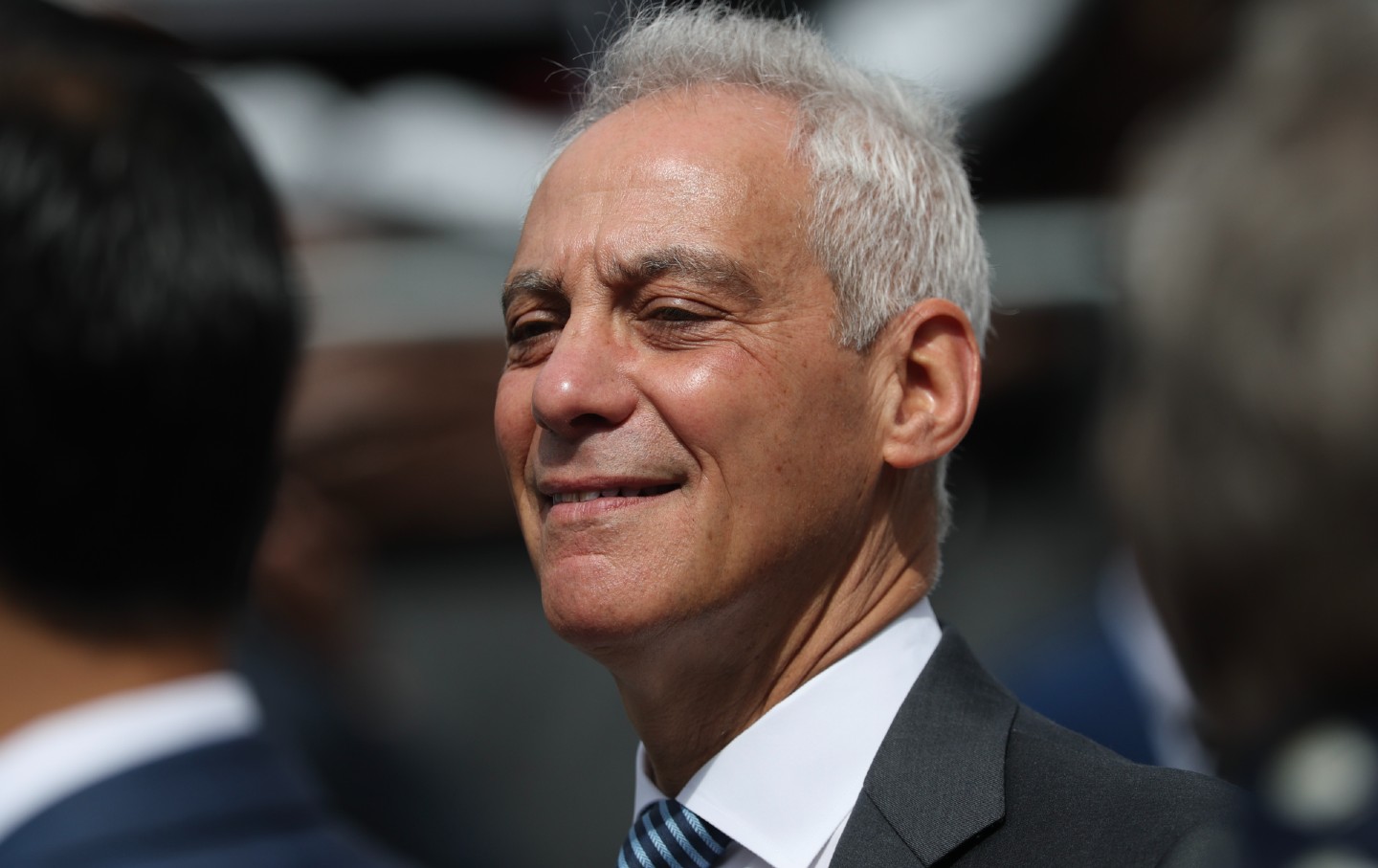
The most important thing about Rahm Emanuel’s speech in Tel Aviv Wednesday is that it was a repudiation of decades of US policy toward Israel, and specifically of Joe Biden’s “No daylight” approach. “For too long, American policy toward Israel operated under the assumption that the best thing Washington could do for Jerusalem was to blindly and silently stand behind your government, without conditions, without demands, and without consequences when we disagreed,” Emanuel said. “That has been our mistake.”
Yes, many of us have been making this argument for years and faced relentless attacks for it from our own Democratic colleagues. It’s long been clear that, rather than giving Israeli leaders the confidence to take tough steps for peace, lockstep US support just gave them the confidence that they would never have to. But still: Welcome, Rahm! Successful politics is about addition.
Unfortunately, even as the speech broke from a failed approach toward Israel, it was still based on the deeply patronizing attitude toward the Palestinians and the same tendentious rendering of history that has undergirded it. It’s hard to see how a new and better policy can be built on that same old logic.
A side note—has any speech by a potential presidential primary candidate (who hasn’t even officially announced his candidacy yet) ever been more extensively and breathlessly previewed? Emanuel’s remarks received glowing anticipatory write-ups in The New York Times, The Washington Post, Politico, and multiple other outlets. Emanuel and his team clearly wanted to set this up as a landmark intervention in a highly charged debate, and a lot of journalists were willing to accommodate. Emanuel is setting himself up as the conservative Democrat who can solve the problems created by conservative Democrats, and much of the political-media establishment seems prepared to hail him as a savior for it.
There’s no question that the speech was significant. Emanuel, a longtime conservative Democratic stalwart with strong family connections to Israel, aggressively criticized Israel’s current government and outlined a much more conditional future US-Israel relationship. He reiterated his previously stated position that US military aid to Israel should end, a position that was still taboo just a few years ago but has quickly become mainstream. He included a bit of a hedge, however, saying that “Israel should be able to buy American arms under the same financial terms, the same restrictions, and the same requirements as every other trusted ally that abides by our laws.” If genuinely enforced, this would (and should) effectively result in an arms embargo, as Israel clearly does not abide by our laws which prohibit supplying arms to militaries engaged in systemic human rights abuses, restricting humanitarian aid or using arms for nondefensive purposes. It was the standard set on paper by the Biden administration, then breached to the point of arming a genocide. (Emanuel made no mention of the current effort in Congress to further intertwine US and Israeli military and intelligence sharing; someone should ask him about that.)
Emanuel also declared that Israeli settlers involved in violence, and officials who support them, should be sanctioned, along with “every construction company or bank building or financing illegal settlements.” Here again, he included a hedge with the word “illegal.” Given that every settlement built in the occupied territories since 1967 is illegal under international law, and that banks financing settlements finance lots of other things in Israel, this is a potentially meaningful consequence—unless of course he means it to apply only to the limited number of settlements and outposts the Israeli government itself regards as “illegal.”
The fact that these terms for a revised US-Israel relationship will now be seen as the rightmost edge of the Democratic debate is not a bad thing. But it’s not enough. Emanuel told some hard truths, but he still trafficked in some falsehoods that fatally undermine the speech as a path forward.
The first of these is the notion that Israel’s problems can all be traced back to Benjamin Netanyahu. “Let’s start by reviewing the recent history,” Emanuel said. “Over the last five years, Israel has evolved from being lauded as the start-up nation to becoming, in Prime Minister Netanyahu’s words, a modern-day Sparta. You have turned from being known for your technological prowess to being considered primarily a territorial pariah.”
Come on. The violent trends in Israel were already well in evidence long before five years ago; they’ve just become undeniable since Israel’s assault on Gaza and the other territory on its periphery that followed October 7, 2023. Netanyahu is Israel’s longest-serving prime minister, having served for 16 of the past 17 years. He is not an Israeli political anomaly. Netanyahu provides a useful foil for Democrats, given that he’s such a repulsive figure, but the tensions in the relationship will not end if he is voted out.
The second and more serious problem with the speech was its trafficking in the tired trope of Palestinian rejectionism. “Three times since the early 1990s, you have offered the Palestinians sovereignty in exchange for your security—and three times your offer was not only rejected, but you were attacked as a direct consequence,” Emanuel claimed.
To call this a tendentious presentation of history would be to give it too much praise. Given that Emanuel worked for the Bill Clinton administration (and reportedly consulted on the speech with both Bill and Hillary Clinton, who immediately praised it), it’s not surprising that he’s still repeating it. The trope has its roots in the failure of Clinton’s 2000 Camp David negotiation, which Clinton laid squarely at the feet of PLO Chairman Yasir Arafat. Multiple observers and participants have challenged this, including American and Palestinian negotiators Rob Malley and Hussein Agha. “Since 2000, it is this narrative—Camp David as a metaphor for Palestinian rejectionism—that has ravaged the Israeli peace camp, distorted both US and Israeli policy and badly undermined confidence in a peaceful settlement of the conflict,” Malley wrote in 2004.
A more detailed dismantling of this narrative was published in 2024 by Al Shabaka: The Palestinian Policy Network. “Of course, the same standard has not historically been applied when Palestinians have made negotiation offers or counterproposals that are then rejected by the Israeli regime,” wrote analyst Fathi Nimer in his paper, “The Enduring and Racist Trope of Palestinian Rejectionism.” “In the decades that have followed the peace process era, blame for the demise of the two-state solution continues to be placed squarely on the Palestinians for failing to be ‘partners in peace.’ This is regardless of the Israeli regime’s continued annexation campaign across the West Bank and successive Israeli prime ministers promising to thwart the creation of a Palestinian state under their tenure.”
It’s quite true that Palestinian leaders have made some very bad choices over the years, and some have pursued violence when they should’ve continued negotiations. The same is obviously true of Israeli leaders. Yet only in one of these two cases has that been used by American politicians to justify the continued denial of a whole people’s rights, their displacement and mass murder.
A better speech would’ve reminded his Israeli audience, and his American one, that in 1993 the Palestinian leadership recognized the state of Israel and accepted a Palestinian state on 22 percent of historic Palestine, the single biggest concession that either side has made and likely will ever make over the course of this conflict, and one to which Israel has never fully reciprocated (in response to Palestinian recognition of Israel, Israel recognized only that the PLO had the right to negotiate on the Palestinians’ behalf); it might have noted that, since 2002, there has been an offer on the table from the entire Arab League for total normalization and peace with Israel in exchange for Israel agreeing to a Palestinian state, an extraordinary offer to which Israel has never even formally responded (indeed, the “23-state solution” Rahm pitched in his speech is just a refresh of this quarter-century-old offer); it could have recognized that the Palestinian leadership seeking recognition in international organizations for the state of Palestine is not a threat to Israel but a legitimate and nonviolent assertion of the Palestinian right to self-determination, and one that legally binds them to the commitment made in 1993.
Popular
“swipe left below to view more authors”Swipe →A braver speech would have acknowledged that the whole reason Hamas came to be in control of Gaza in the first place is because the US rejected Hamas’s victory in elections the US had pushed the Palestinians to hold and then backed an attempted coup which set off a Palestinian civil war. This gets at a core problem with the US approach: The US has never really taken Palestinian politics seriously. Emanuel’s condescending claim that “regional stability in the Middle East is predicated fundamentally on the Arab world’s assuming its rightful place as the adult in the room with the Palestinian leadership,” expressly infantilizing the Palestinians, doesn’t signal that he’s ready to start.
A third problem (this list is by no means exhaustive) was Emanuel’s assertion of an equivalence between “those chanting ‘from the river to the sea’” and “those calling for a greater Israel.” “Both are fantasies chanted by fanatics,” he said. One can argue that the creation of one democratic state on all the land of Israel and Palestine is difficult, even unrealistic, but asserting a moral equivalence between those who want a state in which all people, Palestinians and Jews, enjoy equal rights (which is what the vast majority of people who use the phrase mean by it), on the one hand, and those who want to continue to entrench apartheid on the other is despicable. Yes, there are some idiots who want Jews to be expelled from historic Palestine, but comparing a few activists shouting slogans to a government that is actually pursuing a policy of violent land theft and expulsion every day on the ground is not clarity but mendacity.
Despite these deficiencies, we shouldn’t lose sight of the speech’s significance, which could open a more honest discussion not just in the US but also in Europe, whose policy debates largely remain stuck in the 1990s when it comes to Israel-Palestine. “US Democrats are increasingly debating their foreign policy stance towards Israel and the Palestinians. That is important after Biden’s disastrous Presidency,” wrote policy analyst and consultant Salman Sheikh in response to the speech. “I see no such debate within my [UK Labour Party]. As the governing party, that must change.”
So yes, the speech was a landmark. It’s one we should have passed years ago and should quickly leave in the rear-view mirror now, as we move at speed toward a US Israel-Palestine policy that better serves American interests, voters’ preferences, and justice.
More from The Nation

Pedro Sánchez Is Living on Borrowed Time Pedro Sánchez Is Living on Borrowed Time
Spain’s prime minister has become a global progressive icon. But at home, his government is hanging by a thread.
The Rubio Cable on Cuba The Rubio Cable on Cuba
Inside US efforts to shut down debate at the United Nations on Washington’s economic warfare.

On the Eve of the NATO Summit, Is Europe Rearming Against a Phantom Russia? On the Eve of the NATO Summit, Is Europe Rearming Against a Phantom Russia?
Inflating Russia’s military threat could divert resources from social needs while fueling Europe’s far right.
The Memo of Understanding That No One Understands The Memo of Understanding That No One Understands
The massive ambiguities in the framework for an Iran peace agreement all leave Tehran with the upper hand.

Before Simón Bolívar Could Liberate a Continent, He Had to Fight an Earthquake Before Simón Bolívar Could Liberate a Continent, He Had to Fight an Earthquake
How the aftershocks of an 1812 quake that hit Venezuela changed the world.
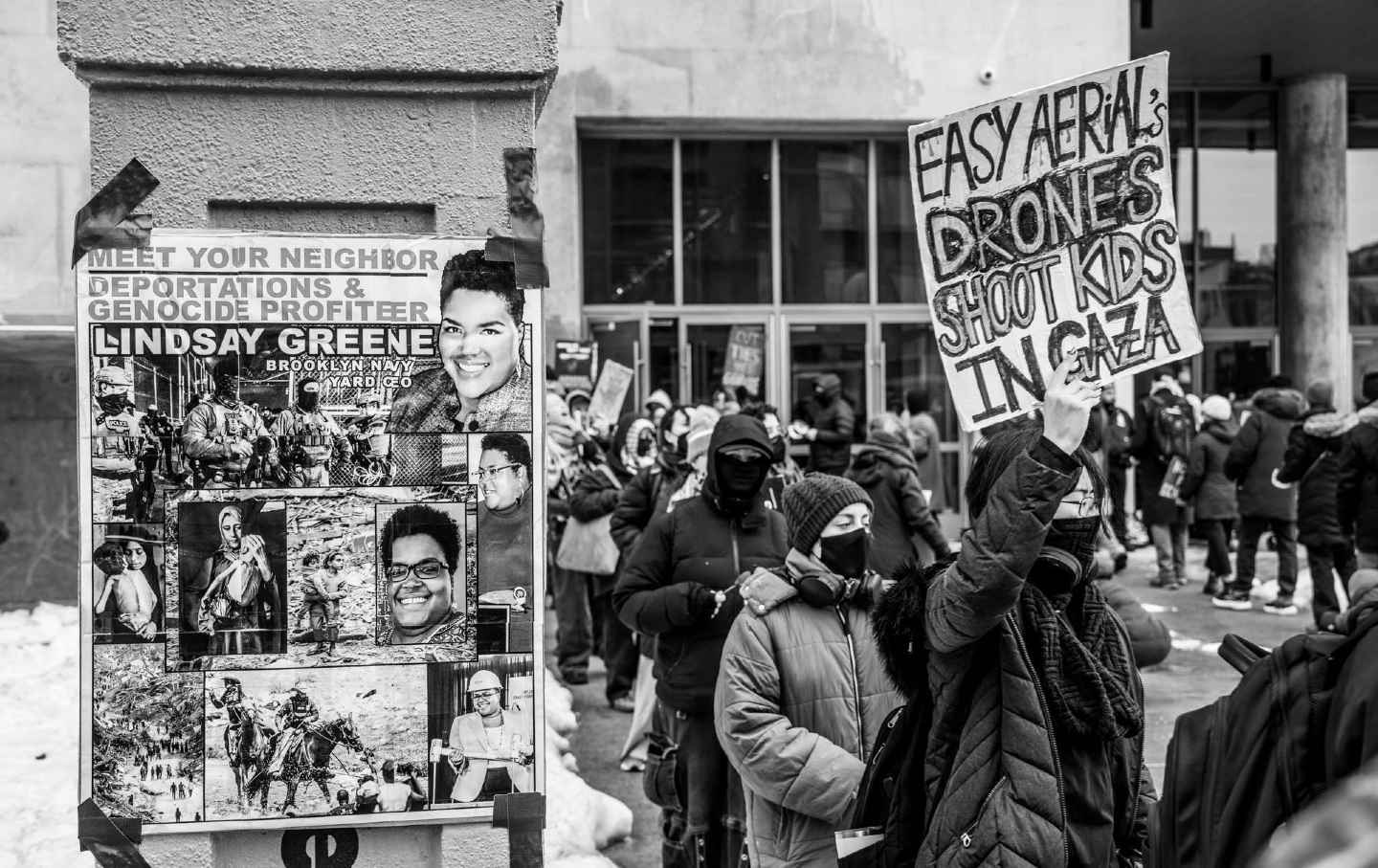
Drones Manufactured in Brooklyn Are Being Used to Bomb Gazans Drones Manufactured in Brooklyn Are Being Used to Bomb Gazans
Newly uncovered documents have provided the first definitive proof that Israel’s largest weapons supplier is purchasing drones built in the Brooklyn Navy Yard.

