
Hey, Don’t Forget: Women Are the Working Class in America
There are more women in the labor force, yet the care economy is still underfunded and undervalued.
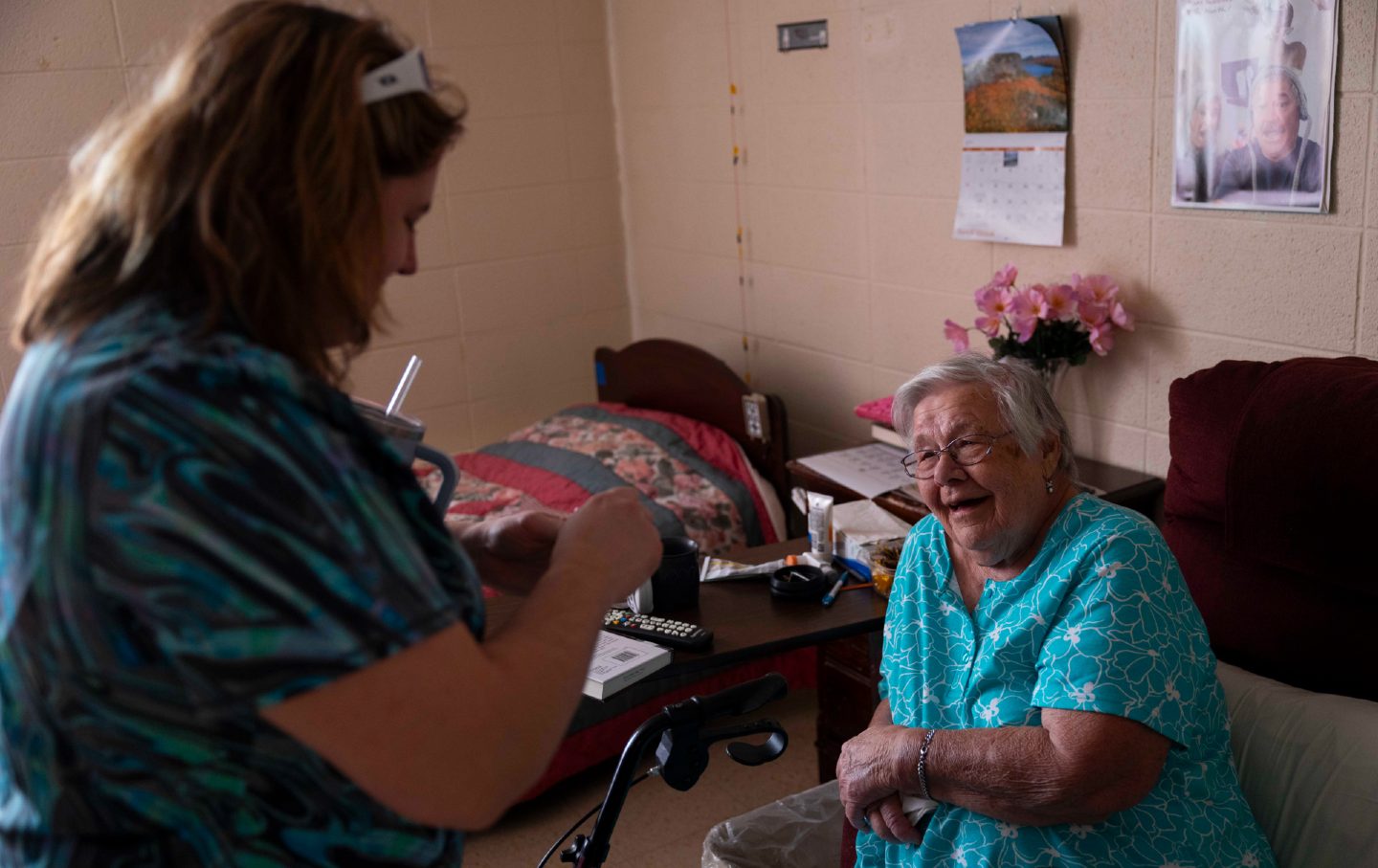
When I was a young woman, I took a job cleaning houses in Raleigh, North Carolina. I signed on with a company, the type that pays you $7.15 an hour but charges the homeowners $65 an hour for the clean. I signed a contract promising I wouldn’t disclose this and steal the clients, but I figure 20 years later I can spill the beans.
My cleaning partner was Jacqueline, who had been cleaning houses for 20 years. Jacqueline taught me everything I needed to know about cleaning: how to polish faucets, dust rooms from top to bottom, how to leave vacuum marks to ensure the homeowner that we had, indeed, been there.
One day, we arrived at a house we cleaned weekly and saw a car in the driveway, which was unusual. We knocked, but when no one answered we let ourselves in. After all, we were on the clock and our pay would be docked if we weren’t efficient.
As we cleaned downstairs, we caught a glimpse of the lady of the house upstairs but she still didn’t respond to our greetings. This client had long been a pain in our sides, complaining to our boss any time we wrapped up early and didn’t clean for the full hour or if there was a hair we had missed in her shower. The hair thing really bothered Jacqueline, who would apologize but point out that it was her hair, not ours. Maybe we had missed it, but so had she.
At the house that day, it came time to go clean the upstairs bedroom and I asked Jacqueline what we should do. We knew the woman was up there, but we also knew that if she complained that we skipped it, we could be fired. “Honey, we go up and knock,” Jacqueline said, hoisting the heavy vacuum cleaner onto her back and heaving it up the stairs.
We didn’t end up needing to knock, because as we headed up the stairs, we saw the homeowner duck into a closet to hide from us. I was flabbergasted and uncertain of how we should continue. But Jacqueline knew exactly what to do. She went straight into the bedroom and started dusting. Then she vacuumed. Then she carefully made the bed. It was at the bed that I noticed that Jacqueline was being extra fastidious, taking her sweet time. She glanced over at me and grinned. “Slow down and dust those lamps one more time, honey.”
Jacqueline taught me a lot about how to be a working-class woman. “You gotta work hard and get over shit,” she’d say. But no matter how hard she worked, I could see that a lot of things weren’t working right for her: Jacqueline had a bad, persistent cough and no health insurance; she regularly got payday loans to make sure the car she used for work didn’t get repossessed. When we had to work overtime, her kids would have to come with us to the houses—something that could have gotten her sacked right then and there.
Women are the working class in America, and we know it. Women who work in the kitchens, the supermarkets, the hospitals, and our schools have a keen sense of who we are and what’s going on. Politicians are obsessed with the working class—they always claim to be from it and to represent it, but rarely move policy that would help working-class women like Jacqueline. Campaign ads show men in hard hats and men throwing hay, but often forget the women out here.
That’s an odd fact, given that there are more women than men in the labor force. This past March, federal data highlighted in a report from Indeed showed that women are participating in the labor force at a greater rate than men, and also hold two-thirds of current job growth. This is barely the feminist revolution that I once dreamed of, however; the jobs women are occupying are paying less and less in real wages every year.
House cleaners. CNAs. Cashiers and store clerks. These are jobs that have long been considered “extra” and not meant to support a family, as if the way women make wages is superfluous instead of central to our economy. When FDR passed Social Security, women’s professions such as domestic workers, as well as many teachers and social workers, were excluded, signaling that women didn’t need to work or, apparently, retire. But women are now “head of household” as frequently as men, just with less money and significantly less protection or support.
In New Rochelle, New York, Deloris “Nunu” Hogan has been running a childcare center for nearly 47 years—on a phone call recently, she told me that she’s cared for 997 children over the years and isn’t “ready to lay down yet.” As a childcare worker, Nunu sits at the center of a working-class women’s world—her work allows other women to work, but because of their limited incomes, she can only charge what they can pay. What this means is that Nunu hardly turns a profit and rarely takes time off.
Nunu has been in a front-row seat to witness a changing economy. “It now takes two or even three incomes to support a family,” she observes, “when it used to take just one. So if there are two parents, they both are working, and if it’s just one parent, she’s sometimes working multiple jobs.” All of this work doesn’t mean that care workers like Nunu—who are essential for it all to happen—are coming out on top. In fact, childcare workers’ pay is so low nationally that two in five working full-time are dependent on public assistance.
For all the pandering and blathering on about the “working class,” there is a telling absence of policy that supports the women who, increasingly, are the rank-and-file backbones of our economy. Nunu, who is part of a childcare workers union in New York, says: “Children will be here forever, and people need to work. But the workers need support, too. We need sick days, vacation days, and a living wage.”
Popular
“swipe left below to view more authors”Swipe →Even while regularly putting in 12-hour shifts to run her family’s around-the-clock daycare, Nunu is active in lobbying for changes to childcare policy in her state. “I wish there was a solution to the equation of cost and wages,” she says. “But the truth is the solution is the government, and they need us at the table to help them see how this should work.”
As campaign season starts, I can’t get Jacqueline and Nunu and the 41 million working-class women in our country off my mind. Will the candidates asking for our vote look up and see us? Before a recent gubernatorial town hall hosted by the Colorado chapter of Mother Forward, one of the organizers, a working mom herself, said to me: “We need to put childcare as a top priority, both for boosting the economy and as a basic need. There’s a business lens, then there’s a human lens. Then there’s the ‘please just see us’ lens to it all.”
It’s as hard to be invisible as it is to work for low wages, not have healthcare, childcare, or paid leave. Working-class women everywhere are showing up and putting in long hours to make our families and our economy work—it’s time for the politicians and policy to catch up.
Become a Sustaining Donor This September
Between the reemergence of right-wing red-baiting and Donald Trump’s use of the chilling National Security Presidential Memorandum–7 to criminalize left political organizing, we’re seeing McCarthyism reborn before our eyes.
This assault on democracy cannot be ignored or wished away. Resisting it requires bravery in the face of threats and repression, a steadfast commitment to the truth, and the unwavering belief that we can—and will—overcome this darkness.
We must have an independent media that sets the record straight, unearths corruption and abuses of power, and advances a politics of justice and dignity for all if we’re to win this fight.
That’s why I’m writing to you today. This September, The Nation needs to add 100 monthly donors to sustain our progressive journalism. Your contribution makes the next investigative report, the next truth-speaking column, and the next pathbreaking essay all possible.
I hope you’ll support our work with a recurring donation today. If you donate $10 or more a month, we’ll send you a brand new “Hands Off the Free Press!” sticker to recognise your commitment to our cause. Please, donate today.
Onward,
Katrina vanden Heuvel
Editor and Publisher, The Nation
More from The Nation

When Texas Sex Ed Falls Short, Gen Z Women Turn to Social Media When Texas Sex Ed Falls Short, Gen Z Women Turn to Social Media
A 2025 study found that 70 percent of adolescents sought reproductive health information through social media platforms.

Justice for Macklemore Justice for Macklemore
The rapper has been dumped from Ed Sheeran’s tour for saying “free Palestine.” That’s a disgrace.

We Are Living Under Roy Cohnian Logic We Are Living Under Roy Cohnian Logic
The political fixer created a career for himself as a self-promoting, ubiquitous hustler. Like Trump, he got away with it by having the right friends.

Time Has Run Out for AI Risk Deniers Time Has Run Out for AI Risk Deniers
The recent spate of reports about the technology’s destructive power underline two prime directives: Be afraid, and regulate aggressively.
Yale’s President Has Become a Shameful Collaborator With Trump Yale’s President Has Become a Shameful Collaborator With Trump
Maurie McInnis has the power to stand up to the administration. Instead, she’s caving.
The Fissures and Fractures Behind the Right’s Pink Facade The Fissures and Fractures Behind the Right’s Pink Facade
After Roe was overturned, some young women are turning more hard-line on abortion—but others are fleeing conservatism altogether.

