
Bruce Springsteen Gave Us Exactly What We Need Right Now
His just-finished tour was a cleansing, healing experience—and a morale-boosting call to arms for everyone fighting for our democracy.
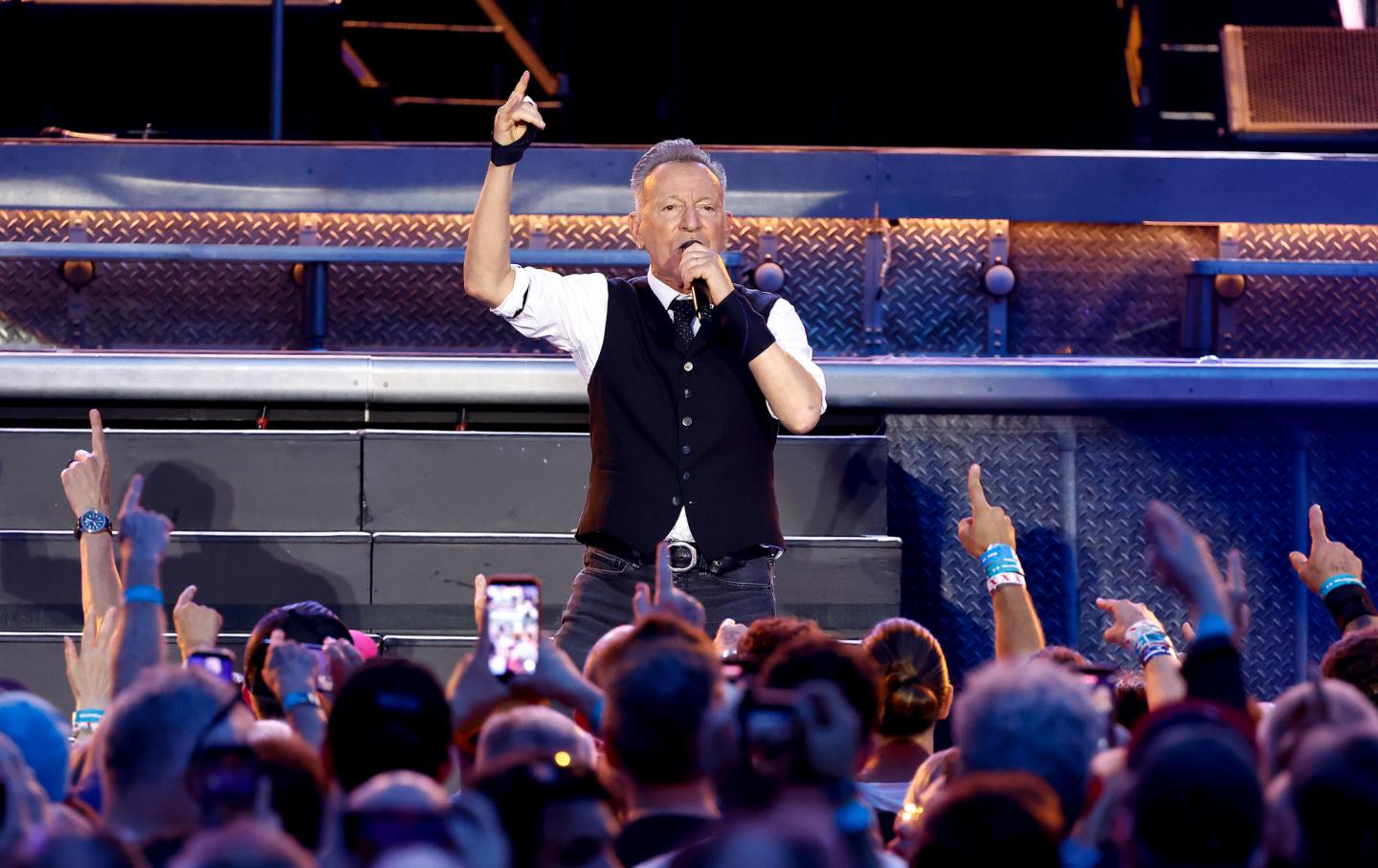
Bruce Springsteen and the E Street Band in concert at Nationals Park on May 27, 2026, in Washington, DC.
(Paul Morigi / Getty Images)
I felt a bit glum when Bruce Springsteen launched his “Land of Hope and Dreams” tour in Manchester, England, last year, and took it on the road across Europe. Not because I didn’t love what he was doing—I wrote enthusiastically about his scathing denunciations of Donald Trump—but because I really thought he should have brought the tour home to America. It wasn’t as much needed in Manchester and Milan as it was in Minneapolis and Washington, DC.
Well, it turns out Springsteen knew that too. And so he scheduled a fairly impromptu US tour on February 17 to run from March through May, Minneapolis to DC. And I was there, from Minneapolis to Madison Square Garden to what was supposed to be the final concert in Washington. (Because of sports-team schedules, he wound up rescheduling a Philadelphia show to be last.)
I almost chased him to Philly and then decided: Perfection is perfect. Leave it alone.
You can read a lot of concert coverage that tells you what Springsteen played; I’m going to tell you how it felt. (Music writer Caryn Rose does both here.)
I never tired of hearing Springsteen talk about the “racist, reckless, corrupt, incompetent, and treasonous” president at these US dates (He embellished his European descriptions as things got worse here.)
His Minneapolis show felt the most astonishing and devastating. Not least because people were crying all around me (I was crying contagious tears too). These were people who’d been on citizen protection alert for months already; who were bone tired from caring for their neighbors, but carrying on, standing for hours in that arena; who knew martyrs Renée Good and Alex Pretti personally, or who felt like they did after so much time in the fight together. Those folks felt so seen and so loved. And when we got “Purple Rain,” because Prince, the Beloved One, lived in that sacred city, we all felt blessed.
But the Washington, DC, show was almost as transcendent. The sky opened up when Springsteen played “Streets of Minneapolis,” and the rain poured for a full hour. I kept thinking of his “Jungleland” lyric, “barefoot girls…drinking warm beer in the soft summer rain.” This was crushing spring rain, in sandals, in dirt. But it was baptism, it was cleansing, it was healing. Hearing the ode to Minneapolis that Springsteen wrote alone, now played with the mighty band, in place of his first stripped-down acoustic version, was galvanizing.
There’s always a call and response in the song, when he says, “With our chants of ‘ICE OUT NOW,’” and waits for the crowd to join him, at least three times. We did this time. But we also took up the chant all by its lonesome, “ICE OUT NOW,” after the song ended. Bruce looked so happy. “Let them hear you at the fucking White House!” he said more than once.
Springsteen never changed up the set. Yes, he did add “Purple Rain” in Minneapolis, but we all knew that was coming at the first show. The band added The Clash’s “Clampdown” a few stops in, and it fit, and they never lost it. Almost all of his songs were tailored to rebellion and a regenerative spirit. “Wrecking Ball,” “Youngstown,” “Murder, Incorporated,” “My City Of Ruin,” “American Skin (41 Shots),” “The Ghost of Tom Joad.” They all tell the story.
But so does one of my favorites, “Long Walk Home,” written for the 2007 Magic album, which was to my mind an elegy for John Kerry’s loss to George W. Bush in 2004. The song has always gutted me: “You know that flag flying over the courthouse means certain things are set in stone / Who we are, what we’ll do and what we won’t.”
What we won’t? There’s nothing Trump won’t.
Playing for Kerry was Bruce’s first formal foray into US election politics, and Kerry’s loss inspired him to gift us the phrase: “The country that we carry in our hearts is still waiting.” I think of that every day.
Near the end of every show, he listed Trump’s depredations and punctuated each one with “This is happening now.” Just a few new ones from recent shows: “immigrants being held in for-profit detention centers around the country, such as Delaney Hall in my home state of Jersey… $1.8 billion slush fund for…January 6 insurrectionists… this is happening now.
“This American tragedy can only be stopped by the American people. Do ya hear me, Philadelphia? Are you with us, Philadelphia?” Philadelphia was with him, as we were in all 20 cities the band visited.
Now the “Hope and Dreams” tour is over, and it reminded me that something else I cherish is over, for different reasons, and I’m sad in a different way. Last week, The Late Show’s Stephen Colbert had to hang up his saddle because Donald Trump, Larry and David Ellison, and Bari Weiss terminated him as they destroy CBS. Watching his last week and a half of shows? They were so fucking good. But it also made me feel every day that I got closer to the end like I was watching a crime in progress. Murder Incorporated? How silly.
To lose these two cultural cheerleaders within about a week is hard for progressives, even though both men’s silence will only be temporary. Bruce certainly chose the time and place he wanted to close this part of his artistic life. Colbert absolutely did not, but knew the time and place of his political execution, May 21. And for the two months leading up to it, the show was extraordinary. It was about “reciprocal human connection,” as the show’s band leader, Louis Cato, says. The people that Colbert chose in those closing shows, and the way they chose to talk to him, whether it was Barack Obama, Pedro Pascal, Julia Louis Dreyfus, Steven Spielberg, Bette Midler, or, yes, Bruce Springsteen, too, was extraordinary. And loving.
Popular
“swipe left below to view more authors”Swipe →“You’re the first guy in America who’s lost his show because we’ve got a president who can’t take a joke,” The Boss told Colbert about our tyrannical temporary boss. I’m juvenile; one of my favorite bits featured Colbert and former Late Show host David Letterman throwing pieces of show furniture off the roof and onto a big CBS logo, shattering it.
Both Springsteen and Colbert know how to do grief and resilience at the same time. Colbert lost his father and two brothers in a plane crash when he was 10; his seven older siblings were already out of the house, so it was up to him and his mother to comfort (and amuse) one another. Springsteen has written about his role in cheering up his (dancing and singing and often cheery already) mother while his father was suffering from severe depression. I’ve found myself wondering about this similarity in the last few weeks: that these two men who’ve known such deep pain, but had to help family members through it, know how to help us.
“If you’re feeling helpless, if you’re feeling hopeless, if you’re feeling betrayed, if you’re feeling frustrated, if you’re feeling angry, I understand,” Springsteen told the crowd at my last show. “That’s why we’re here tonight. We needed to come to Washington and feel your strength and your hope and your faith. And we needed, we needed to bring to your city some strength and some hope and some faith, and I hope that we did tonight.”
He also said, at his last few shows, in places he has played so many times before, “Thank you for a lifetime.” He has played in so many of these cities 50 years or more. Bruce has told us he is never doing a farewell tour—that the E Street Band will go on as long as it can. But it was hard not to think that he is 76, and I am 67, and… None of us have forever. But we had this.
While the tour may be over, Springsteen’s political crusade is not. He carries on with two America 250 shows in June, with guests ranging from Mavis Staples to Jackson Browne to Rosanne Cash to Kenny Chesney (while Trump’s own Freedom 250 concerts are hemorrhaging acts and may be down to Vanilla Ice. Seriously. “Ice, Ice, Baby” indeed). Springsteen will be back in the DC metro area for Tom Morello’s “Power to the People” show on October 3, with the Dropkick Murphys and other bands. There will almost certainly be more.
At some point during the tour, I came to think about how the bands of the 1940s, from Glenn Miller to Count Basie to Cab Calloway, entertained the troops during World War II, both in the field and via radio broadcasts, to boost morale. We are the troops in this fight for democracy, and Springsteen and his band toured for two months to keep us fighting. Maybe Colbert will join him at one of these next stops.
More from The Nation
Fascists Try to Write Trans People Out of the “Natural Order.” The Earth Disagrees. Fascists Try to Write Trans People Out of the “Natural Order.” The Earth Disagrees.
The vast majority of life on earth exists outside of sex and gender binaries—despite what the right likes to claim.
“Amazon Is the New Slavery”: Chris Smalls on the Labor Fight of a Lifetime “Amazon Is the New Slavery”: Chris Smalls on the Labor Fight of a Lifetime
A conversation with the labor organizer about his new book, When The Revolution Comes: A Fight for the Future of the Working Class.
How America’s Courts Fell for a Con Man How America’s Courts Fell for a Con Man
In her new book, Catch the Devil, reporter Pamela Colloff traces the life and crimes of a mendacious jailhouse informant and exposes the systems that allowed him to walk free.

Why the Brooklyn Courtroom Birth Was the Last Straw for Public Defenders Why the Brooklyn Courtroom Birth Was the Last Straw for Public Defenders
“What occurred in that courtroom was not simply a failure of protocol or preparedness. It was....a devastating reflection of the cruelty embedded in our carceral system.”
The Legacy of Barney Frank The Legacy of Barney Frank
A look back through The Nation’s coverage of Frank’s long and storied political career suggests the late congressman was always a man containing multitudes.
Nurses Are the Backbone of US Healthcare—and They’re Getting Screwed Nurses Are the Backbone of US Healthcare—and They’re Getting Screwed
A recent hospital stay reminded me of the incredible work that nurses do. So why are we making it harder for them to do their jobs?

