
The Billionaires’ Bathos Club
American plutocrats can’t stop whining about how extremely modest tax increases are killing their initiative.
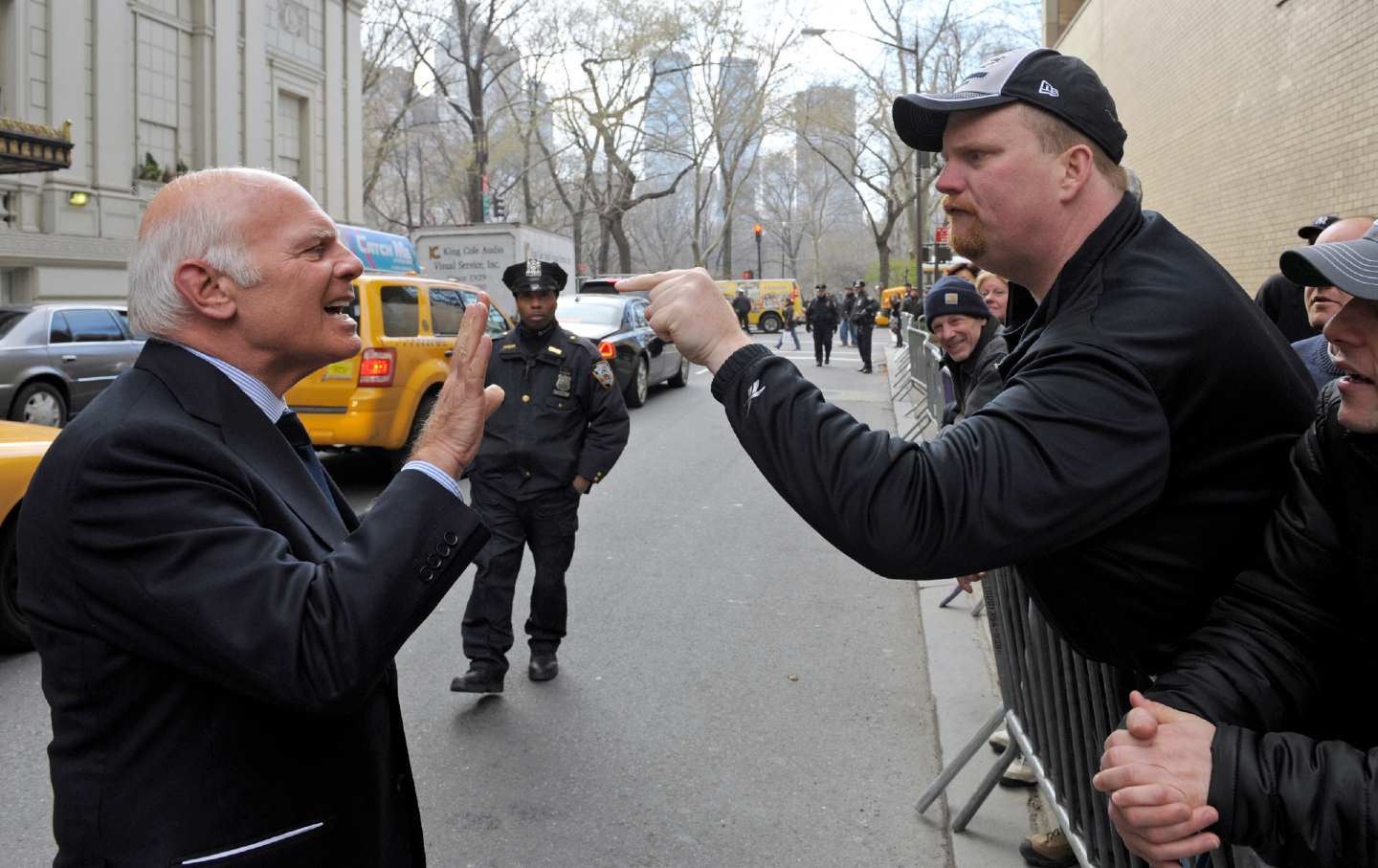
New York real estate mogul Steven Roth, who recently complained on a Vornado earnings call that calls to tax the rich were akin to a racial slur, appears here in his safe space: haranguing a worker on a picket line in 2011.
(Peter Foley / Bloomberg via Getty Images)New York City Mayor Zohran Mamdani can reliably infuriate the ultrarich regardless of whether they live in New York City, whether his policies affect them, or whether they can spell and pronounce his name correctly. As a democratic socialist who believes the über-wealthy are paying far too little in taxes, Mamdani is able by his mere existence to send them into paroxysms of outrage and self-pity.
To listen to some of the nation’s wealthiest, you’d think Mamdani was putting them in danger of living like the average American, i.e., someone who struggles to pay higher food and gas prices, who’s increasingly at a loss to afford retirement and healthcare, and who must rely on heavy infusions of high-interest credit-card debt to get by. But no. Mamdani simply wants wealthy Gothamites to pay more taxes on pieds-à-terre worth more than $5 million. Higher taxes on second homes already exist in conservative strongholds like South Carolina and Montana, but if Mamdani adopts them in New York, the ultrarich argue, we might as well be in Soviet Russia. If they cannot have an unfair advantage in a city that’s increasingly unaffordable for middle-class people, they’ll take their ball and go home—or at least to Miami.
And what will the city do without them? They’re job creators, they argue. In a recent Financial Times story, one unnamed and aggrieved well-to-do restaurateur from Miami with a second home in Manhattan spells out the horrifying injustice of it all. “I think it’s shameful,” he said. “I provide a lot of money to people who are blue-collar workers who work for me, servers in restaurants. If we’re not there, there are going to be less people being paid.”
It’s irritating when people who claim to be enthusiastic capitalists ostensibly schooled in the basic exchange of money for labor nonetheless act as though paying workers for work is essentially charity. If this heroic wealth creator had no servers to staff his restaurants, he’d have no profits from it, either. Yet in his telling he should be applauded—and generously subsidized—for hiring people to make himself money.
Nevertheless, the idea that the wealthy benefit the city more than the city benefits them is pervasive among the billionaire and centimillionaire class. It’s rooted chiefly in their conviction that they deserve their wealth based on their superior personal merit—as well as the corollary folk belief that people who are struggling have simply made bad decisions or refused to work hard enough. In this view, hostility toward billionaires’ paying single-digit effective tax rates, or no taxes at all, thanks to a constellation of tax breaks, rigorous loophole navigation, and offshore tax shelters, is simply hostility toward success.
This worldview is on lavish display at the Washington Post editorial board, now entirely captured by the self-enamored plutocratic whims of billionaire Jeff Bezos. After scotching the paper’s 2024 endorsement of Kamala Harris, Bezos proceeded to announce that the Post’s opinion pages would furnish a nonstop and deafening chorus of cheers for the purest libertarian caricature of laissez-faire capitalism. In an editorial published last week, the editorial board adopted the hoary argument that any criticism of capitalism—in this case, New York Democratic Representative Alexandra Ocasio-Cortez’s assertion that wealth hoarding is immoral and bad for society—was simply ill-disguised envy on the part of lazy and unmotivated economic failures.
“Every self-made billionaire—and most of them are self-made—was at one point worth $999 million,” these indignant defenders of unbridled greed announced. “Was everything they did up to that point legitimate? What made the additional million immoral?” The sad truth of the matter, the Post harrumphed, is that Ocasio-Cortez “has a low opinion of human potential.”
Where to begin? For starters, most billionaires are not self-made by even the most generous definition of the term. Extreme wealth in America is almost always the product of inherited money and resources and equity appreciation far out of proportion to the individual contribution of corporate founders and executives. It’s also never accumulated without the support and contributions of workers who are not compensated nearly as well for their work (or, in some cases, even credited for it). And the whole scheme of plunder is sealed by a mammoth assortment of resources and tax breaks that the average person has no ability to take advantage of.
Elon Musk, the world’s richest man, who likes to complain about ungrateful plebes and other foes of his model of space-conquering self-enrichment, is a classic case study in the actual social composition of the billionaire class. Musk grew up in a family that owned emerald mines in South Africa, and had some success (underwritten by massive capital infusions from well-resourced family and friends) with a company he sold to PayPal. He then used the proceeds to buy what became Tesla and Space X from their original corporate founders. Both companies were heavily subsidized by the US government via tax breaks for electronic-vehicle development, federal research grants, additional pure research that would never have been undertaken by any institution outside of the government—and oh, $38 billion in direct government funding, paid for in part by your taxes. In what alternate universe would any of this translate into a saga of “self-made” wealth?
The pernicious myth of the self-made man is a story the wealthiest like to tell themselves for the obvious reason that it flatters their vanity and minimizes their social obligations. And they’ve now somehow built it out into the fanciful dogma that all their many millions are a testament to nothing but their hard work and entrepreneurial persistence. What’s more, since most of the über-wealthy only spend time with other rich people, their vision of hard work is comically divorced from anything like actual productive labor. Instead, it’s memorialized in countless tech-libertarian propaganda outlets as a free-form combination of start-up coding marathons, hustle-bro culture, and the willingness to fail at an overcapitalized business or two in their early careers. In this version of the self-made myth, you prove your indefatigable pluck and market savvy by eating ramen for a year in your 20s while sleeping in your office.
Once these people become wealthy—if they weren’t to start with—they interact with regular people only in a service capacity. The experience of people who are struggling financially is alien to them, and they tell themselves stories about those people too. Sometimes it’s that they don’t work hard enough. They make bad decisions. They’re not that smart. They don’t take enough risks. They’re financially irresponsible.
Last year, I interviewed Brian Goldstone about his book There Is No Place for Us, which chronicles the plight of the working homeless in America. It won the Pulitzer Prize last week, and for good reason. It’s a crucial and heartbreaking read, reflecting the experiences of people I know who’ve struggled to find affordable housing, even as they worked two or more jobs. And when they fall behind on payments through no fault of their own—be it through health problems, loss of income, inability to find new jobs, caretaker responsibilities for ailing parents—they’re punished with higher fees and reduced access to critical resources.
There may well be a handful or the über-rich who have genuinely financially struggled like that and have been lucky enough to come out on the other side—though it must be said that not a single one of them did it entirely on their own. Somewhere along the line, they were helped—by teachers, coworkers, friends, or family members willing to write them a check. But overwhelmingly, our billionaire class has no experience of what it’s like to really work hard, juggling two or more backbreaking jobs for minimum wage, and never being able to truly get ahead. The Venn diagram overlap between these guys (they’re indeed mostly guys) and the people who think they should not have to pay an additional tax that amounts to a rounding error and helps to repay the government programs they’ve benefited from, from the basic upkeep of public infrastructure to the massive tax breaks for their businesses is, I’m guessing, 100 percent.
Yet they all offer variations of the Musk-Bezos vision of wealth creators as solitary Olympian demigods—and deride the very idea of a viable public sphere as an affront to the proper order of things. “The progressive movement is the most dangerous thing for the upper-middle-class professional that’s ever happened in these big cities,” said Patrick Dwyer, a wealth adviser for NewEdge Wealth in Miami—a fund that, here in consensual reality, would no doubt benefit from the threatened outmigration of New York billionaires to Desantis country. “When these people are successful, and they become a managing director after working 100 hours a week and they’re making real money, these governments are going to crush that person.”
Dwyer’s self-interest aside, an upper-middle-class professional who’s making real money and can afford a pied-à-terre, which, to be clear, is a second home, is not going to be “crushed” by a tax on that home that maybe gets them to an effective tax rate on par with what middle-class residents of New Jersey pay. (If that’s all it takes to crush such people, it’s reasonable to ask just how heroic and Promethean they actually are—they clearly would lack the bravado to prosper in the face of the 90 percent marginal tax rates inflicted on the super-wealthy by that maniacal socialist [checks notes] Dwight D. Eisenhower.) It is indeed this very mentality that makes middle- and working- class people hostile to the rich: the idea that paying a little more for owning an additional apartment in one of the most expensive cities in the world is some kind of meaningful deprivation.
Yet Dwyer is a virtual Robin Hood compared to Steven Roth, the CEO of Vornado Realty Trust, whose horror at the idea of marginally higher taxes suggests that he thinks that “Eat the rich”—the shorthand slogan for class confrontation in moneyed metropolises—is a literal directive to the brainwashed progressive rabble. Roth went to an Ivy League school and started a business with a quarter million dollars in seed money in 1964—more than $2.5 million in today’s dollars. On a recent earnings call, he suggested that “tax the rich” was hate speech akin to a racial slur. Nine in 10 people who were stopped and frisked by the NYPD in 2024 were Black and Latino. ICE is kidnapping immigrants who are here legally because the Supreme Court ruled that racial profiling was legitimate and legal. Like the other members of his class, Roth has no idea how real racism destroys people’s lives, because he’s never personally been at risk of losing his job, his family, or his life because of it.
And like the other members of his class, he simply can’t stop whining. Consider in this same regard the harrowing recent outburst from Ken Griffin, the histrionic billionaire head of the Citadel hedge fund who had threatened to sue over Nick Offerman’s lightly unflattering portrayal of him in the 2023 comedy about the GameStop investment bubble Dumb Money. Griffin moved Citadel’s headquarters to Miami four years ago but keeps a $238 million penthouse in New York City. Mamdani ingeniously filmed a video about the pied-à-terre tax in front of his building. “What Mamdani just did to me,” Griffin said in response, “and more broadly is doing to the city of New York, is triggering of the trauma I went through in Chicago.”
Trauma in Chicago, you say? Was Ken Griffin kidnapped by ICE? Abused by a family member? Shot by a cop in the back while unarmed? Evicted while working two jobs and trying to be a caretaker to his children and parents?
Popular
“swipe left below to view more authors”Swipe →No, no, and again no. Griffin was—I hope you’re sitting down—asked to pay slightly more in taxes. Here I imagine another near-total Venn diagram overlap: the right-wing billionaires who use the word “trauma” to describe having to pay a low-single-digit effective tax rate and the right-wing billionaires who complain that college kids at their alma maters are too soft and constantly looking for safe spaces.
But let’s face it. Ken Griffin and his ilk actually move to Miami only in the same sense that nameplate corporations have headquarters in Panama or Ireland: They own a home there, out of a clutch of homes in their possession, chiefly for tax purposes. Some Silicon Valley billionaires are threatening to avoid a threatened California wealth tax by maintaining a residence in Florida; in doing so, they’d simply be following the lead of fellow tech-libertarians like Peter Thiel, Keith Rabois, and Sequoia Capital’s Jim Goetz, who already own places there. All of these people continue to do business in California and New York City, and if the only place Ken Griffin can stay when he’s in town is his $238 million penthouse, I think he’ll live.
These wealth accumulators had originally gravitated to these places because San Francisco and New York are where the action is if you’re a tech or finance mogul. And they all imagine themselves titans of sort you read about in Tom Wolfe novels or the books of Michael Lewis—big swinging dicks, in Lewis’s parlance.
But you can’t be a master of the universe from Boca Raton, and they know it. New York is the center of the finance world, a cultural powerhouse, and a global hub. It’s not going to stop being those things because we have a democratic socialist as a mayor who wants the rich to pay in taxes as much as they would pay to live in Montclair, New Jersey. They cannot replace New York City, and the status it affords them.
When Ocasio-Cortez says that wealth hoarding is immoral, it’s because it often happens at the expense of people who are not wealthy. Servers at restaurants in New York City have to scramble for tips because the guy complaining about the pied-à-terre tax won’t pay them a livable wage. Everyone’s electrical bills are going up so tech billionaires can build data centers and make even more money from AI. People who had finally figured out how to make childcare work as they worked remote jobs are now being dragged back into offices at the behest of commercial real estate executives like Roth who are worried about vacancies in commercial buildings. Elon Musk is dropping space junk on people in Texas and single-handedly destroyed USAID, killing hundreds of thousands.
It’s hard, in short, to escape the fact that if you have more money that you could ever possibly spend and if you’re continuing to amass more in wild disproportion to to your personal contribution to society, a bitter denunciation of wealth taxes and levies on second homes is pretty much the equivalent to a tantrum thrown by a toddler. Refusing to pay a tiny bit more in recognition of what you’ve been given by your workers, the government, and other taxpayers—people who haven’t gotten your (often lucky) breaks—all but guarantees that they will resent your selfishness and greed. And if you’re spending vast amounts of your very expensive time whining about paying taxes that in the absolute sense are negligible and are at historic lows to begin with, it’s clearly not Ocasio-Cortez who is devaluing human potential.
More from The Nation
The School Behind the Billionaires and the Billionaire Tax The School Behind the Billionaires and the Billionaire Tax
UC Berkeley will inevitably be behind the defeat or victory of Proposition 40.
Dolly Parton Was a Proud Union Sister Dolly Parton Was a Proud Union Sister
Organized labor is celebrating the life and legacy of an artist who championed working women and carried a union card for almost 60 years.
Of Debt and Deficits and the Dollar System Of Debt and Deficits and the Dollar System
By force of preset agendas, conservatives and liberals react to debt headlines like Pavlov’s dogs.

What Happens When 8 Million People Lose Their Student Loan Repayment Plan? What Happens When 8 Million People Lose Their Student Loan Repayment Plan?
As the Biden-era SAVE plan ends, borrowers are facing unaffordable bills, lost payment records, and errors that have falsely put some into default.
David Ellison’s Delusional Stab at Self-Justification David Ellison’s Delusional Stab at Self-Justification
While the Skydance–Warner Bros. merger is in legal limbo, the CEO seeking to pull it off makes a disingenuous case for it in the court of public opinion.
The War on the UAW The War on the UAW
The United Auto Workers called for a ceasefire in Gaza. The union’s federal monitor didn’t like it—and now he’s investigating Shawn Fain, just weeks before union elections.

