
Why Do the Democrats Keep Expanding the Institutions They Claim to Oppose?
The pattern is always the same: The public demands change, but the Democrats cave to political pressure and maintain the status quo, allowing the machinery to grow.
In January, the senseless killings of Renée Good and Alex Pretti briefly forced many Americans to confront the brutalities of state violence. Millions took to the streets nationwide to express their anger and outrage over the murders of a 37-year-old mother and poet and a 37-year-old nurse who cared for veterans. The idea that ICE is beyond reform and should be abolished was no longer confined to the left. Even prominent conservative pundits began saying openly what many progressives have known for years: This agency cannot be restrained by norms, oversight, or exposure.
But as the administration’s “shock and awe strategy” advances, launching a war with Iran and generating new crises domestically, public attention has largely moved on from ICE violence to other outrages. Meanwhile, the deportation operations have not stopped. ICE has continued making hundreds to more than a thousand arrests daily, with more than 32,000 people booked into ICE detention in March alone. Tens of thousands of community members continue to cycle through a detention system operating at full scale, largely out of public view, and increasingly untethered from any coherent claim of public safety.
Instead of endorsing popular calls to abolish ICE in this critical moment, establishment Democrats have again sprinted in the opposite direction. In headline after headline, Democrats are described as standing firm—blocking funding, demanding reforms, holding the line. But look closer at what that “line” is: They are not fighting to shrink the enforcement state. They are negotiating the terms under which it continues.
What follows is always the same: a grab bag of guardrails, tweaks, and reassurances; small changes that sound serious but leave the underlying power exactly where it is.
ICE is dangerous, and we are not wrong to demand that it be abolished as an agency. But what worries me more, and what will outlive ICE regardless of what happens next, is a governing instinct that has become second nature to Democrats. Rather than enact real change, Democratic lawmakers double down on the same policies that produced the violence the public is protesting—look no further than Senator Cory Booker demanding body cameras, uniform codes of conduct, tighter warrant rules, “masks off”—while dressing them up as “reform.”
This instinct isn’t new. I warned about this long-standing dynamic in a law-review article more than 15 years ago about life-without-parole sentences for juveniles, in which I explained how criminal justice politics become a one-way ratchet, where expansions of state power are politically easy and contractions are nearly impossible. Republicans drive it forward. Democrats rarely reverse it. The machinery grows either way.
ICE is uniquely positioned to be an apparatus for abuse. The law enforcement agency was born in the early 2000s, at a moment when Democrats believed they had to prove they were just as tough as Republicans on terrorism and immigration. Democrat Senator Joe Lieberman was a central architect of that strategy. As chair of the Senate committee responsible for post-9/11 government restructuring, he helped design and champion the Department of Homeland Security—dramatically expanding the federal government’s reach.
The bet was familiar: build a powerful security agency, and trust that professionalism will somehow prevent abuse.
That bet has failed—violently—for more than two decades, as the agency has expanded family separations, raids, militarized enforcement, civil rights violations, and now killings in broad daylight. Renée Good was killed by a 10-year ICE officer. Alex Pretti was killed by an eight-year Border Patrol officer. These officers were experienced federal agents, operating inside a department that has repeatedly shown us exactly how it uses power—and the staggering $85 billion in federal funding it has been granted.
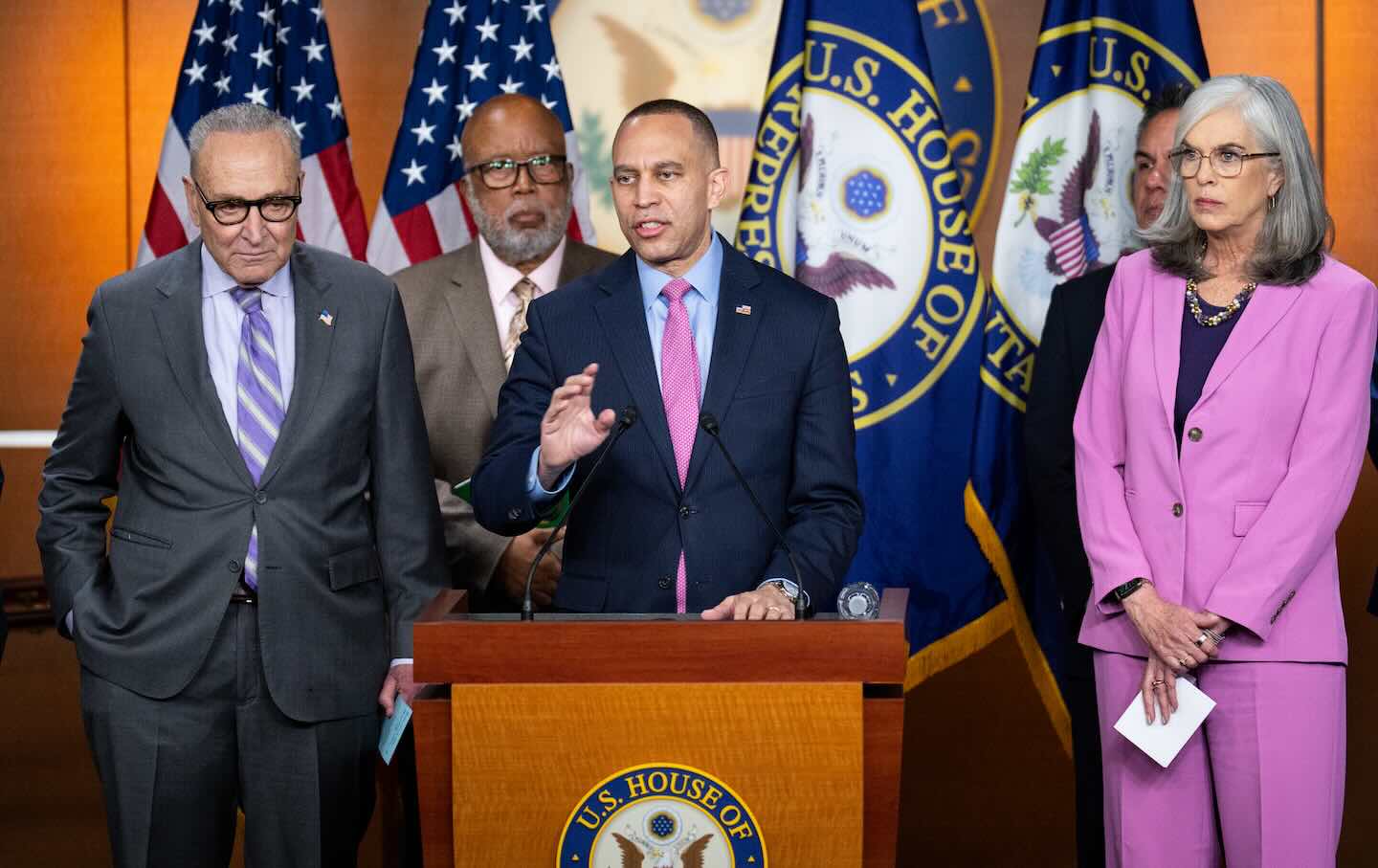
And yet instead of calling to slash this budget, leading Democrats are doubling down on the calls for professionalism that have allowed ICE to masquerade its violence as public safety in the first place. Top Democratic leaders, Chuck Schumer and Hakeem Jeffries are demanding reforms—warrants, identification, limits on tactics—as conditions of funding. In the Senate, Chris Murphy and Alex Padilla are pushing accountability measures. Others, like Ruben Gallego, are calling for “guardrails,” standards, and oversight before supporting additional funding.
This response is not unlike what we witnessed from party leaders after the killing of George Floyd. Faced with undeniable violence, leaders rejected ultimately reasoned proposals and ran scared, doubling down on the very policies that produced the harm, dressed up as reform. And when police brutalized protesters and journalists in plain view in New York City as they spoke out against violence, I wrote about it then: The response was not to meaningfully limit police power but to preserve it—new trainings, new task forces, new language, same results.
Establishment Democrats are so wedded to the logics of the criminal punishment system that they distort popular calls for common sense, evidence-backed public safety policies as a minority demand from the radical left—a demand to be contained, rather than answered. This costs them elections, and it costs millions their safety and liberty. That pattern is now on full display on immigration.
If politics were removed from the equation, we would follow evidence. Targeting immigrants for capture and deportation is not a legitimate public safety strategy—study after study shows that immigrants, documented or not, commit crimes at lower rates than native-born Americans. The current mass deportation campaign is sweeping up thousands of people with no criminal history—not that a record should determine worth, or require separation and deportation—because this is an indiscriminate exercise of power, not a public-safety policy. More than half of those sent to El Salvador’s CECOT prison in last year’s high-profile deportation had not been convicted of a crime in the United States. The data does not support an immigration system founded on mass arrests and detention.
What it does point to is something far less politically convenient: the need to invest not in ICE or border control but in the basic machinery of immigration law. Even before the current administration took a chainsaw to what remained, our immigration system was strained with years-long backlogs of unheard immigration court cases, no guaranteed right to counsel even though legal representation results in more-just outcomes, no real pathway to legal status for the millions of long-term residents who fall outside the narrow categories immigration law recognizes, and no timely resolution for those with pending asylum claims. When immigrants can stay with their communities, earn a living legally, and have a fair legal process, all of us are safer. But instead of investing in stability, work authorization, and due-process rights, Democrats continue to negotiate the terms of an enforcement machine that the evidence says we should be dismantling.
Popular
“swipe left below to view more authors”Swipe →And short of the real solution—abolition of ICE—real accountability would look like independent investigations with teeth, separate from the agencies involved; consequences for officers who lie, abuse power, or use violence, whether or not someone dies; limits on when armed enforcement is deployed, or whether it should be deployed at all; removal of federal agents from communities that did not invite them and do not consent to their presence.
The choice right now is false. It is not between reform and chaos. It is between preserving violent institutions with better language—or telling the truth about what they are, and acting accordingly.
The direct line between Democrats in the early 2000s and today matters because it explains the stakes of this moment. ICE was not inevitable. The DHS was not inevitable. They were the result of political choices, made in a moment of fear, and sustained by leaders who believe law enforcement violence comes from excess, not design. Two decades later, we’re still living with the consequences.
The political choices Democrats make now will shape American life for decades to come. Instead of drowning out cries for the abolition of ICE by telling us the answer is to trust the same institutions with slightly better paperwork, Democrats must commit to the policies that actually keep their constituents safe. They must dismantle and stop funding ICE.
Democrat cowardice is how this violence keeps happening. It doesn’t have to be this way.
Become a Sustaining Donor This September
Between the reemergence of right-wing red-baiting and Donald Trump’s use of the chilling National Security Presidential Memorandum–7 to criminalize left political organizing, we’re seeing McCarthyism reborn before our eyes.
This assault on democracy cannot be ignored or wished away. Resisting it requires bravery in the face of threats and repression, a steadfast commitment to the truth, and the unwavering belief that we can—and will—overcome this darkness.
We must have an independent media that sets the record straight, unearths corruption and abuses of power, and advances a politics of justice and dignity for all if we’re to win this fight.
That’s why I’m writing to you today. This September, The Nation needs to add 100 monthly donors to sustain our progressive journalism. Your contribution makes the next investigative report, the next truth-speaking column, and the next pathbreaking essay all possible.
I hope you’ll support our work with a recurring donation today. If you donate $10 or more a month, we’ll send you a brand new “Hands Off the Free Press!” sticker to recognise your commitment to our cause. Please, donate today.
Onward,
Katrina vanden Heuvel
Editor and Publisher, The Nation
More from The Nation

Irish Goalkeeper Gavin Bazunu’s Refusal to Play Against Israel Puts Him on the Right Side of History Irish Goalkeeper Gavin Bazunu’s Refusal to Play Against Israel Puts Him on the Right Side of History
Bazunu’s decision raises the perennial question: Why is a country that is currently committing a genocide allowed to compete in the first place?

The Promises and Compromises of the University of California The Promises and Compromises of the University of California
I grew up in a neighborhood manufactured by the University of California, Irvine. It felt like a utopia for academics—until the university forsook its mission of serving the publi...

Is Platonic Co-Parenting the Future of the Family? Is Platonic Co-Parenting the Future of the Family?
Disillusioned with the nuclear family and apprehensive of tethering their reproductive futures to the bleak hellscape of modern love, young people are seeking a different way.

How Trump’s Crackdown on Speech Has Damaged the Student Press How Trump’s Crackdown on Speech Has Damaged the Student Press
I serve as editor in chief and president of The Stanford Daily. Our newsroom has keenly felt the effects of Trump’s campus crackdown, which is why we sued the federal government.

Treat Spotify Like a Public Utility Treat Spotify Like a Public Utility
Music streaming platforms have way too much control over musicians and music lovers. It’s time to rein them in.

