
I Was Treated for Tuberculosis While Millions Were Robbed of Care
And RFK Jr.’s HHS leadership will only make contracting arcane illnesses like this one a more common affair.
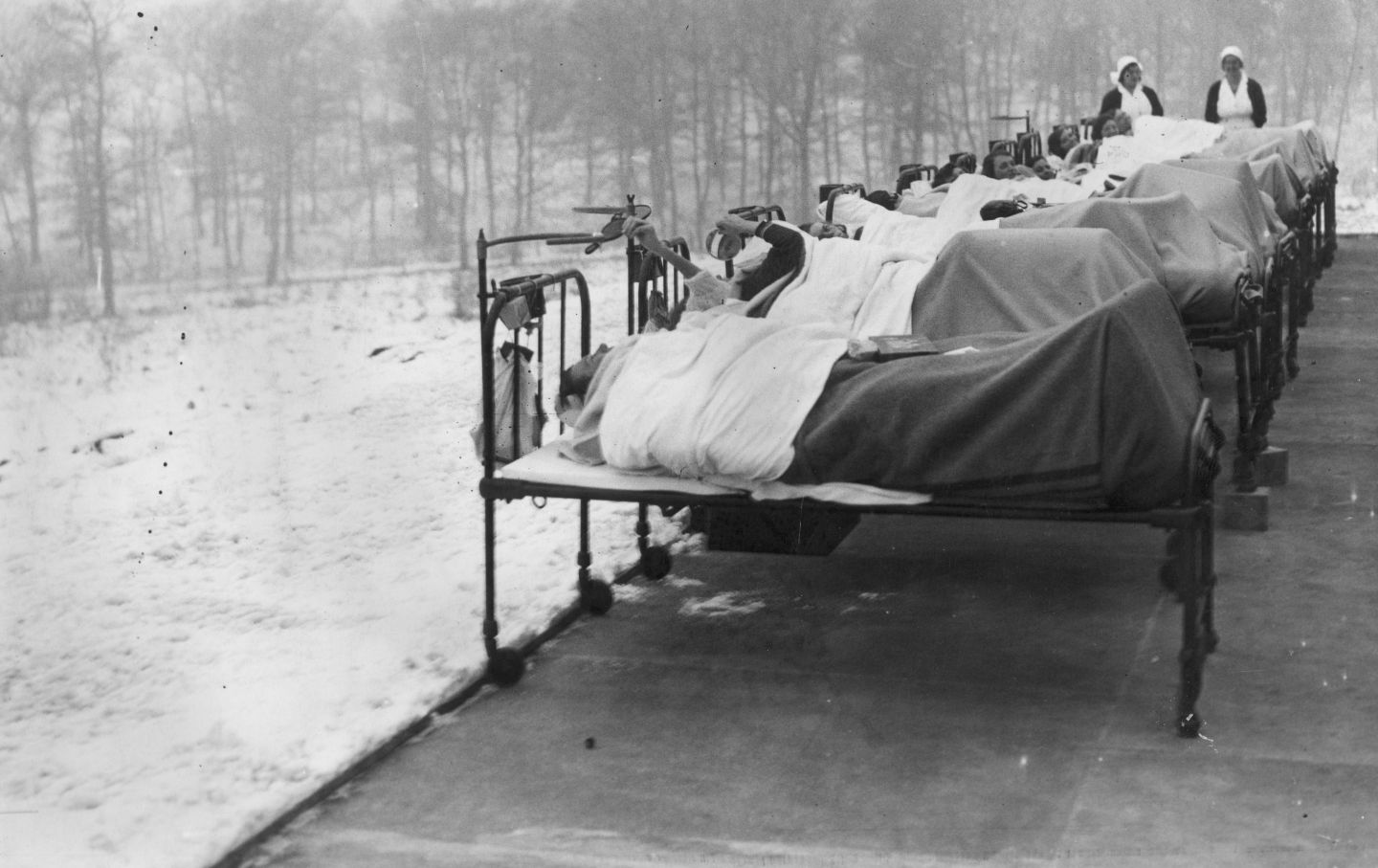
Patients crippled by tuberculosis are treated outdoors in the snow at the Harlow Wood Orthopaedic Hospital in Nottinghamshire, on January 24, 1933. Whatever the weather, they spent their days lying on iron bedsteads in the open air, as a “curative” measure.
(Harry Shepherd / Fox Photos / Getty Images)When my rheumatologist decided to put me on immune-suppressant medication for my inflammatory arthritis in the summer of 2020, there were a handful of concerns. First of all, I would now be at much higher risk of illness from viruses and bacterial infections. The Covid pandemic had been raging for five months, and with a medication that dampened my immune system, I was suddenly in the high-risk category.
I’d also have to be tested annually for tuberculosis and hepatitis, dangerous diseases that can take hold much more quickly when you’re immunocompromised.
Thankfully, all my blood tests came back normal. I could start my new treatment regimen.
If there were ever going to be a time that I’d test positive for tuberculosis, I assumed it would be that first test I took in July 2020. I’d spent time abroad in rural Morocco, Nicaragua, and China while an undergraduate student, all parts of the world with much higher rates of TB than the United States. The bacteria can live inside some silently, noncontagious and asymptomatic, until something triggers it to start multiplying. That trigger can be anything from stress or additional illnesses to immunosuppressive drugs and malnutrition. I figured I was in the clear for good, and the following three TB tests bore that out.
Then, in March 2025, my rheumatologist called to let me know I’d tested positive for tuberculosis. It was probably a false positive, she reassured me. That happened occasionally. But they’d do some more tests to make sure.
In total, it took three blood tests to confirm that I did have tuberculosis. Three separate needles puncturing three different veins, vacuuming a swirl of blood into three glass vials. When that blood was exposed to fragments of tuberculosis, it responded with a sudden eruption of immune proteins, a recognition of an infectious agent that proved my blood was familiar with the mycobacterium that causes TB. Finally, the doctor ordered a chest X-ray to see if the disease had started causing any damage. My lungs, at least, looked clear.
But the news was still a shock. Where had I caught it? What was the disease going to do to my body? How had this happened? My rheumatologist sent me off to an infectious disease specialist, who would decide the next steps to take.
Tuberculosis has existed for millennia and remains one of our deadliest biological adversaries. Generally, the disease is spread through the air by those who are infected. But it can also be spread by consuming raw milk—in case you needed yet another reason not to trust a word out of RFK Jr.’s mouth. Symptoms range from a bloody cough—shoutout to Moulin Rouge for being the first to enshrine the disease in my cultural memory—to fatigue and rapid weight loss. It can spread throughout your body, infiltrating your bones, your liver, your stomach, and even your brain. Between 1882, when the disease-causing bacteria were first discovered, and 2021, TB killed over 1 billion people globally. Even though we now have antibiotics to treat it, the disease still kills more than 1.2 million people annually. Sometimes that’s because of lack of access to medicine and healthcare, sometimes because people develop antibiotic-resistant strains of TB, and sometimes it’s because patients aren’t able to complete the full treatment regime.
When I first met with the infectious disease doctor, he wanted to know if I’d traveled abroad recently, or been in jails, prisons, or homeless or migrant shelters. His questions hinted at the socioeconomic reality of tuberculosis, something viewers of HBO’s medical drama The Pitt may be familiar with. Like many diseases, it’s more than just an illness: It’s an indicator of inequality and a barometer of our ability—or, more accurately, inability—to care for the most vulnerable. Food insecurity, lack of access to medical care, and crowded housing conditions all play roles in spreading the disease. There were about 10,000 cases of tuberculosis in the United States in 2024; the worldwide rate was 10.8 million new cases.
Only about 10 percent of people infected with the bacteria will ever develop an active infection, while in the rest they lie dormant. Fortunately, my case was still latent. But having a weakened immune system made me much more likely to develop an active infection. And therein lay the problem.
But because the heightened risk of TB is a known factor in immunosuppressant medications, the American medical system has arranged ample preventive measures. My infection was detected early. I was immediately sent to an infectious disease specialist. And I went on antibiotics before my TB could progress to active disease. The five months of treatment were miserable (more on that shortly), but my numerous privileges—having health insurance, access to doctors, and the ability to get myself to and from appointments—meant I didn’t have to worry about dying of a curable disease.
The same can’t be said for millions of people around the world. As I started my antibiotics, I watched the Trump administration completely dismantle the public health infrastructure that supports the eradication of TB, while also threatening the well-being of people within the US.
That process began in January of 2025, when an executive order called for a freeze on all foreign aid for 90 days, including funding provided by the United States Agency for International Development (USAID). Tuberculosis programs around the world immediately reported massive disruptions to their programs.
The “StopTB” Partnership issued a report in March 2025 with alarming details about the impact of the sudden cuts to funding in countries across the world. They found that screening and case-finding activities in 27 districts of Pakistan (one of the most affected countries in the world) had stopped, which meant cases would go undetected. There were similar effects in Cambodia, where some 25,000 people had undiagnosed TB. Around 50 percent of people with bacterially confirmed TB don’t have any symptoms, but they can still spread the disease to others—which is why outreach and testing are such important elements in reducing the spread of TB, alongside access to treatment and the development of vaccines.
In Tajikistan, psychosocial support for those receiving treatment was ended completely—an important aspect of getting better, both because of the stigma that can come with a TB diagnosis and because the drugs produce such onerous side effects, including nausea and vomiting, liver toxicity, fatigue, peripheral neuropathy (tingling, numbness, and burning in the hands and feet), and irreversible hearing loss.
In September, researchers used mathematical models to predict how many additional people might fall ill and die of tuberculosis as a result of the US funding cuts. Their worst-case scenario results were grim: an additional 10.6 million new cases and 2.2 million additional deaths by 2030.
Perhaps the most affecting demonstration of the human lives at stake was a tracker I found that counted additional deaths and TB cases (on top of the expected ones) since January 24, 20215, when the freeze was issued. When I looked at it the afternoon of December 1, there were already 58,174 additional deaths. A new death was added about every eight minutes.
Meanwhile, I was struggling terribly on the daily antibiotic rifampin. It made me nauseated all the time. I had regular bouts of diarrhea. My joints were starting to hurt because I wasn’t on my arthritis medication, which I was unable to take because it would interfere with the TB antibiotics by weakening my immune system. I was exhausted to a level I’d never been before, even after years of living with multiple chronic illnesses. I slept nine hours a night, then 10, then 11, and I still awoke most mornings feeling fatigued. All these side effects occurred within the first two weeks of taking rifampin. How was I going to manage for another three and a half months?
By the end of the first month, I was ready to beg the doctor to put me on something different. As it happened, the drug was also causing my white blood cells to drop to a concerning level. Between that lab result and my symptoms, the doctor agreed that I could try a different drug cocktail, this one weekly. I’d now be taking nine pills every Monday: a mixture of isoniazid and rifapentine.
This kind of collaboration between patient and doctor is often necessary for people to finish their course of treatment. (On average, about half of the people who are prescribed antibiotics don’t finish their courses, leading to 5 million deaths annually associated with antimicrobial resistance.) Tuberculosis medications can come with dangerous side effects, especially the antibiotics used for drug-resistant TB. But all too often, patients don’t have the income necessary for treatment, or the stamina to endure side effects, or the guidance from healthcare workers on the best way to follow a treatment plan.
Most Americans don’t know that tuberculosis still sickens and kills millions of people. When I told friends about my treatment, a number of them didn’t even know TB still existed; it seemed like something that belonged to The Oregon Trail or period dramas.
But I also heard a surprising number of stories from people who had direct experience with the illness. One friend was diagnosed with latent TB after being exposed in a university class, though she never required treatment. Another tested positive before starting immunosuppressants for her arthritis, and had to be treated before she could begin her medications. My mom, who grew up in Puerto Rico and was tested annually as a kid, was treated for latent TB.
It’s more important than ever that we become aware of the prevalence of this disease: We may end up with an increasing number of cases in our communities. With a sudden increase in arrests and detentions by US Immigrations and Customs Enforcement (ICE), people placed in detention facilities face overcrowding, malnourishment, and lack of access to bathroom facilities—all the conditions that breed outbreaks of tuberculosis.
By the end of last summer, facilities in multiple states had reported ICE detainees with active cases of TB: the Anchorage Correctional Complex in Alaska, the Tacoma Immigrant Detention Center in Washington State, and the Eloy Detention Center in Arizona. In that last facility, the patient was an Ethiopian named Serawit Deneen, who died of TB after being in custody in Arizona.
Popular
“swipe left below to view more authors”Swipe →Federal law requires that all people be screened for TB within 12 hours of intake in an ICE facility, but as Whitney Curry Wimbish reports for The American Prospect, this doesn’t always happen, by the government’s own admission. And with these types of outbreaks, where treatment isn’t immediately forthcoming, it’s possible for even deadlier (and harder to treat) strains of drug-resistant tuberculosis to develop.
While these stories trickled out throughout the summer, I struggled to make sense of them alongside my own experience. Though the weekly medication regime was more bearable than my first daily antibiotic, I still suffered from excruciating side effects: headaches so bad they made me cry, nausea that grew over the weeks—and regular bouts of pelvic pain, as the antibiotics interfered with the birth control I take to suppress my periods, painful because of endometriosis. I was taking medication to avoid becoming sick with TB—but the way the drugs interacted with all my other illnesses only made me feel sicker.
This is yet another aspect of USAID cuts impacting people worldwide: coinfections with TB and other diseases. TB is the main cause of death and hospitalization for people with HIV, for example. For those with diabetes, becoming sick with TB comes with a twofold risk of death and a fourfold risk of TB relapse after treatment is completed. The funding cuts to USAID didn’t just impact TB treatment; they impacted treatment and screening for HIV/AIDS and malaria and diarrheal diseases, among others.
Despite how miserable I felt during treatment, I’m an example of how TB can be conquered. I had easy access to testing. Insurance covered most of the cost of the medications, as well as testing and my appointments. And when the first antibiotic had too many side effects, my doctor put me on a different drug regimen that was slightly more tolerable. I was regularly monitored with blood tests and check-ins. Yes, it made for an unpleasant summer. But now I won’t develop a debilitating, deadly disease—or spread it to anyone else in my community.
The same can’t be said for the hundreds of thousands of people who have gone without treatment, and the tens of thousands more who have died since the Trump administration cut nearly all funding to USAID. We have the technology, tests, and medicines to cure tuberculosis. The only reason more than a million people die of it every year is because we have decided that only some people deserve the treatment that will keep them alive.
More from The Nation
Trump Has Made it Legal to Destroy Endangered Species’ Habitats Trump Has Made it Legal to Destroy Endangered Species’ Habitats
By redefining the meaning of “harm” in the Endangered Species Act, the administration is giving big corporations a gift they have long demanded.
Journalist Meaghan Beatley on Latin America’s Feminist Resistance Journalist Meaghan Beatley on Latin America’s Feminist Resistance
A conversation with the author of Sex and Dissent about what American feminists can learn from the Green Wave movement.
As Cornell’s Rape Case Draws National Attention, Students Want Accountability As Cornell’s Rape Case Draws National Attention, Students Want Accountability
A new lawsuit alleging that a former student was drugged and gang-raped by Chi Phi fraternity members is sparking outrage in the Cornell community.
Irish Goalkeeper Gavin Bazunu’s Refusal to Play Against Israel Puts Him on the Right Side of History Irish Goalkeeper Gavin Bazunu’s Refusal to Play Against Israel Puts Him on the Right Side of History
Bazunu’s decision raises the perennial question: Why is a country that is currently committing a genocide allowed to compete in the first place?
The Promises and Compromises of the University of California The Promises and Compromises of the University of California
I grew up in a neighborhood manufactured by the University of California, Irvine. It felt like a utopia for academics—until the university forsook its mission of serving the publi...

