
Yale’s Summer Storage Wars
Yale just cut summer storage reimbursements for first-gen and low-income students. The university has a $44 billion endowment. What it chooses to budget for says everything.
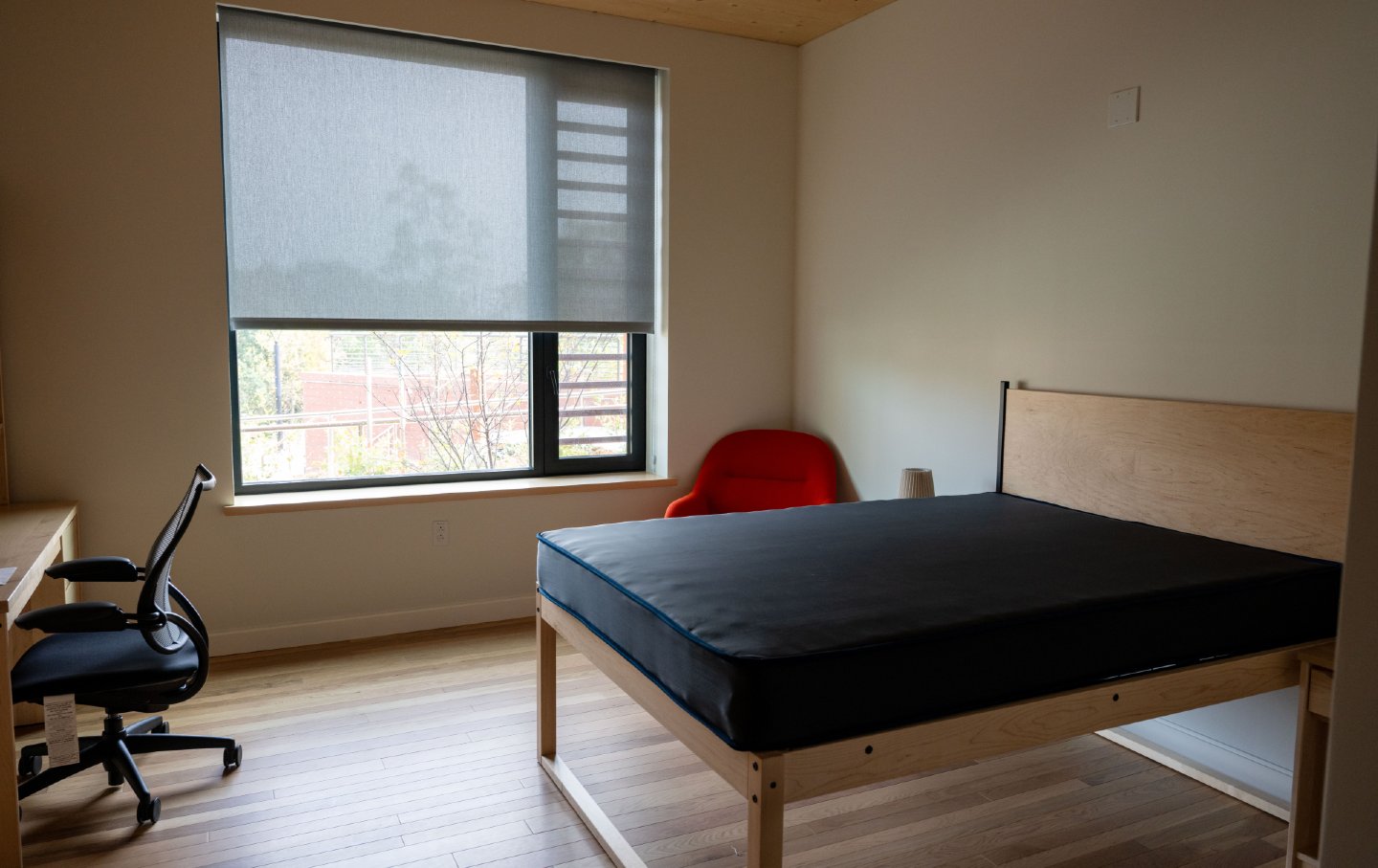
An unfurnished dorm room at Yale in New Haven.
(Ayannah Brown / Connecticut Public via Getty Images)Early on Monday morning, someone from the Yale College dean’s office sent me a message on WhatsApp. A link led to a letter by professor Glenda Elizabeth Gilmore published in the Yale Daily News. It was a letter written about a word. The word was “stuff.”
In 1967, Gilmore finished her first year at Wake Forest. When school let out, she had nowhere to go, so she found a friend with a room on campus where she could stay for a few weeks. She also found a place in the dormitory’s basement where her belongings—presumably, a suitcase and the accumulations of her first year—could wait for her sophomore year.
A dean eventually found her and what she had stashed in the basement. He told her to leave it exactly where it was.
Gilmore is now the Peter V. and C. Vann Woodward Professor Emerita at Yale, where she holds appointments in history, Black studies, and American studies. But she did not write her letter to the Yale Daily News about any scholarship or expertise in the many fields for which she is considered an authority. She wrote it to describe that dormitory basement at Wake Forest. And she wrote it because the dean of Yale College, Pericles Lewis, defending his administration’s decision to eliminate its summer storage reimbursement program for first-generation and low-income students, suggested that those students simply “should not buy too much stuff.” Dean Lewis had used “stuff,” so Gilmore did too. She put quotation marks around it. She was, after dealing with universities for 60 years, precise.
A week before it ran her letter, the Yale Daily News published a story about the cuts to the summer storage reimbursement program. When the News posted the story on Instagram, it received nearly a thousand likes and more than a hundred comments from current students and alumni. Jake Thrasher, a PhD candidate at Yale, wrote the most-liked comment: “If I made $450k/year (according to public info), I personally think it would be tacky as hell to tell the poorest students here ‘not to buy too much stuff’ but what do I know?” Lizzie Conklin, who graduated last year, commented, “This is genuinely absurd.” Elizabeth Shvarts, who will graduate next month, wrote, “Let’s just store it in his mansion.” Another commenter compared Dean Lewis to Marie Antoinette. Several others called the situation absurd.
Alex William Chen was not one of those who commented on the Instagram post. But Chen is the Yale College Council’s speaker and has helped allocate the council’s remaining budget—almost $13,000—toward supporting students who need financial help with summer storage costs.
Chen texted me a message he’d like to send Yale’s administrators: “Please come down from your offices and meet with students on campus. Explain to us how the utility of financial support for Yale’s most financially vulnerable students is somehow less than the utility of preserving an exponentially bloated administrative apparatus.”
Chen told me that he knew several Yale students from New Haven who were offering up their own homes to store boxes for friends who will lose reimbursement for summer storage. He asked, “Would these Yale administrators be willing to do the same?”
The reimbursement program had covered summer storage costs for first-generation, low-income students and had provided relief for qualifying students whose socioeconomic backgrounds do not provide a financially feasible option for summer storage. Its elimination upended the relief that had become expected.
A week after the announcement, and a day after Gilmore’s letter, a new announcement came—this one from a student who, like Chen, wanted to figure out a way for students to fix this on their own.
Topher Allen, the student equity coordinator at Dwight Hall, a center for public service at Yale, held emergency meetings with storage vendors, container brokers, and colleagues on the student executive committee. Between meetings, he was on calls with alumni and leaders of the Yale College Council. Within a week, they had reallocated their entire spring budget for community-building, social justice, and outreach. Everything allocated to those programs was folded into creating solutions for students who still needed the summer storage reimbursement.
What they built: a flat rate of $50 for full-summer storage, available to any student eligible for the full Pell Grant, living on campus with a home address more than 150 miles away.
In an e-mail to the student body, they compared their rate to that offered by local vendors—between $400 and $700. Allen, however, called the solution a Band-Aid. He said it was born of necessity, not abundance. He also noted that some students, before the Dwight Hall intervention, had planned to hide belongings around campus, or to throw items away and try to replace them in the fall.
Gilmore’s letter, about halfway through, finishes her story about the dean who let her keep her “stuff” in a dormitory basement all those years ago. When she finishes that story, she begins another—one in which Yale holds a $44 billion endowment. In that story, she asserts that the administration might make itself more useful by eliminating two administrator positions than by ending a summer storage reimbursement program that has benefited thousands of students.
Popular
“swipe left below to view more authors”Swipe →Gilmore’s second story, alluding to what Chen called a bloated administrative apparatus, had not arrived at its conclusion arbitrarily.
In 2025, more than a hundred Yale faculty, drawn from dozens of academic departments across nearly every discipline, including Yale Law School and Yale School of Medicine, signed a letter calling for a freeze on new administrative hires. Professors were watching their own salary increases slowly while the ratio of administrators to undergraduates crept toward parity.
The endowment that pays those administrators has accumulated, at least in part, from generations of alumni who wanted to give back to the school that had given them so much. Among what Yale had given them were programs like summer storage. It seems, from Chen’s text messages, and a lot of angry Instagram comments, that such programs give Yale the chance to show students that it sees them as more than their good grades, SAT scores, and ISEF awards.
This is the argument Gilmore made in her letter, which began, she told us, in a dormitory basement in Winston-Salem in 1967. She remembered it 60 years later. She put the word in quotation marks. She took a word a dean had used carelessly and precisely demarcated it in the oldest college daily newspaper in the United States. But Gilmore was not calling any of it absurd. “Yale College Dean Pericles Lewis perhaps attempting to be humorous…when he suggested that low-income students should simply not ‘buy too much stuff,’” Gilmore wrote, “instead seemed arrogant.”
More from The Nation


Trump Has Made it Legal to Destroy Endangered Species’ Habitats Trump Has Made it Legal to Destroy Endangered Species’ Habitats
By redefining the meaning of “harm” in the Endangered Species Act, the administration is giving big corporations a gift they have long demanded.
Journalist Meaghan Beatley on Latin America’s Feminist Resistance Journalist Meaghan Beatley on Latin America’s Feminist Resistance
A conversation with the author of Sex and Dissent about what American feminists can learn from the Green Wave movement.
As Cornell’s Rape Case Draws National Attention, Students Want Accountability As Cornell’s Rape Case Draws National Attention, Students Want Accountability
A new lawsuit alleging that a former student was drugged and gang-raped by Chi Phi fraternity members is sparking outrage in the Cornell community.

Irish Goalkeeper Gavin Bazunu’s Refusal to Play Against Israel Puts Him on the Right Side of History Irish Goalkeeper Gavin Bazunu’s Refusal to Play Against Israel Puts Him on the Right Side of History
Bazunu’s decision raises the perennial question: Why is a country that is currently committing a genocide allowed to compete in the first place?
The Promises and Compromises of the University of California The Promises and Compromises of the University of California
I grew up in a neighborhood manufactured by the University of California, Irvine. It felt like a utopia for academics—until the university forsook its mission of serving the publi...

