The AI Sector’s Crass Bid for Media Domination
When you’re a galactically rich tech mogul upset with adverse press coverage, you just buy yourself more flattering media outlets.
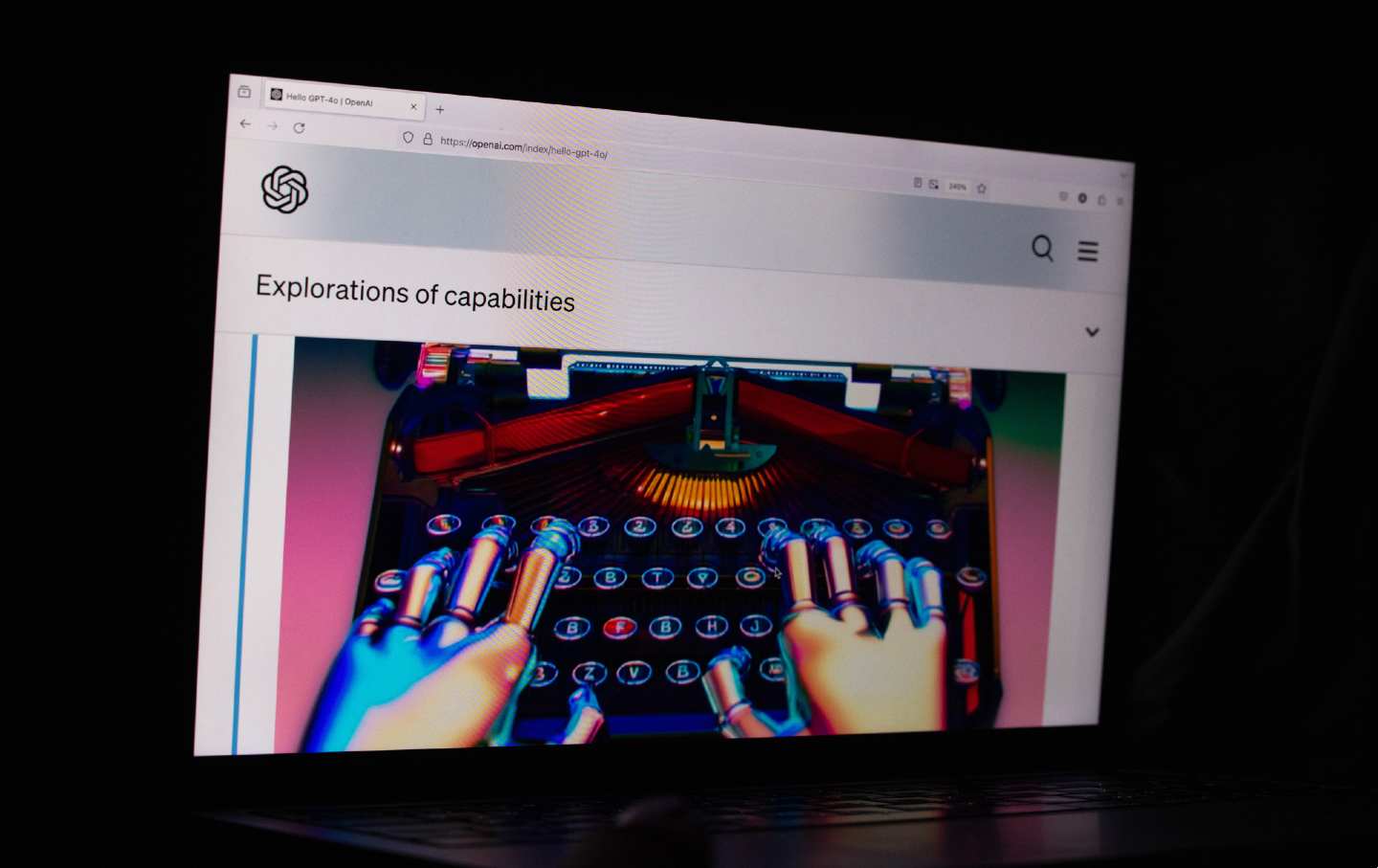
A ChatGPT assistant display on a laptop.
(Andrey Rudakov / Bloomberg via Getty Images)“Freedom of the press,” A.J. Liebling famously wrote, “is guaranteed only to those who own one.” This pithy observation from one of Liebling’s 1960 “Wayward Press” columns in The New Yorker sums up a great deal about how journalism is transacted under the pressures of American capitalism. But the gist of it has to hit different if you have several hundred million dollars sitting around and a reputation that could use a bit of burnishing.
OpenAI, the company behind ChatGPT, announced last week that it was buying Technology Business Programming Network (TBPN), a daily Internet talk show known for its puffball interviews with Silicon Valley execs and hopeful tech entrepreneurs, hosted by two former start-up founders, Jordi Hays and John Coogan. OpenAI shelled out something in the “low hundreds of millions” for the show, according to the Financial Times—a figure likely in the same range as the $250 million that Jeff Bezos spent buying The Washington Post in 2013. The then-venerable-if-troubled paper had a weekday circulation around 450,000 at the time. TBPN, only about a year-and-a-half old, reaches somewhere on the order of 70,000 viewers per show, mostly on X and Youtube. It does, however, have a huge gong, which the six-foot-eight Coogan, the taller of the two hosts, will bang upon to mark any good news guests bring with them to the show. (Hays, for his part, has a soundboard.)
Given that OpenAI just took in $110 billion in new funding (GONG!), valuing the company at some $840 billion, a couple hundred million dollars is more or less a rounding error. But what does an AI lab hope to get from ownership of a tech podcast? The company insists that it’s going to respect TBPN’s “editorial independence,” such as it is, but it’s pretty clear OpenAI isn’t altogether happy with the media coverage it’s been getting lately. The general run of OpenAI coverage these days tends to focus on things like the numerous lawsuits the company faces from the families of former ChatGPT users allegedly driven to suicide by its sociopathic prompts, as well as the company’s cravenly speedy move to sign a lucrative contract with the Pentagon in late February after its rival Anthropic lost a similar deal for taking a small stand against autonomous killer drones and mass domestic surveillance.
In an official statement, OpenAI’s Fidji Simo said that the deal was all about “creat[ing] a space for a real, constructive conversation about the changes AI creates.” This appears to be a jargon-laden way of saying the company intends to lead conversations that don’t include any actual journalists, who are known even in Silicon Valley for sometimes asking the sorts of questions that tech CEOs would rather not answer in public. Of course, TBPN should be well suited for its new role as a wholly owned media entity given that the show is “already so dedicated to cheerleading for the rich and powerful people in tech as to have been indistinguishable from marketing,” as Patrick Redford of Defector acidly put it.
OpenAI isn’t the first tech company to adopt a strategy of “going direct”—a maneuver that by and large bypasses, well, the media in favor of blogs and podcasts under corporate control. No one has embraced “going direct” more insistently than the venture capitalists at Andreessen Horowitz, and their story helps illustrate both the promise and the pitfalls of this particular path.
The firm, known widely as a16z, spent the first few years after its founding in 2009 assiduously courting the press with the help of a dedicated and skillful press-whisperer named Margit Wennmachers. She managed, among other things, to get The New Yorker to devote considerable real estate to a laudatory story about cofounder Marc Andreessen, labeled “Tomorrow’s Advance Man,” in 2015. But the company began to sour on what it now derisively labels the “legacy media” not long after, when reporters started raising critical questions about one of a16z’s portfolio companies, Zenefits, and about the much-hyped venture fund itself. So instead of “trying to get reporters to write the right things,” as Andreessen put it in a recent interview, the firm started hiring journalists to run its own media operation, devoting so much energy to the project that some people began referring to a16z as a media company that just happened to do some venture capital investing on the side.
In 2021, a16z tried to take its “new media” strategy to the next level by launching Future.com, a sleek web publication that Wennmachers suggested would become “the go-to place for understanding and building the future.” (Hence, presumably, the name.) Soon, she said at the launch, tech entrepreneurs would be asking themselves “should I try to get this into The New York Times, or should I get it into Future?”
The site sputtered out in less than a year and a half. Apparently the teeming millions of techbros weren’t lining up to read relentlessly positive takes on such topics as “How to Know Your Users as You Grow” and “What Synthetic Embryos Can and Can’t Do.” As Bloomberg’s Brad Stone noted, “it doesn’t always end well when you hire people to tell the world how great you are. Future.com, from my periodic glances, is a snooze fest.”
The Future.com debacle didn’t really alter a16z’s big plans for media domination. The company just shifted direction, and returned to pushing its podcasts and blog posts on its own site. As always, Andreessen Horowitz continues talking a big game—selling its “new media” team hard to startup founders as “the best turnkey media operation in venture.… We offer an extensive menu of services for our portfolio companies, up and down the New Media stack, that add up to one experience: ‘shipping a great story.’” (I think you may see what Stone was getting at with that “snooze fest” remark.)
Speaking of snooze fests, some worry that an OpenAI-owned version of TBPN might lose whatever spark its fans now think it has. (Frankly, I don’t see much of a spark there now, though I am very much not part of the show’s target demo.) But I think the show may face an even bigger challenge in the form of one Elon Musk. TBPN, you may recall, gets most of its current audience on X, and Musk, who owns X, is not what you’d call a big fan of OpenAI or its CEO Sam Altman. Indeed, Musk, one of the original investors in the company, is suing Altman and other OpenAI bigwigs for $134 billion for allegedly lying to him about keeping the company a nonprofit; OpenAI is countersuing him for harassment. Musk, a deeply vindictive man, is widely reported to have sometimes used his control of X’s algorithm to throttle the traffic of media outlets and even individual accounts on the site that he dislikes. If he decides to do the same to the OpenAI-owned TBPN, it will likely trigger a singularly petty clash of press-owning titans. On the plus side, I guess, the ensuing drama would prove far more interesting than anything you’d hear on a TBPN podcast.
Become a Sustaining Donor This September
Between the reemergence of right-wing red-baiting and Donald Trump’s use of the chilling National Security Presidential Memorandum–7 to criminalize left political organizing, we’re seeing McCarthyism reborn before our eyes.
This assault on democracy cannot be ignored or wished away. Resisting it requires bravery in the face of threats and repression, a steadfast commitment to the truth, and the unwavering belief that we can—and will—overcome this darkness.
We must have an independent media that sets the record straight, unearths corruption and abuses of power, and advances a politics of justice and dignity for all if we’re to win this fight.
That’s why I’m writing to you today. This September, The Nation needs to add 100 monthly donors to sustain our progressive journalism. Your contribution makes the next investigative report, the next truth-speaking column, and the next pathbreaking essay all possible.
I hope you’ll support our work with a recurring donation today. If you donate $10 or more a month, we’ll send you a brand new “Hands Off the Free Press!” sticker to recognise your commitment to our cause. Please, donate today.
Onward,
Katrina vanden Heuvel
Editor and Publisher, The Nation