
The Olympics Is Repeating One of Its Worst Mistakes
The IOC’s new anti-trans testing regime revives some of the most discredited and discriminatory policies in the history of the games.
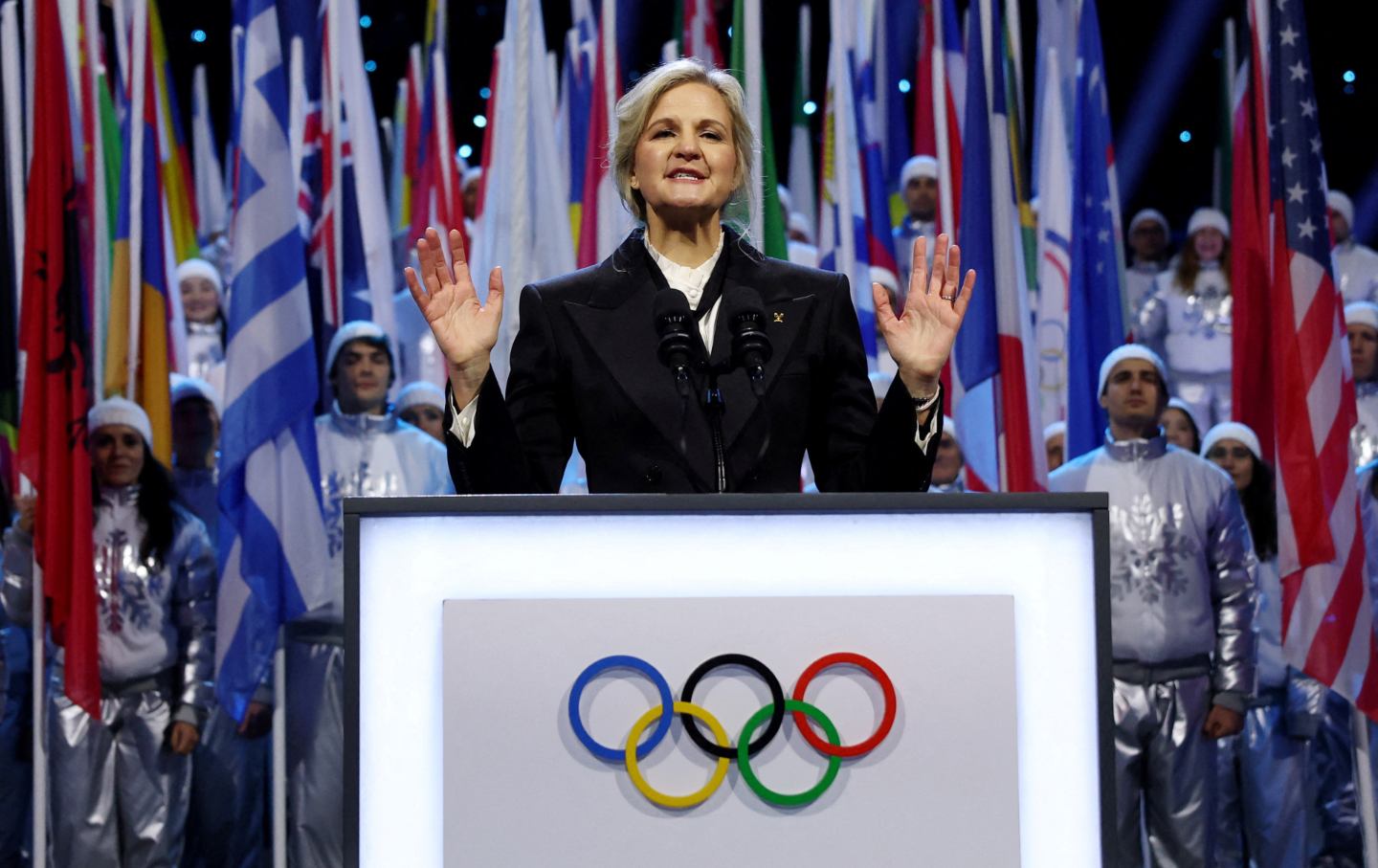
IOC president Kirsty Coventry speaks during the Olympic opening ceremony at the 2026 Winter Olympics, in Milan, Italy, on February 6, 2026.
(Yves Herman / Pool Photo via AP, File)In 1967, a Polish sprinter named Ewa Kłobukowska sat for a mandatory DNA test. Kłobukowska, a rising track star, had won a gold and a bronze medal at the 1964 Olympics in Tokyo. Now, a new policy required all women track-and-field athletes to be screened for the presence of X chromosomes. Kłobukowska was probably shocked to learn that the test had placed her on the wrong side of the gender binary. Exactly what happened is hazy—news reports claimed that Kłobukowska was discovered to have “one chromosome too many,” without further explanation—but the consequences were immediate. Kłobukowska was banned from the Olympics. Her sporting career was over.
Track-and-field officials framed this as an unmitigated triumph, proof that DNA testing had weeded out an athlete who was “not truly female.” But even at the time, some onlookers could see that the International Olympic Committee (IOC) was going down a dark road of gender policing, weeding out women who had always understood themselves as female based on some arbitrary biological marker. The head of the Polish Olympic Committee, perhaps radicalized by the dismissal of one of his top athletes, called DNA testing a “form of discrimination” as well as something of a gender delusion: How could the IOC hope to split up athletes into biological binaries when “there are no generally accepted criteria of sex for woman athletes”? Sex, after all, is a spectrum.
These critiques did not stop the IOC from expanding its testing requirements. From 1968 on, all women athletes had to sit for chromosome exams ahead of the Olympics. Only at the end of the 1990s, when the chorus of critical voices became unavoidable, did the IOC ditch this sex testing regime.
Now, though, amid a rising global tide of transphobia, the Olympics is retreating into the past. Last week, the IOC announced it was banning trans women from competing in women’s events and embracing—what else?—chromosome testing. In her statement, IOC head Kirsty Coventry insisted that she wanted to “ensure the fairness, safety, and integrity of all competitions within the Games.” What she did not mention was her organization’s sordid history with DNA testing—or the widespread condemnation that this experiment had once drawn.
It would be simply inconvenient to admit that, two and a half decades ago, a coalition that included the American Medical Association, the government of Norway, and then–first lady Hillary Clinton helped to unravel these very same policies, or that the IOC’s chosen DNA test, the SRY test, has failed before. The SRY test detects the presence of Y chromosomal material, but many people who are not men, including a number of cis women, have Y chromosomal material. The IOC knows this firsthand; when it rolled out the SRY test in 1996, at the Atlanta Olympics, the test famously backfired: Eight women tested positive and risked getting kicked out of sports, until they were eventually reinstated after further review. (These women were never publicly identified.)
The test has not changed in the 30 years since. Neither has the science around human biology. But the Olympics is forging ahead regardless.
Just as it did in 1968, the IOC is insisting that the new regime is about preventing men from breaching the barriers of women’s sports, saying that “it is absolutely clear that it would not be fair for biological males to compete in the female category.” And, just as was true all those decades ago, this excuse doesn’t hold up to scrutiny. Instead, the IOC is playing a linguistic jiu-jitsu with us, lumping intersex and trans women into the categories of “biological males,” even though they are not men and do not have the same athletic advantages as men.
Clearly, this new policy has little to do with science or fairness—and everything to do with the metastasizing right-wing panic against trans women. Instead of dealing with the occasionally messy work of including gender-diverse athletes in a binary sports infrastructure, the IOC seems to have decided that it’s more convenient simply not to try. That the global right has made trans women athletes into a fixation, a proxy for their much wider-ranging campaign to disenfranchise trans people, has proven to be a convenient cover for a return to the 20th century. It’s also only the latest example of the regressive gender politics that have defined the Olympics for their entire history.
Skepticism of women’s athletics is encoded into the Olympics itself. Pierre de Coubertin, the founder of the modern Olympics, thought women’s sports were “impractical, uninteresting, unaesthetic and improper,” and limited the competitions that could be available to women. The women who did make it to the Olympics were often thought to have unfair physical advantages: when the American sprinter Helen Stephens won gold in 1936, newspapers pointed to her deep voice and big arms and accused her of being a man.
Right-wingers and fascists have often tapped into these anxieties around women’s sports to platform their ideologies. Nazi officials shepherded the first sex testing policy in women’s sports, which the track-and-field federation passed in 1936, as I wrote in my book The Other Olympians: Fascism, Queerness, and the Making of Modern Sports. Meanwhile, America’s Cold War rivalry with the USSR—and its consistent losses in the women’s sports category—sharpened the push for expanded DNA testing policies in the 1960s.
Similarly, it is hard to explain the IOC’s retreat into DNA testing today without acknowledging the global political context—particularly the specter of Donald Trump, who has made anti-trans hate a central part of his governing agenda. While Coventry has insisted that banning trans and many intersex women from sports is not a reaction to Trumpism—“this was a priority for me way before President Trump came into his second term,” she said—Olympic officials told The Guardian that Trump was certainly on their mind. Los Angeles is hosting the next Olympics in 2028, and Trump, after successfully pressuring the NCAA and the US Olympic Committee to ban trans women athletes, has made his stance known to IOC leaders. Last February, Trump vowed to pressure the IOC to ban trans women athletes; his administration even threatened to block trans women athletes from entering the United States if they arrived intending to compete in women’s sports.
By embracing the Trumpist war on trans women, the IOC has become party to a vitriolic right-wing feedback loop, where major institutions that ban trans women athletes are held up as examples of the righteousness of this project. During a recent US Supreme Court hearing in a case challenging bans on trans women and girls in school sports, Justice Brett Kavanaugh pointed to the Olympics as proof that sports leaders agreed with the bans. “A variety of groups who study this issue,” including “some states and the federal government and the NCAA and the Olympic Committee,” Kavanaugh said, “think that allowing transgender women and girls to participate will undermine or reverse that amazing success” of women athletes. In this way, the right-wing fearmongering of trans athletes and the IOC’s new policy have become indelibly intertwined. What’s lost in all of this is that a basic human rights issue—who has access to playing sports according to their gender—has been completely obfuscated.
If history is any guide, what will happen next is a slow thinning out of gender-diverse athletes from elite sports. In 1967, the IOC responded to Kłobukowska’s very public dismissal from women’s sports by taking DNA testing underground. Going forward, women athletes who failed chromosome tests were no longer publicly named. Often, they simply dropped out, claiming an injury, never to be heard from in professional athletic settings again. We don’t know how many athletes were disqualified because of these chromosome tests—the IOC never counted—but it is probably not a negligible number. Tellingly, in 1967, the head of the track-and-field federation, David Burghley, boasted that he had “managed to keep out six who were hermaphrodites” and was on track to “frighten the doubtful ones away.”
Popular
“swipe left below to view more authors”Swipe →That latter part of Burghley’s statement speaks to one consequence of the IOC’s revived DNA testing policies. In the latter half of the 20th century, many women who might have tried to compete in women’s sports simply dropped out when it became clear that they would fail their sex tests. The scholar Lindsay Pieper recently unearthed a 1980s letter from a Finnish geneticist about a young female skier who would have failed a chromosome test. The woman’s coach “had told her she should not try to make a career in skiing, and I could do little to help her, because she would indeed always ‘fail’ in the IOC’s tests,” the geneticist wrote. “This woman represents the invisible part of the iceberg: those numerous unfortunate women who are subjected to sex chromatin screening and eliminated from sports long before they reach a major competition.”
These quiet expulsions, where athletes are steered away from sports because of fear of the scrutiny, are probably where we are headed next. That is, if this new policy holds. There are real roadblocks to the full rollout of the IOC’s new DNA testing policies. Some countries, like France, ban genetic testing unless it is medically necessary; France’s top sports minister, Marina Ferrari, has already called the new IOC policy a “step backwards.” A similar law in Norway, which was passed in the 1990s and which helped to topple the original DNA testing regime at the Olympics, is still on the books. As in the 1990s, human rights experts, as well as scientists, widely oppose the new testing regime. A panel convened by the UN Human Rights Council lambasted the policy as a human rights violation; legal experts tend to agree. Caster Semenya, the South African gold medalist who was recently barred from Olympic sports because of her testosterone levels, called the policy a “disrespect for women,” while Andrew Sinclair, the scientist who discovered the SRY gene, denounced it as “ill-advised” and “overly simplistic.”
The backlash makes clear that the IOC’s new policy is a purely political decision, and will have political spillover. Anti-trans sports policies are rarely ever just about sports, and the new Olympics testing regime will probably bolster efforts to isolate and disenfranchise trans people globally. Already, sex testing is gaining traction on the anti-trans right in America. Conservative activists in Washington State are currently gathering signatures to introduce “genital inspections” in school sports; Indiana Republicans recently killed a bill that would have banned genital inspections in their state. Political leaders and Olympics officials have whipped themselves up into a kind of hysteria, where evidence and history and human rights barely hold water. All women, but particularly trans and intersex women athletes, will bear the burden.
Become a Sustaining Donor This September
Between the reemergence of right-wing red-baiting and Donald Trump’s use of the chilling National Security Presidential Memorandum–7 to criminalize left political organizing, we’re seeing McCarthyism reborn before our eyes.
This assault on democracy cannot be ignored or wished away. Resisting it requires bravery in the face of threats and repression, a steadfast commitment to the truth, and the unwavering belief that we can—and will—overcome this darkness.
We must have an independent media that sets the record straight, unearths corruption and abuses of power, and advances a politics of justice and dignity for all if we’re to win this fight.
That’s why I’m writing to you today. This September, The Nation needs to add 100 monthly donors to sustain our progressive journalism. Your contribution makes the next investigative report, the next truth-speaking column, and the next pathbreaking essay all possible.
I hope you’ll support our work with a recurring donation today. If you donate $10 or more a month, we’ll send you a brand new “Hands Off the Free Press!” sticker to recognise your commitment to our cause. Please, donate today.
Onward,
Katrina vanden Heuvel
Editor and Publisher, The Nation
More from The Nation

Irish Goalkeeper Gavin Bazunu’s Refusal to Play Against Israel Puts Him on the Right Side of History Irish Goalkeeper Gavin Bazunu’s Refusal to Play Against Israel Puts Him on the Right Side of History
Bazunu’s decision raises the perennial question: Why is a country that is currently committing a genocide allowed to compete in the first place?

The Promises and Compromises of the University of California The Promises and Compromises of the University of California
I grew up in a neighborhood manufactured by the University of California, Irvine. It felt like a utopia for academics—until the university forsook its mission of serving the publi...

Is Platonic Co-Parenting the Future of the Family? Is Platonic Co-Parenting the Future of the Family?
Disillusioned with the nuclear family and apprehensive of tethering their reproductive futures to the bleak hellscape of modern love, young people are seeking a different way.

How Trump’s Crackdown on Speech Has Damaged the Student Press How Trump’s Crackdown on Speech Has Damaged the Student Press
I serve as editor in chief and president of The Stanford Daily. Our newsroom has keenly felt the effects of Trump’s campus crackdown, which is why we sued the federal government.

Treat Spotify Like a Public Utility Treat Spotify Like a Public Utility
Music streaming platforms have way too much control over musicians and music lovers. It’s time to rein them in.

