
Trump’s Plan for “Energy Dominance” in Alaska Is a Pipe Dream
A natural gas pipeline has been proposed once again in the 49th state, but advocates and critics alike are skeptical.

President Donald Trump speaks to the press in October after signing an executive order to allow construction of an access road to the Ambler mining district in Alaska.
(Sarah L. Voisin / Getty)Alaska’s Railbelt is quickly running out of natural gas. The region, which hosts three-quarters of the state’s population, could face severe energy shortages as soon as 2027. Utilities rely on fossil fuel production from vast Cook Inlet fields to power and heat the state’s largest cities, but old reserves are dwindling faster than new ones are discovered.
Now, the Trump administration and industry actors are breathing new life into an old dream: a natural gas pipeline.
Plans for such a pipeline have circulated for more than 50 years, but none of them have gotten off the ground. The Alaska LNG (liquified natural gas) Project, as it is currently known, wants to change that. It has become central to the Trump administration’s agenda of “energy dominance,” and featured in a day-one executive order entitled Unleashing Alaska’s Extraordinary Resource Potential. The pipeline would stretch 807 miles across the state from the North Slope, which holds a glut of oil and gas on the banks of the Arctic ocean, to a liquification plant in Nikiski, a small community on the Kenai Peninsula in the south. Its first gas has been promised for the Railbelt. Eventually, most of it would be liquified and carted across the Pacific to Asian markets.
But although Glenfarne, the company that owns 75 percent of the project, optimistically expects the first gas to flow by 2029, the project still lacks committed buyers for its natural gas. And its exorbitant cost of $44 billion is likely an underestimate, according to independent analysis. Chances that it will come in time to save the Railbelt are slim. “There’s nothing new about these boondoggles costing a lot of money and not providing economic return,” said Sam Cason, former chair of Alaska’s largest utility company.
The real danger of the natural gas pipeline, according to experts like Cason, is that it is a distraction from confronting the climate crisis and the buildout of renewable energy. Others are just skeptical. “A gas line would be great, if it ever actually gets built,” one trucker told me as we waited in a long line of diesel trucks huffing exhaust into the dust. Because of heavy flooding three days prior, we were stuck at mile 315 of the Dalton Highway, the only road to reach Alaska’s North Slope.
Many in Alaska share the trucker’s skepticism, accustomed to the pipeline always being just a few years away. Polling by Dittman Research released at the Alaska Sustainable Energy Conference this past June, where the LNG Project received top billing, showed that while most Alaskans support the construction of a pipeline, less than half think it will happen anytime soon.
Critically, one major pipeline from the North Slope did succeed. The Trans-Alaska Pipeline System (TAPS), which bisects the state, has been carrying crude oil from the North Slope to a marine terminal in Valdez since its completion in 1977. Constructed in response to the 1973 Arab oil embargo, the pipeline doubled the state’s population with workers coming from the continental US, and prompted Alaska’s Permanent Fund, which provides every Alaskan with a yearly dividend check of $1,000.
For 93-year-old Dick Mackey, who effectively founded the town of Coldfoot along the TAPS’ route, the pipeline marks a clear before-and-after in the state’s short history. “What was Alaska like prior to the pipeline? I mean, what was California before the gold rush, right?” he said.
Some politicians point to the first pipeline’s success to suggest that a second would be similarly transformative. Secretary of Energy Chris Wright has called it a “big, beautiful twin” to its 1970s predecessor. But the circumstances that allowed developers to build the TAPS have never been repeated for a gas pipeline, even after dozens of proposals and hundreds of millions of dollars in planning.
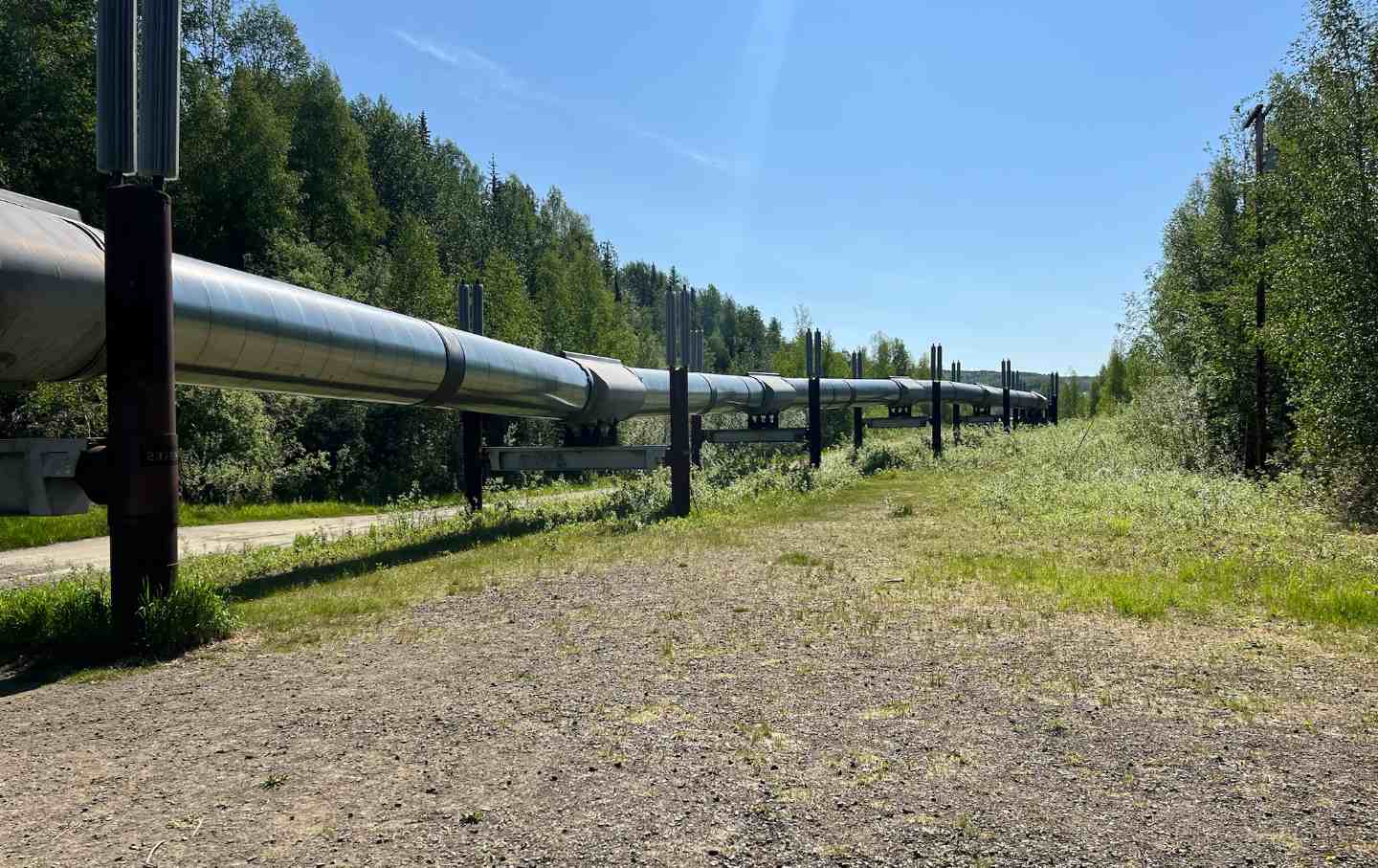
Since the start of the war in Iran, the global economic picture has changed as oil prices have soared. President Trump has promised that the hefty prices are only “short term” and will drop as soon as the war is over, but he has not released a timeline. With the disruption of shipments through the Strait of Hormuz, the Department of Energy has announced the release of 172 million barrels of oil from strategic reserves. The situation echoes the circumstances that gave rise to the Trans-Alaska Pipeline System and may significantly shape the future of Alaska’s liquified natural gas. Glenfarne officials claim that the war has sparked renewed interest in the pipeline, but preliminary deals have yet to become long-term agreements.
During his second term, Trump and his administration have pivoted from promising “energy independence” for Americans to explicitly seeking global “energy supremacy” through exports.
While the Biden administration quietly approved future exports from Alaska LNG, Trump has made it a top priority, even sending a delegation from the National Energy Dominance Council to Alaska in June to promote the agenda. On a visit to the North Slope, Secretary of Energy Chris Wright emphasized the project’s significance to state, national, and global interests. “We can sell energy to our friends and allies so they don’t have to buy it from our adversaries,” he said, “and that’s a key part of President Trump’s energy dominance strategy.”
Larry Persily, who spent five years as the federal coordinator for Alaska Natural Gas Transportation Projects in the Obama administration, dismissed this statement as “political theater.” The current federal government’s strategy, in Persily’s view, is “to announce big things, blame someone else, and if it doesn’t happen, so what? The public will forget.” He added that he believes the state government continues to support the project to keep the Trump administration happy, and to keep the dream of not needing to import natural gas alive.
“The state has put half a billion dollars into it, and it still doesn’t have a project. The economics haven’t changed” said Persily. “None of this crap with Trump changes it,” he added.
Even if the pipeline were built, there are communities along its route who would never reap its benefits. Heidi Schoppenhorst grew up the daughter of a bush pilot in Wiseman, a tiny town through which the TAPS passes, where she currently runs the Boreal Lodge. Schoppenhorst said she would appreciate access to affordable natural gas via a pipeline, as she currently needs to buy propane in the neighboring town of Coldfoot.
But current plans do not include a spur from the pipeline to Wiseman, whose population barely scrapes the double digits. When Schoppenhorst has attended public meetings concerning the project over the years, she has been left unsatisfied. “Will they end up shutting down the road? Will that affect our businesses? There’s those questions related to it, with no benefit,” Schoppenhorst said. “Is this going to be a detriment?”
A Department of Energy official who asked to remain anonymous acknowledged that the pipeline would leave unresolved problems. “While the pipeline may or may not happen—and it’s something that we have been talking about for several decades in the state—we have a lot of remote communities who are not necessarily going to be connected to the pipeline and need continued attention.”
Supporters of the project claim that the pipeline will at least serve the Railbelt. At the Alaska Sustainable Energy Conference in June, a short video introduced the audience to Glenfarne—also a conference sponsor. An ambiguous British male voice boomed, “A vital pipeline from the North Slope to Anchorage must be built to solve Alaska’s looming natural gas shortage.”
Tim Fitzpatrick, who spoke on behalf of AGDC when we spoke in June and now works for Glenfarne, insisted that the project was on track to do so. “We’re going through the steps that we need to go through to get to the finish line,” he said.
But where exactly is that finish line? The Railbelt’s gas shortage may begin in 2027. Governor Mike Dunleavy has claimed that construction on the LNG project could start as soon as 2026, with gas flowing in 2028. In December, Fitzpatrick said that the project would deliver its first gas to Alaskans in 2029. Yet according to a Wood Mackenzie analysis commissioned by AGDC, the pipeline’s first gas would not arrive until 2031. Persily expressed deep doubt that there would be a pipeline bringing gas to Southcentral Alaska by 2028. “The notion that we can have it working in three years is just a fallacy,” he said.
Popular
“swipe left below to view more authors”Swipe →Environmental groups also oppose the pipeline, which could double Alaska’s emissions. Eight young people are suing the project on the grounds of its threat of pollution, and the Center for Biological Diversity has also sued, challenging the biological opinions related to the project. “A massive gas pipeline that would wreak havoc on the climate would be devastating for polar bears on multiple levels and for the critically endangered Cook Inlet beluga whales,” said Cooper Freeman, Center for Biological Diversity’s state director.
There may be other options for the Railbelt. Cason said that the promise of the pipeline has clouded the Chugach Electric Association’s judgement. He mentioned a slew of renewable opportunities which the Railbelt is currently sitting on, including a local wind farm that he said offered to sell Chugach Electric power at under 11 cents per kilowatt-hour. Yet, instead of accepting the wind farm’s offer, the board decided to import and store LNG. “[The gas line] was a distraction that put a damper on any sort of adaptive thinking,” Cason explained. In addition to confidence in the pipeline, wind developers in Alaska have struggled to begin construction before tax credits expire.
Without the promise of the pipeline, Cason expects that there would have been more openness to renewable alternatives. And as long as communities keep betting on a natural gas pipeline, an energy transition will continue to be pushed further down the line, especially as the Trump administration cuts dozens of renewable projects in Alaska since entering office.
Director of the Alaskan Energy Infrastructure project Ariel Hasse-Zamudio, who hails from the Matanuska-Susitna Valley, is no stranger to Alaska’s fossil fuel dependency. “Alaskans are often scared into believing that oil and gas are the only ways to have energy in our homes,” she explained.
Hasse-Zamudio left June’s Sustainable Energy Conference feeling “disgusted” by its energy dominance focus. “They haven’t hidden at all their desire to piecemeal out Alaska for our natural resources,” she said. “They weren’t even answering the question about whether or not Alaskans are going to have the energy they need. They won’t. Not with this pipeline plan.”
Become a Sustaining Donor This September
Between the reemergence of right-wing red-baiting and Donald Trump’s use of the chilling National Security Presidential Memorandum–7 to criminalize left political organizing, we’re seeing McCarthyism reborn before our eyes.
This assault on democracy cannot be ignored or wished away. Resisting it requires bravery in the face of threats and repression, a steadfast commitment to the truth, and the unwavering belief that we can—and will—overcome this darkness.
We must have an independent media that sets the record straight, unearths corruption and abuses of power, and advances a politics of justice and dignity for all if we’re to win this fight.
That’s why I’m writing to you today. This September, The Nation needs to add 100 monthly donors to sustain our progressive journalism. Your contribution makes the next investigative report, the next truth-speaking column, and the next pathbreaking essay all possible.
I hope you’ll support our work with a recurring donation today. If you donate $10 or more a month, we’ll send you a brand new “Hands Off the Free Press!” sticker to recognise your commitment to our cause. Please, donate today.
Onward,
Katrina vanden Heuvel
Editor and Publisher, The Nation
More from The Nation
Zohran Mamdani Hosts the World Zohran Mamdani Hosts the World
In a meeting with mayors from around the globe, Mamdani argued that the left must fix everyday problems—or the right will find someone to scapegoat for them.


Is There Any Good News Left? Is There Any Good News Left?
Despite what our algorithms suggest, there’s still news worth celebrating.

CEOs Are Losing Control of AI CEOs Are Losing Control of AI
With no slowdown from Trump’s administration.

Gina Hinojosa: “We Flip Texas, and It’s Over” Gina Hinojosa: “We Flip Texas, and It’s Over”
Talking to Texas gubernatorial candidate Gina Hinojosa about what redistricting could mean and how a new generation of Democrats is speaking more directly to voters.

Trump Wants to Keep Journalists Out of the White House. He Should Get His Wish. Trump Wants to Keep Journalists Out of the White House. He Should Get His Wish.
The president has banned MS NOW, CNN, and Politico from attending press briefings. The rest of the media should respond with a boycott.

