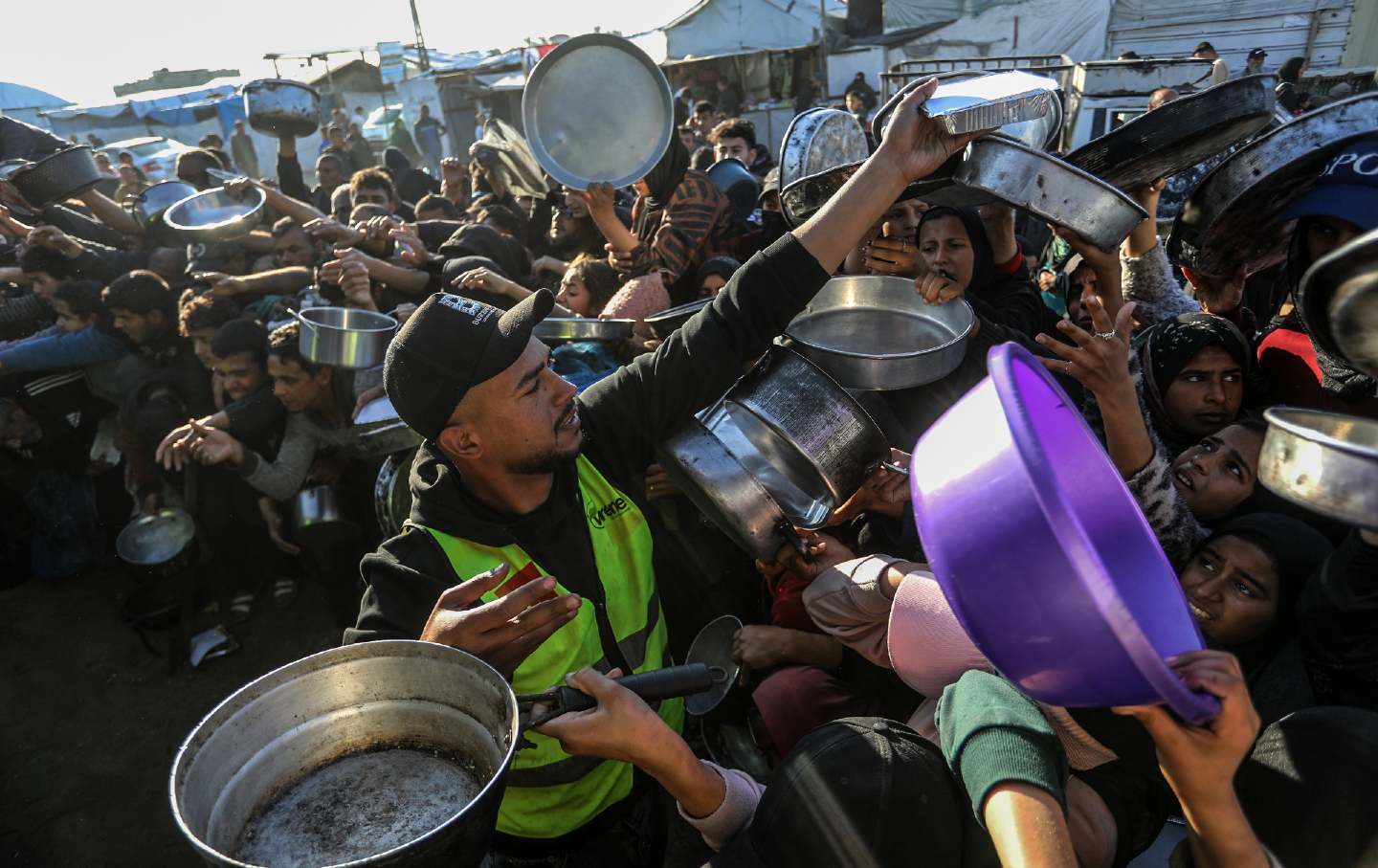
Palestinians, mainly children, wait to get hot food distributed by a charity organization as food shortages continue amid restrictions on the entry of aid.
(Abed Rahim Khatib / Anadolu via Getty Images)“I’m here at the market—come help me, I bought a lot to carry with me.”
With this short message, my father told me on a recent morning that he had decided to go to the market. He knew prices were high, yet he chose to buy more food despite the cost. In Gaza, people don’t always buy food because they need it today—they buy it because they fear it might not be there tomorrow.
The morning was Saturday, February 28, 2026, the same one that international news reported that after Israel, along with the United States, had launched a military strike inside Iran. For much of the world, this probably seemed like a distant crisis, one they could read, even amid their horror, through a political or military lens. But in Gaza, the news was more than a far-off event—it was an early warning of what might come.
In a place that has endured two years of genocide and long years of blockade, any regional escalation is immediately read as a direct threat to daily life. Israel often takes advantage of such moments to tighten its control over Gaza, restrict access to essential goods, and limit movement, making daily life even more precarious for residents, while much of the world and the media remain distracted or unaware of what is happening on the ground.
The signs appeared quickly. Israel sealed off Gaza’s borders—blocking the flow not just of goods but also humanitarian aid. It even shut down travel crossings that allow patients to leave Gaza for urgent medical treatment abroad.
With the closures, fuel and gas trucks—which had only just begun to pick up after the ceasefire required Israel to lift its near-total siege—stopped entering the territory. These supplies are essential for running generators, cooking, and operating some basic facilities. In a place where more than 2 million people live in a small area with high population density, and where daily life depends almost entirely on what enters through these crossings, any closure can quickly become a real crisis—especially during Ramadan, when families need more food and essential goods.
Hours after hearing the news, I went to the market myself.
What I saw there was fear and anxiety. People’s faces were tense as they crowded into shops to buy both essential and nonessential goods in larger quantities than usual. Lines stretched outside the stores, and people moved quickly between the stalls, filling bags with as much as they could.
Meanwhile, prices were already rising.
I first went to the vegetable seller, as it is usually the first to be affected in such circumstances. Just two days earlier, ten kilograms of potatoes had cost around $10. By the time I arrived, the same amount had risen to about $30. And it wasn’t just potatoes—prices for many vegetables and other food items, like flour and sugar, were climbing quickly.
The fear people felt, and their rush, was not based on political analysis—it was grounded in long experience with crises. For nearly 20 years, people in Gaza have lived under a blockade, which Israel tightened to siege levels during the worst days of the genocide. For months, they endured the hardest days of famine, facing death traps at aid distribution points, with thousands killed or injured just to secure a kilo of flour and a basic meal. Some were forced to drink saltwater to survive, while others walked hours to gather a few food for their families.
During that time, food was no longer just a daily need—it became an obsession.
For me, it reached the point where I looked for any way to produce food myself. At one stage, I found myself trying to farm as much as I could—not because I wanted to, but because the idea of not being able to feed my family was terrifying.
This is why, when people hear news of border closures or regional escalation, they do not treat it as distant news—they hear it as a loud, blaring alarm.
Even so, not all families are able to respond to this alarm. Some do not have the money to buy extra, while others have no space to store it in cramped homes or worn-out tents in the middle of winter. Preparation becomes a privilege not everyone can afford.
As 29-year-old Ahmed Asfour explained: “I didn’t have enough money to buy anything because my work had stopped, but I borrowed and bought what I could, fearing the crossings would stay closed and we would return to days of famine.”
As international aid organizations warned that food and medical supplies could run out quickly in Gaza, and that a halt in fuel imports could paralyze essential services, life in the occupied West Bank took its own dire turn. Once the US and Israeli bombs began dropping on Iran, Israel closed all checkpoints between cities, isolating Palestinians from each other and forcing them onto circuitous routes to reach their homes. The occupation also banned access to the Al-Aqsa Mosque in Jerusalem and the Ibrahimi Mosque in Hebron for several consecutive days during Ramadan—a historically unprecedented measure.
In Gaza, the question is: Will I find food today? In the West Bank, it is: Can I reach my home, my mosque? For Palestinians, any regional tension quickly turns into tangible restrictions on daily life—through crossings in Gaza or checkpoints in the West Bank—amid ongoing violations and pressures on the population.
Popular
“swipe left below to view more authors”Swipe →Dr. Ismail al-Thawabta, a humanitarian expert, warned that the closures constitute a form of collective punishment prohibited under international humanitarian law, particularly the Fourth Geneva Convention. “The ongoing closure of the Rafah crossing and its severe humanitarian consequences constitute a legal and moral responsibility of the occupying authorities and demands accountability under established international mechanisms,” he explained.
In recent days, the Israeli occupation partially reopened the Rafah crossing, but Thawabta noted that concerns remain about the speed and volume of incoming supplies and whether this gradual process will be enough to stabilize the markets. Thus far, the flow of supplies remains severely limited. Many essential goods, including cooking gas, chicken, and other basic food items, have disappeared from the markets, forcing people to return to cooking over wood fires, a hardship they had recently tried to move away from, especially during this month of Ramadan.
And so, in Gaza, the fear remains. Here, geopolitics is not measured by rockets or maps of influence. It is measured by the price of bread, the number of days food will last, and the simple, recurring question: Will the crossing open tomorrow?
That is why a rocket does not need to fall in Gaza for its shadow to be felt. Even before a war officially begins, and before Gaza is mentioned in any formal statement, the impact of escalation has already started. In Palestine, the war abroad is always felt at home.
Become a Sustaining Donor This September
Between the reemergence of right-wing red-baiting and Donald Trump’s use of the chilling National Security Presidential Memorandum–7 to criminalize left political organizing, we’re seeing McCarthyism reborn before our eyes.
This assault on democracy cannot be ignored or wished away. Resisting it requires bravery in the face of threats and repression, a steadfast commitment to the truth, and the unwavering belief that we can—and will—overcome this darkness.
We must have an independent media that sets the record straight, unearths corruption and abuses of power, and advances a politics of justice and dignity for all if we’re to win this fight.
That’s why I’m writing to you today. This September, The Nation needs to add 100 monthly donors to sustain our progressive journalism. Your contribution makes the next investigative report, the next truth-speaking column, and the next pathbreaking essay all possible.
I hope you’ll support our work with a recurring donation today. If you donate $10 or more a month, we’ll send you a brand new “Hands Off the Free Press!” sticker to recognise your commitment to our cause. Please, donate today.
Onward,
Katrina vanden Heuvel
Editor and Publisher, The Nation