
Rubio, Rodeo, and Tall Tales of Empire
The secretary of state has provoked the ire of Britain’s first black woman lawmaker and put the spotlight once again on how the US has historically treated people of his own heritage.
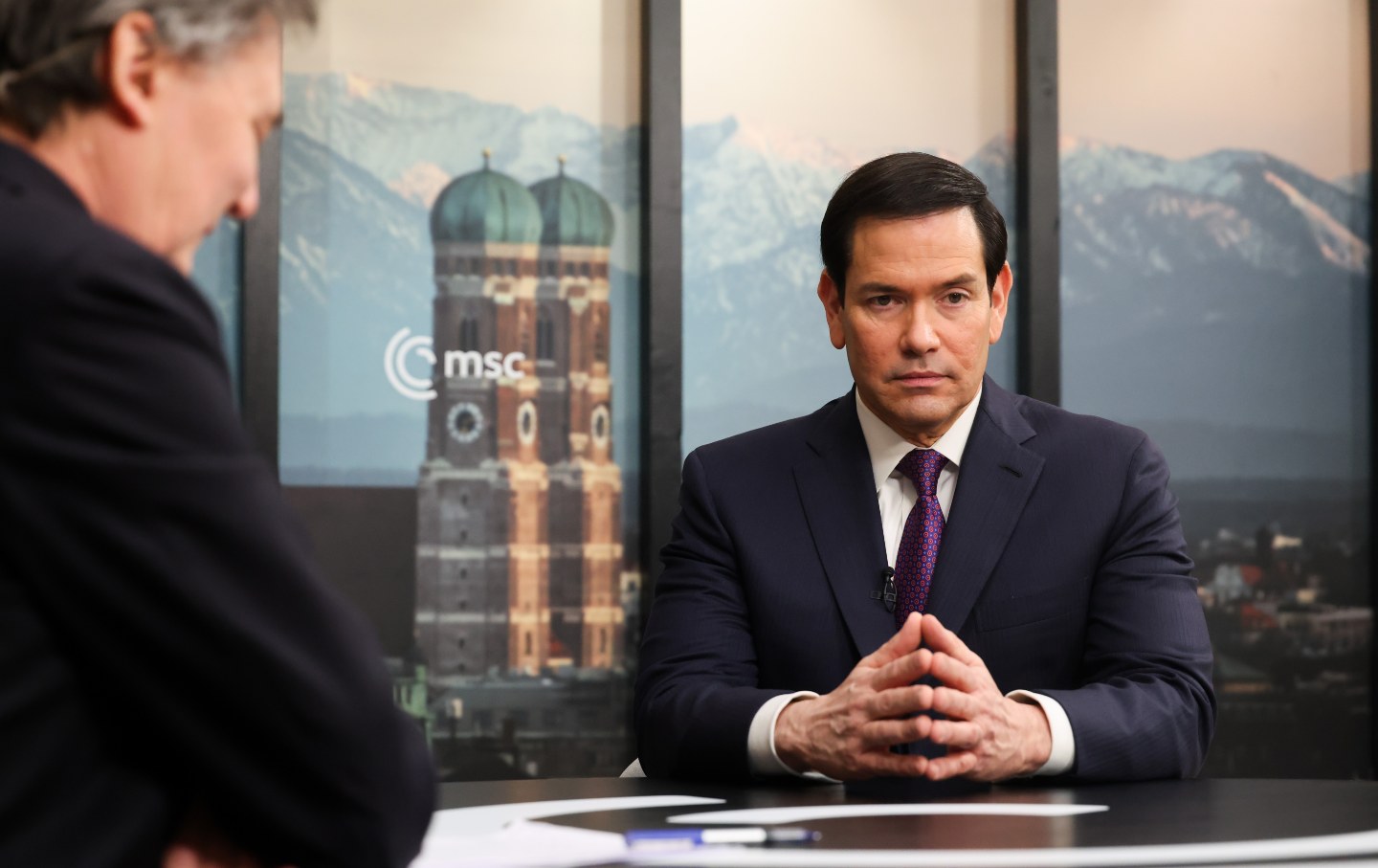
From claiming the mantle of McKinley to issuing a “corollary” to the Monroe Doctrine, the Trump administration has never been bashful about asserting what it perceives as its place in history. Marco Rubio took this to a new level recently with an assertion at a security conference in Munich that the US and Europe are engaged in an existential battle with “the forces of civilizational erasure.”
Reinforcing this message last week, the State Department posted a photograph of Rubio on X with the message: “The United States and Europe belong to a civilization that stretches over continents, crossed over oceans, and persisted for thousands of years: from Athens to Rome to America. Western Civilization must embrace its noble legacy if it is to reverse its decline.”
This drew a sharp rebuke from Britain’s first black woman lawmaker. Diane Abbott, who holds the title Mother of the House as the longest-serving female member of Parliament, accused Rubio of “trying to forge a white supremacist version of human history” and said: “Language was first spoken in Africa. Language was first written in West Asia. Mathematics originated in Africa, so too the first translation. The first 2-storey building was also in built in Asia.”
In his Munich speech, Rubio had described colonialism as “a great civilization” that had sent “its missionaries, its pilgrims, its soldiers, its explorers pouring out from its shores to cross oceans, settle new continents, build vast empires extending out across the globe.” To resounding applause, he told European leaders that America would always be “a child of Europe” and then illustrated this with a curious collection of examples.
Credited in turn were the Italians for Christianity, the English for their language and political and legal system, the Germans for farming and beer, the French for exploring the North American interior, and the Scots-Irish for Davy Crocket, Teddy Roosevelt, Neil Armstrong, and Mark Twain (evidently, overlooking the latter’s opposition to imperialism).
Predictably, of course, there was no place in this fairy tale for Indigenous nations who had been ethnically cleansed to make way for colonization. Nor was there any mention of the 7.9 million people whose slave labour created the wealth of King Cotton and whose notional freedom required a civil war in which around a million Americans died.
But what about Spain? Rubio could not credibly omit his own heritage from the story, especially as the Mediterranean members of NATO are as important geopolitically as the Anglo-Saxon ones. Spain, he said without apparent irony, was responsible for “our horses, our ranches, our rodeos—the entire romance of the cowboy archetype that became synonymous with the American West.” And, for good measure, he added that his own European ancestors would never have imagined that “one of their direct descendants would be back here today on this continent as the chief diplomat of that infant nation.”
This hackneyed allusion to the American Dream begs examination of the actual history. From the outset, the architects of empire viewed Spanish Americans as inferior and institutionalized their second-class status. When the United States expanded westward, it treated the land it conquered as “incorporated territories” eligible to become “states,” but only once there were enough Anglo-Saxon settlers to outnumber both Indigenous inhabitants and, in the Southwest, the Mexicans from whom the land was taken in 1848. This meant that Arizona and New Mexico were not admitted to the Union until 1912.
However, while incorporated territories were destined for statehood once the right ethnic mix was eventually achieved, the colonies seized directly from Spain in 1898 were a different matter. When the Philippines, Cuba, Guam, and Puerto Rico became US possessions, there was much debate about what to do with them. Cuba was allowed nominal independence, but with the US retaining—to this day—45 square miles for a military base at Guantánamo. Filipinos mounted fierce resistance that was crushed by US forces in what one senator described as “a foul blot on the flag,” but they eventually gained independence in 1946. Guam and Puerto Rico were, meanwhile, retained as US possessions for their geopolitical value in the Pacific and Caribbean respectively, prompting the need to resolve what their legal status should be.
The solution of giving these outposts “unincorporated” status was proposed by Abbott Lawrence Lowell in an article for The Atlantic Monthly in February 1899. The Harvard law professor advanced the thesis that persons’ being created equal is “quite a different matter” from their being equal politically. While “the Anglo-Saxon race was prepared for [political equality] by centuries of discipline under the supremacy of law,” he claimed that “the Spanish race” had not acquired “the habits of self-government.” Puerto Ricans, he continued, “must be trained for it, as our forefathers were trained, beginning with local government under a strong judicial system, and the process will necessarily be slow.”
Puerto Rico’s unincorporated status was legally formalized in 1901 when the Supreme Court decided that oranges imported from the island into the United States should be subject to duty because “neither military occupation nor cession by treaty makes the conquered territory domestic territory in the sense of the revenue laws.” In the words of Justice Edward Douglass White, Puerto Rico was “foreign to the United States in a domestic sense” because it was unincorporated and therefore “merely appurtenant thereto as a possession.”
This judgment continues to underpin Puerto Rico’s status. It was not altered by giving Puerto Ricans US citizenship in 1917, conveniently making them eligible for conscription. It was camouflaged in 1952 where—to quash accusations of colonialism at the United Nations—Congress gave the island limited self-government. And it was exposed as a sham when Washington imposed direct rule in 2016 after a debt crisis that even a US city would have been allowed to manage independently by filing for bankruptcy protection.
Popular
“swipe left below to view more authors”Swipe →The hostility from some quarters toward Bad Bunny’s appearance at the Super Bowl brought to the fore confusion that was bound to arise from the idea that a place can be owned by the US but not part of it. Attitudes have changed little since Lawrence Lowell’s day: Puerto Ricans are OK as fodder for war or for their land’s military value, but they are un-American when they assert their cultural identity. It is no wonder that more and more of them are now demanding political equality through self-determination.
Rubio’s attributing ranches and rodeo to his ancestors was quaint, and might go down well with some European politicians clutching at Atlanticist straws, but having someone of Hispanic heritage at the center of US power does not make it any less a racist endeavour. As another Harvard professor, Samuel P Huntington, put it in 2004: “There is no Americano dream. There is only the American dream created by an Anglo-Protestant society. Mexican Americans will share in that dream and in that society only if they dream in English.”
More from The Nation
Israel’s Extremist Election Israel’s Extremist Election
The run-up to the vote on Tuesday is exposing the façade of Israeli democracy—and the fealty of the country's so-called opposition when it comes to matters of Jewish supremacy.
“NAZA” and Israel’s History of Automated Warfare “NAZA” and Israel’s History of Automated Warfare
As violent technologies like spyware, predictive targeting algorithms, and 2,000-pound warheads become ordinary instruments of military rule, once-abhorred practices become routin...

Brazil’s Workers’ Party Is Not Stopping Brazil’s Workers’ Party Is Not Stopping
With just a few days remaining before the runoff election, supporters of Lula’s party are doing everything possible to rally support behind the president.
Brazil’s Decision Brazil’s Decision
The moral compass and basic humanity of political leaders really does matter.
Albanian Student Strikes Spur a Political Crisis Albanian Student Strikes Spur a Political Crisis
A new round of protests against the ruling party’s corruption has Prime Minister Edi Rama giving cops bonuses to crack down on dissent.

