JD Vance: A Prisoner of the Caucasus
The vice president’s trip adds fuel to regional fires.
If there is one characteristic that defines the erratic and incoherent “Donroe Doctrine” of President Trump, then it must be the principle that “might makes right” in international politics. The Trump administration has little need for international law. It is willfully and blatantly disregarded and, indeed, discarded. Instead, from Greenland to Gaza, from Venezuela to Iran, the “law of the jungle” reigns supreme.
The essence of the “Donroe Doctrine” can be observed in the administration’s approach to both war and peace. An example of the latter is what occurred earlier this week when Vice President JD Vance flew to the Caucasus in a bid to bolster American influence and pressure on Iran’s northern frontier, at a time when tension between Washington and Tehran has never been higher. Amid profound domestic crises in the US, it would seem prudent to avoid dragging America into such far-flung adventurism, in a part of the world that is virtually unknown to most Americans. Yet there was Vance, stoking tensions with a large regional power—Iran—and a massive atomic superpower—Russia—all while quietly sanctioning democratic decline and ethnic cleansing in the post-Soviet Caucasus.
Vance’s Caucasian itinerary consisted of two of the three South Caucasus states—Armenia and Azerbaijan. Georgia, once the favorite of American neocons, was conspicuously avoided. In 2008, its president, Mikheil Saakashvili, had bungled his way into a confrontation with Russia at the behest of the Bush administration. Facing a bear-like reaction from Moscow, Tbilisi was left in the lurch by Washington. While Georgia has since learned from this painful episode, Armenia’s Nikol Pashinyan and Azerbaijan’s Ilham Aliyev have decided to try their luck at the “Saakashvili” approach, with ample encouragement from President Trump. It is at their own peril that they ignore the clear warnings from Russia and Iran against any American presence on their borders.
Vance arrived first in Armenia, flying into Yerevan from Milan on a rainy Monday afternoon. A major part of his visit was to reinforce American commitment to the Trump Route for International Peace and Prosperity (TRIPP). Hailed by the Trump administration as a “historic” project to bring peace to the region, the known details of this initiative indicate that it is more likely to bring war than peace. TRIPP involves Armenia effectively relinquishing control of its crucial southern border with Iran to a joint US-Armenia company (with the US holding a 74 percent stake) for a period of 49 to 99 years.
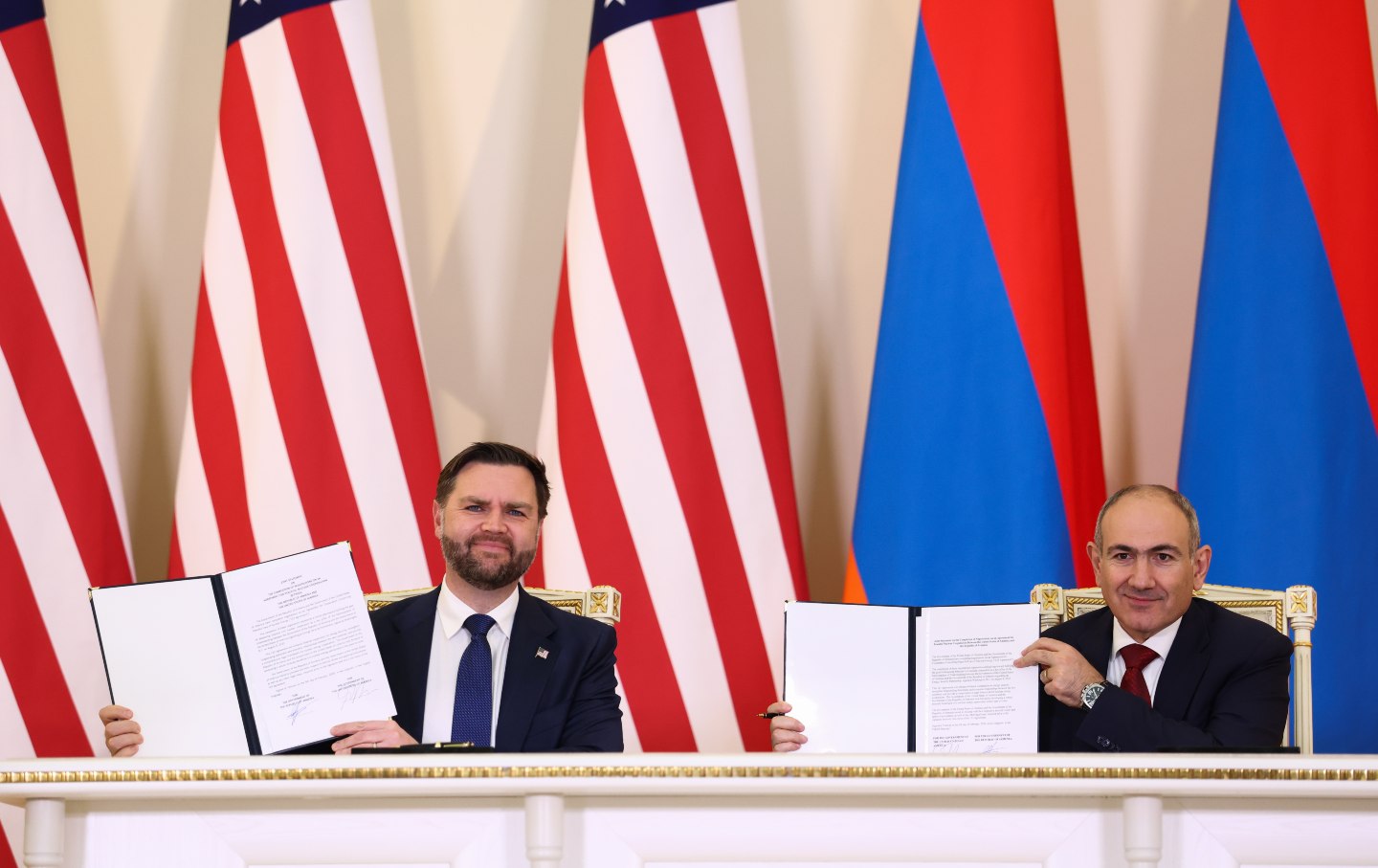
Naturally, any plan to establish a long-term US or NATO presence on Iranian and Russian frontiers is bound to raise alarms in Moscow and Tehran. Yet in Yerevan Vance not only brushed aside such concerns but even pledged to export $9 billion in the sphere of civil nuclear cooperation, in remarks that raised more questions than answers in Armenia. Observers of the vice president’s press conference with Pashinyan were treated to a stream of empty platitudes of “peace,” even though only a declaration of intent has been signed between Armenia and Azerbaijan. Indeed, despite Pashinyan’s confident assertion that peace had been definitively established between Baku and Yerevan under President Trump, the fact remains that a formal peace agreement has never been inked between the parties. Meanwhile, Azerbaijan continues to advance territorial claims on Armenia.
Vance failed to utter a single peep about Pashinyan’s abuses in office. Despite being catapulted to power in 2018 on proclaimed promises of political reform, Pashinyan instead embarked on a course of de-democratization. Under his neoliberal administration, poverty and inequality have worsened and corruption has flourished. Freedom of speech has come under assault, leaving Armenia with one of the highest pre-trial detention rates in Europe. The democratic right of the Armenians of Artsakh (Nagorno-Karabakh) to self-determination—the cornerstone of Armenia’s 1988 Karabakh movement—was betrayed by the PM to the whims of an aggressive Azerbaijan. Even the Armenian Apostolic Church, the country’s foremost religious institution with roots extending back to the time of Christ, has not been spared Pashinyan’s wrath. Despite widespread public trust in the church, Pashinyan’s government has arrested an Armenian bishop and three Armenian archbishops, including the beloved Archbishop Mikael Ajapahyan. Samvel Karapetyan, a prominent supporter of the church, has also been arrested. Even the patriarch of the church—Catholicos Karekin II—has come under attack.
Unsurprisingly, Vance was mum on the sorry state of Armenian democracy. Instead, he took a page from the playbook of Walter Duranty and openly endorsed Pashinyan, emphatically stressing the government’s commitment to “markets” and “prosperity.” “All too predictably, the allegedly devout, pious, believing Catholic US vice president whispered not a word of protest against Pashinyan’s jailing of clergy of the Armenian Apostolic Church,” noted James Carden, a former State Department adviser for the Obama administration. “Instead, these and other unjustly imprisoned will be sacrificed on the altar of TRIPP—none of which redounds to the interests of the Armenian or American people.” Even the most potentially redeeming element of Vance’s trip to Armenia—his visit to the Armenian Genocide monument at Tsitsernakaberd in Yerevan—was marred by controversy. Vance, who was accompanied only by his wife, Usha, and not by Pashinyan, laid flowers at the monument’s eternal flame and posted about it on Twitter/X, only to delete the post soon after, out of fear of offending NATO member Turkey.
While in Baku, Vance met with Azerbaijani President Ilham Aliyev and inked a strategic partnership agreement with him. “For us, it’s a great honor to be a strategic partner to the most powerful country of the world—[the] United States of America,” Aliyev underscored in his press conference with Vance. The Azerbaijani president likewise boasted of “cooperation in defense sales” with the US, a remark likely to be viewed critically in Tehran, given fears of Israeli use of Azerbaijan as a potential “forward base” against northern Iran. For his part, Vance praised Aliyev, noting that “other than President Trump, the only leader in the world that has really good relations with both the Turks and the Israelis is President Aliyev.”
As in Yerevan, Vance sidestepped the “inconvenient” matter of Baku’s democracy deficit, alluding only to the atrocious state of affairs when referencing the fact that Aliyev’s wife, Mehriban, now absurdly serves as the country’s vice president. “Hopefully that doesn’t give the [US] second lady any ideas,” remarked Vance, in a joke censored by Azerbaijani state television. Nothing was mentioned about Azerbaijan’s pervasive problem with political prisoners and dissidents, such as Bahruz Samadov and Igbal Abilov, to say nothing of the 19 Armenian prisoners languishing in Baku’s jails, such as Ruben Vardanyan. Behind closed doors, Vance reportedly raised the issue of the latter group to Aliyev, but Aliyev’s response is unknown. The vice president did praise Azerbaijan’s army for having “some of the toughest and fiercest troops anywhere in the world,” although he failed to mention that this same army had ethnically cleansed the indigenous Christian Armenian population of Artsakh in September 2023.
Naturally, the Vance visit failed to impress Moscow or Tehran and, by any objective measure, has only succeeded in antagonizing the two Eurasian giants. As Russian Foreign Minister Sergey Lavrov warns that US-Russian relations are “moving in the wrong direction,” the clouds of war continue to gather over Iran. Thus, rather than promoting “peace,” the Vance tour of the Caucasus will only add fuel to the fire of regional tension, signaling a continuation of the reckless interventionism that has come to define US foreign policy in the post–Cold War era.