
Bad Bunny’s Stunning Redefinition of “America”
His joyous, internationalist, worker-centered vision was a declaration of war against Trumpism.
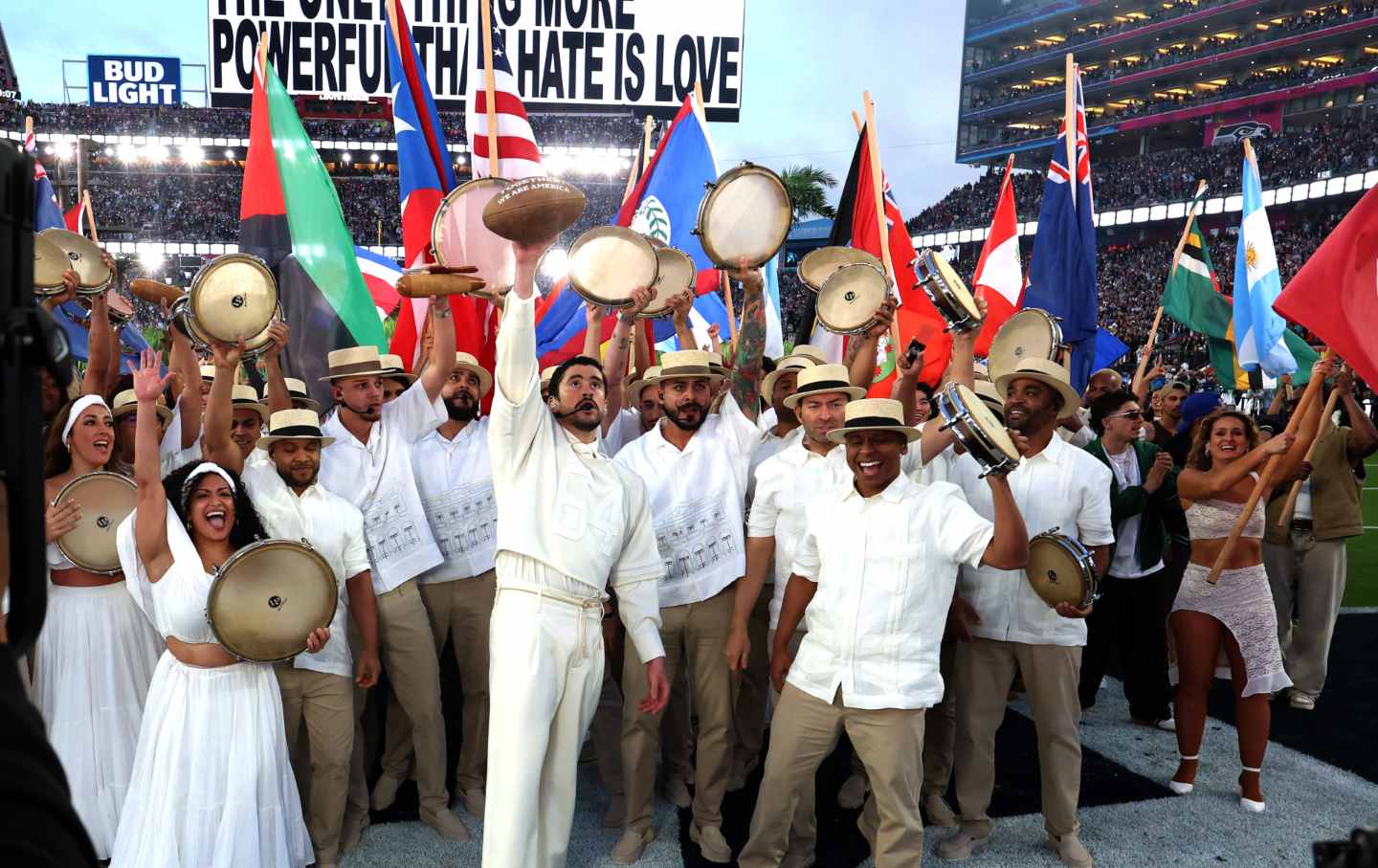
Bad Bunny performs onstage during the Apple Music Super Bowl LX Halftime Show at Levi’s Stadium on February 8, 2026. in Santa Clara, California.
(Kevin Mazur / Getty Images for Roc Nation)An estimated 135 million viewers in the United States watched Benito Antonio Martínez Ocasio, aka Bad Bunny, perform live at the Super Bowl halftime show on Sunday. Many millions more all over the world later caught the show online. What they saw was a stunning redefinition of what it means to be an American.
It took about five seconds to realize this was no ordinary halftime show. And another 30 for Bad Bunny to overrun the trench work of the US culture war, and the schisms of race, gender, class, and sexuality so easily manipulated both by MAGA nationalists and bad-faith centrists. He showed all kinds of people working and playing, creating a universal joy that excluded none.
Bad Bunny jammed over a century of history into his 13-minute performance. He started where all good history should: with labor, walking through a sugar plantation set as workers cut the cane that, over the decades, has generated incalculable profits, mostly channeled to Europe and the United States from the Caribbean, including Bad Bunny’s Puerto Rican homeland. And even as the show moved on to other themes—and the other performers, Lady Gaga and Ricky Martin—the sugar cane remained, surrounding scenes of urban streets, Puerto Rican casitas, Bronx bodegas, and those ubiquitous cheap plastic chairs. The whole extravaganza—its monumental scale, cultural storytelling, and celebration of hard-working men and women—seemed like a WPA mural jolted alive by the rhythm of perreo.
That Bad Bunny sang mostly in reggaeton Spanish was an unabashedly defiant act. But most of the show’s politics, however obvious to some, was largely muted by the lush pageantry. Was the woman in the couple who married on stage pregnant? If so, was this a symbolic thumbing of the nose atTrump’s efforts to end birthright citizenship? (We’ll have this baby right here on the 50-yard-line, and it will be American and a US citizen!) Similarly, when Bad Bunny gave a Grammy he recently won to a young boy, viewers immediately speculated that the boy was Liam Conejo Ramos, the 5-year-old seized by ICE in Minneapolis. He wasn’t, but the point felt clear: He could have been; according to The Guardian, ICE has captured roughly 3,800 minors between January and October 2025.
And the sexualized twerking dancers and stereotypical Latin lovers who filled the Super Bowl stage are subverted in Bad Bunny’s lyrics. His second number, “Yo Perreo Sola,” asserts the right of women to dance alone without being hassled by “creeps,” a demand made even clearer in the song’s video.
The dance songs gave way to Ricky Martin—who, as a gay Puerto Rican, is both a symbol of Latino and LGBTQ pride and a rejoinder to Trump’s bigotry—singing a snippet of Bad Bunny’s ballad “Lo Que Pasó a Hawaii.” Only if you understand Spanish or are familiar with Bad Bunny’s discography would you catch that “Lo Que Pasó a Hawaii” links US colonialism in the Caribbean and the Pacific—all the more apt given that Puerto Rico and Hawaii were formally seized by the United States in the same year, 1898.
The song’s subtext is that Martínez Ocasio is a nationalist—he wants his island home to be a free nation, fearing that statehood would bring a new wave of dispossession and late-capitalist overlord colonialism, and would do to Puerto Rico what it did to Hawaii: seizing the best lands, closing access to the sea, turning Puerto Ricans into the servants of the world’s billionaires. “They want the river and beach too,” he sings.
Later in the show, Bad Bunny held up not the official Puerto Rican flag but the lighter-blue flag of the island-nation’s independence movement. Only a minority of Puerto Ricans, for now, say they are in favor of independence—but let’s take a poll after a few more shows like this, and a few more years of US disintegration.
Then it was back to reggaeton, with “El Apagón”—“The Blackout”—whose protest lies mostly in its attitude and a music video that provides a civics lesson on how the privatization of electricity has led to exploding electric plants, fires, and blackouts. Here, dancers dressed as linemen climbed up and down electric poles as wires sparked, fuses blew, and the power of Bad Bunny, to entertain and educate, surged. Playing this song now also invokes Trump’s blockade of oil to Cuba, which will soon leave that nation—historically considered Puerto Rico’s sister island (compare the flags)—in the dark.
One way to consider the importance of Bad Bunny’s halftime extravaganza is to place it in relation to another global sensation from a son of Puerto Rico: Lin-Manuel Miranda’s Hamilton. That play, coming in the last years of Obama’s restoration of the neoliberal order, was hailed for celebrating diversity—a vision of multicultural harmony that many thought, even as Trump lurked in the wings, had gained a permanent place in US culture. Then came Trumpism, which turned Hamilton into an autumnal yearning for a nation that could have been.
In contrast to Miranda’s inadvertent elegy for the Obama era, Bad Bunny is not mourning. He’s fighting. His vision of multiculturalism, as mentioned above, is founded on labor, and, by implication, a demand for a more equitable distribution of the wealth it produces. If Hamilton was a paean to an idealized version of America, Bad Bunny’s narrative effectively declared war against the America that actually exists under Trump—as well as the deeper currents that made Trumpism possible.
And Martínez Ocasio is waging that war by celebrating America in its broadest sense, reminding his massive audience that what makes the United States “exceptional” isn’t its sense of singular uniqueness but that it shares a hemisphere with hundreds of millions of other people who also are Americanos. This vision, of nationalism not as hunkering down but opening up to the world, was on full display in the halftime show’s raucous finale, where, after yelling out “God Bless América,” Bad Bunny loudly roll called all the nations of the Western Hemisphere (including Canada, which really doesn’t really consider itself “American”…), spiked the football, and led his fellow performers off the field in victory.
America, América, a book I published last year, argues that, at its best, Latin America knows how to reconcile nationalism and internationalism, diversity and universalism. Other countries dealing with the dire consequences of corporate globalization and US militarism (which produced tens of millions of refugees) have retreated into a nasty, authoritarian, or tribal nationalism, like the United States, but also India, Turkey, Israel, Hungary, and Russia.
Latin American nations mostly haven’t. Their reaction to corporate globalization is rarely expressed in xenophobic, antisemitic, or conspiratorial tropes about a struggle against “globalists.” True, the region isn’t immune to the world’s new demonology of the desperate millions on the move, and in some countries, there does exist, ominously creeping anti-migrant xenophobia.
Still, for many in Latin America, among the most peaceful continents in the world in terms of state-to-state relations, nationalism is a gateway not toward tribalism but universalism.
Cultural displays of defiance only go so far. Even as Bad Bunny sings songs of solidarity, Venezuela has been turned into an informal colony, ICE is still terrorizing Americans, and the White House is threatening to starve Cubans to death if they don’t submit. But this performance still seemed consequential. It had energy, it wasn’t self-satisfied, and I think it’s safe to say that Martínez Ocasio knows the fight isn’t just representational. It’s political and economic. At the very least, he routed MAGA with sheer numbers and happier music.
Popular
“swipe left below to view more authors”Swipe →And it is a fully American fight. Trumpism needs to be defeated at home and abroad. Right now, Latin American nations waver between two opposing currents. The first is an acceptance of the servility demanded by Trump, reinforced by a punitive rational-choice diplomacy: submit or die. The other sees a stirring of the kind of historic anti-interventionism and pro-sovereignty activism that Latin America, in the past, was famous for. Let’s hope Bad Bunny’s audacious halftime show reinforces the second.
More from The Nation

What’s It Like Inside a Data Center? What’s It Like Inside a Data Center?
Northern Virginia is laden with structures that house data for Fortune 500 companies. I went inside just one of those monstrosities that bothers its neighbors.
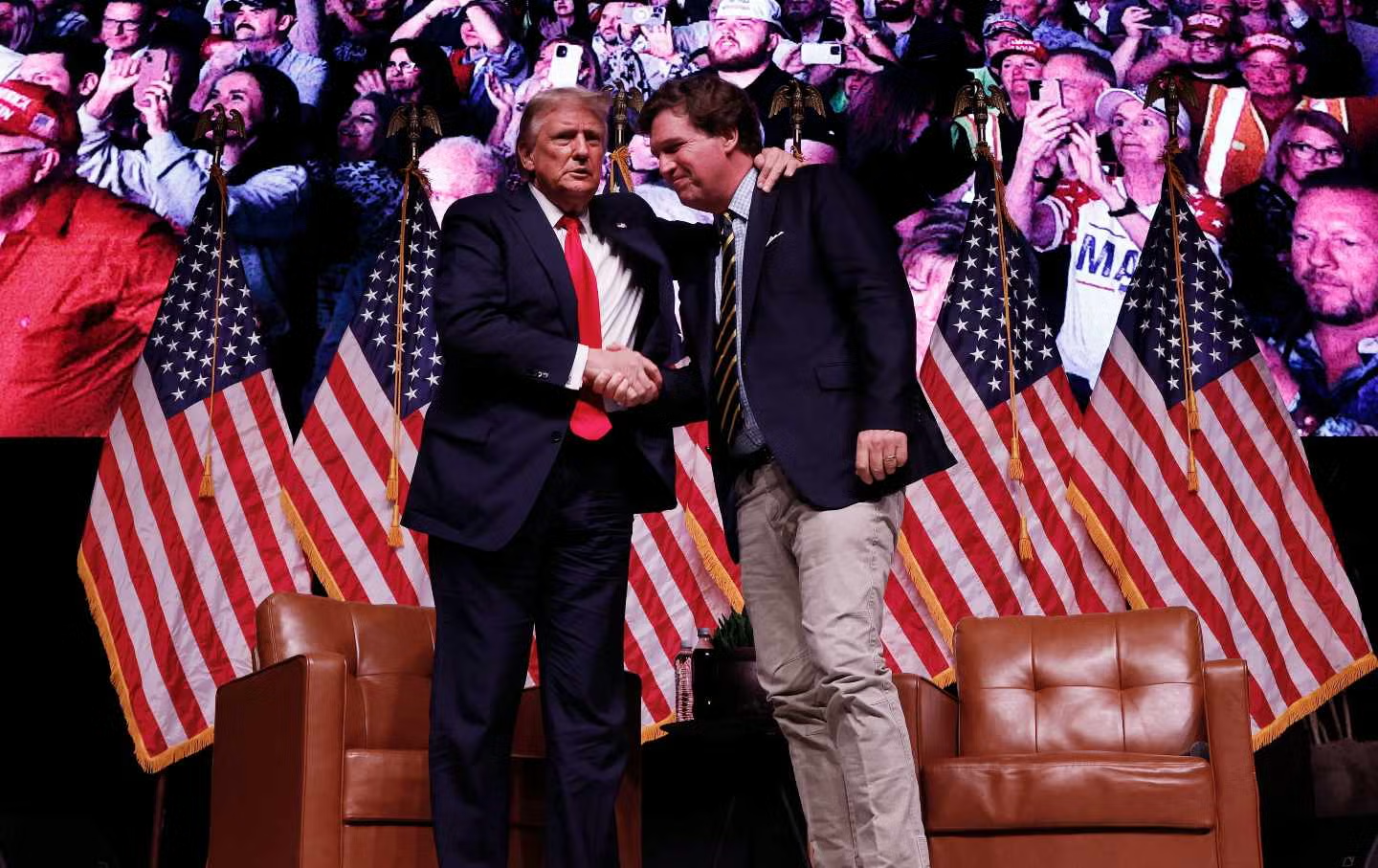
What Trump and Tucker Carlson Have in Common What Trump and Tucker Carlson Have in Common
Carlson has broken with Trump largely over the war in Iran. But on Ukraine and immigration, the two speak very much the same language.

The Jewish Case Against AI The Jewish Case Against AI
Haredi rabbis and the secular left agree: This technology is a threat to the entire social fabric.
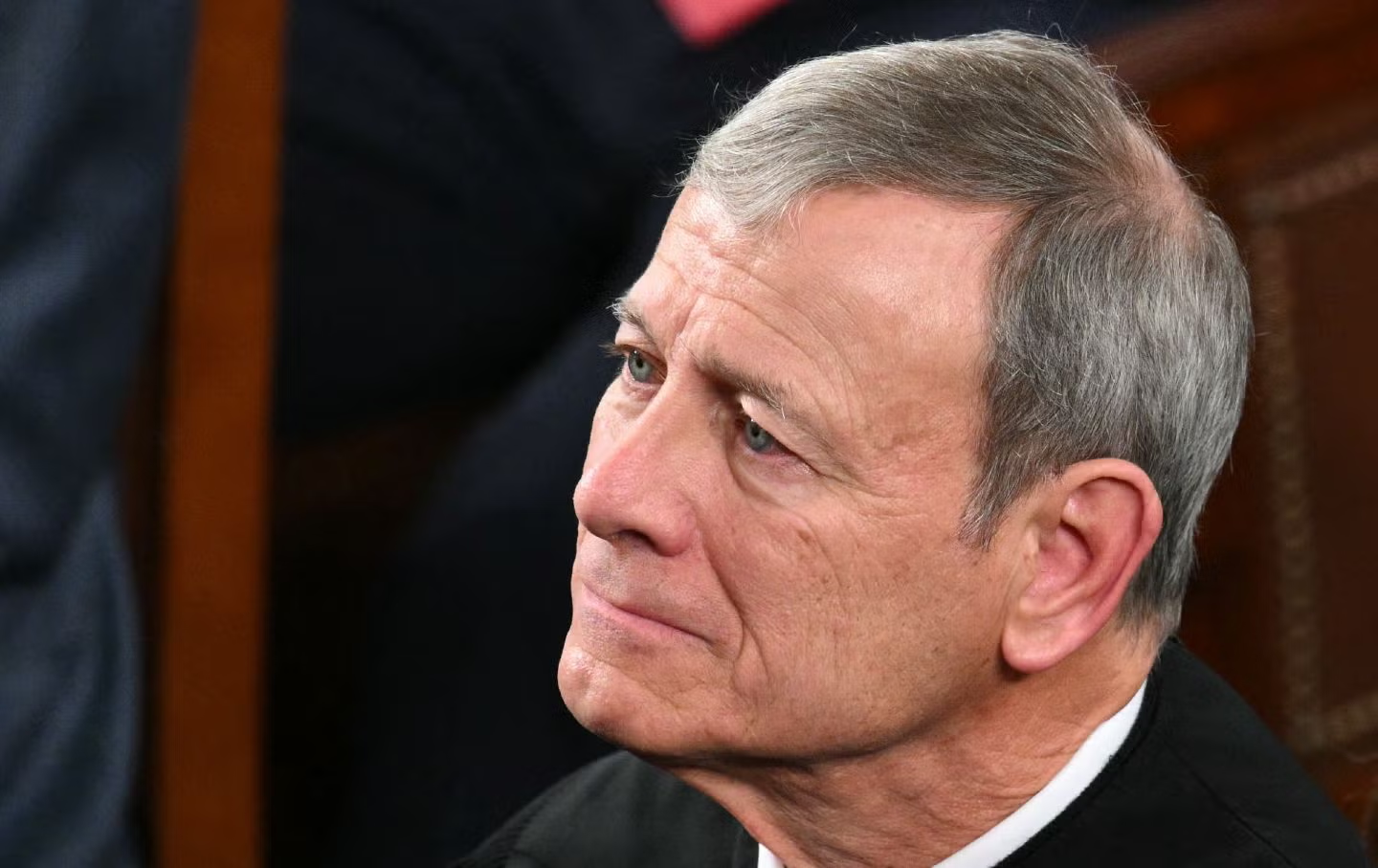
The Fight for Educational Equality Is Also a Fight for a Just Supreme Court The Fight for Educational Equality Is Also a Fight for a Just Supreme Court
The court has severely weakened our ability to make an education system that fulfills the promise of Brown.
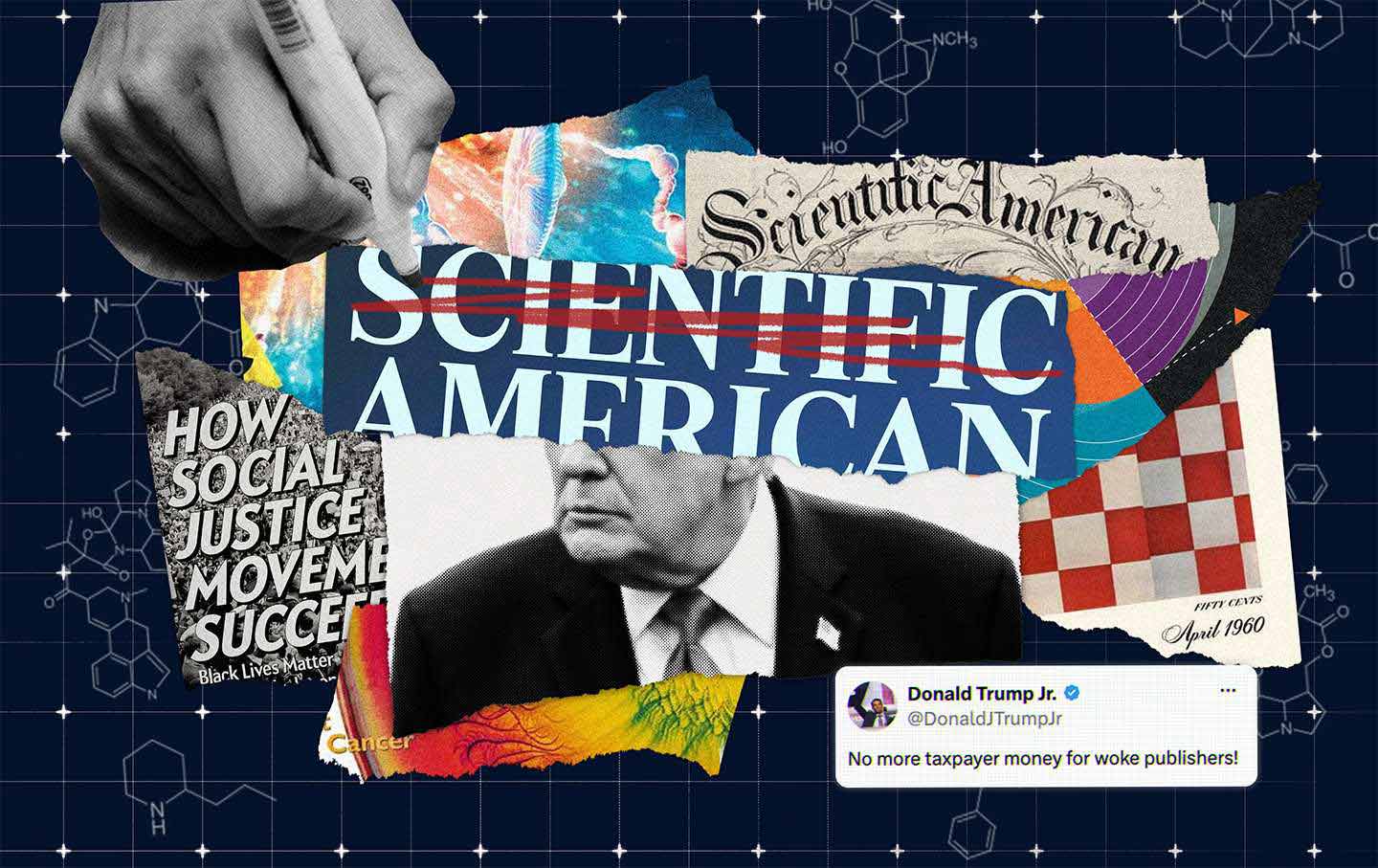
The Fall of “Scientific American” The Fall of “Scientific American”
When the beloved science publication got too political, its corporate owners stepped in. Now its future is uncertain.
The Bookstore Revolution in Taiwan’s Conservative Heartlands The Bookstore Revolution in Taiwan’s Conservative Heartlands
After Taiwan legalized same-sex marriage, gender-themed bookstores are working to build the social acceptance that the law alone couldn’t deliver.

