
Childcare Providers Around the Country Are Being Targeted by Vigilante Surveillance
In response to bogus allegations of fraud in Minnesota, strangers are filming them, knocking on their doors, demanding to be let in. It’s scaring parents and costing providers.
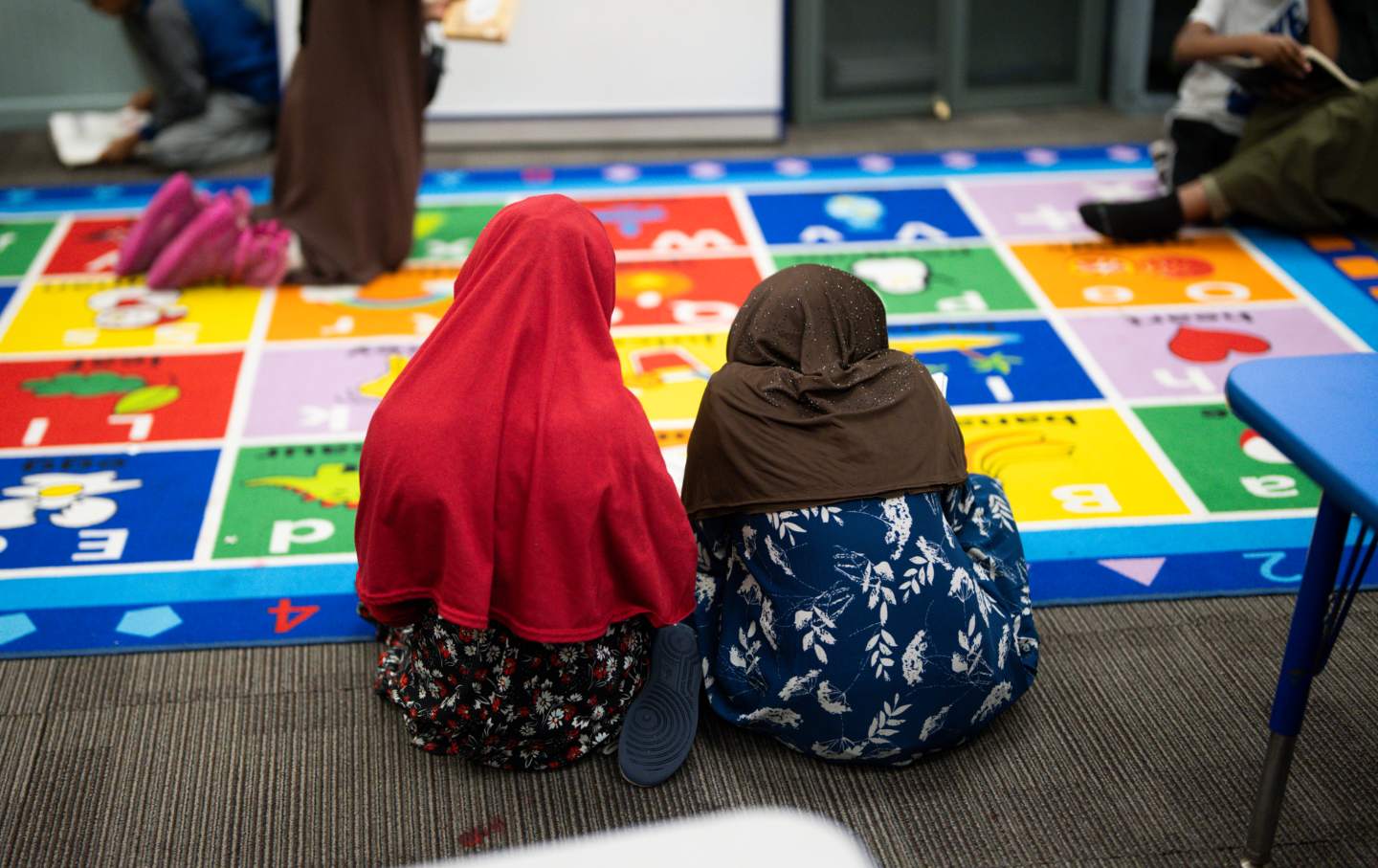
Children read at ABC Learning Center Inc. in Minneapolis, Minnesota, on Tuesday, December 30, 2025. A viral video showed a YouTubers knocking on doors of Somali run daycares and claiming there were no children there, accusing the owners of defrauding the state. This daycare was featured in the video but did not allow the Youtuber in to the building.
(Renee Jones Schneider / The Minnesota Star Tribune via Getty Images)As a woman originally from Somalia who runs a childcare business out of her home in California, Safiyo Jama found herself the target of harassment late last year. Shortly after right-wing YouTuber Nick Shirley posted a now-viral video claiming to show, without any actual evidence, that daycares run by Somali Americans in Minnesota were fraudulently receiving federal funding, Jama started getting harassing phone calls and online messages. Shirley had shown up at daycares that he claimed were closed or didn’t have any children inside, although investigators have debunked those claims, and President Trump elevated his allegations, which led not only to his administration’s attempting to freeze federal funding to Minnesota and other states but launching the current ICE occupation of the state. Trump has called Somali immigrants “garbage.”
Jama’s daycare operates 2,000 miles away in San Diego, but it caught the eye of others who seem to have taken inspiration from Shirley. A man called Jama at the start of the year saying he wanted to enroll his son in her care, but when Jama responded that she didn’t have any open spots and would have to put him on a waiting list, he demanded to come immediately and “see some of the kids,” she said. She hung up, but he texted her saying he and his son were coming to her home, and when she responded again that she didn’t have capacity he sent her back an image of an eye and a photo of someone in handcuffs. It has been “stressful, harmful, and deeply discouraging,” she said. “No one should be harassed for trying to earn a hard, honest living.”
Then a middle-aged white man in camo pants and an LA Dodgers baseball cap showed up outside her home taking video of her and her neighbor, who is also a childcare provider. “We don’t know where he’s coming from, who’s sending him,” Jama recalled. In the video Jama took of the incident, which she shared with The Nation, he stood just outside her fence with his phone recording, yelling at her. She said he pointed out that there are no signs out front advertising the daycare; Jama responded that it’s her home and she doesn’t need to post any signs.
After these incidents, Jama bought a camera to install outside her home so “if somebody is coming we know,” she said. She put a “no trespassing” sign on her front gate. She told her staff that if somebody they don’t know shows up, they aren’t to open the door. If someone is recording video, she told them, they shouldn’t engage.
Then things escalated further. Nick Shirley went to in California, seemingly running the same playbook that he did in Minnesota. On January 30, someone knocked on Jama’s door, and when she looked through her doorbell camera she recognized Shirley, a conservative activist who unsuccessfully ran for San Diego County Board named Amy Reichert, and two other people she couldn’t place. Shirley told her he wanted to enroll a child, but Jama told him he was trespassing and needed to leave the property. Shirley asked to talk to the owner; Jama once again told him to leave. Shirley said he would stand outside her gate until somebody came to speak to him; Jama said no one would be coming out. “He said, ‘I need to clarify something for the American people,’” Jama said. “I said, ‘We’re not going to clarify anything.’” She answers, she said, to the state Department of Social Service, which grants her a license to operate and oversees her business. Jama told them she was going to call the police, which she did. Finally, Shirley and the others left.
“It was scary,” she said. It made her “panic.” She’s glad she didn’t engage further or let anyone on her staff show their faces to Shirley, “because that’s what he’s looking for, he’s looking for videos,” she said. But she had to let parents her parents know. Her staff were even more scared than she was, she said.
She now checks the security camera “every minute,” she said. “That’s too much, you’re using up all your energy.” Through her union, United Domestic Workers, she’s shared her story with local politicians. But the harassment has continued; she still gets calls from strangers and can’t determine who is a real parent and who isn’t. She’s just had to turn everyone down, costing her potential enrollment money. “It’s jeopardizing your business,” she said. She feels like she has to keep looking over her shoulder. Her address is still searchable online. “Somebody can come with a gun and shoot us. That is a big fear,” she said. Like many home-based daycare providers, she lives with her children in the same home where she provides care. “Anybody can come anytime. Somebody can take your life very easily.”
Childcare providers across the country are now dealing with these concerns in the wake of Shirley’s video and Trump’s elevation of its claims. Providers in Minnesota have reported harassment and surveillance by strangers. The Nation spoke with providers in three other states who all described also having strangers show up outside their businesses recording video, with some also making demands to come inside and see children. Providers in other states have likely endured the same. In response, childcare providers have done their best to take matters into their own hands to protect themselves, their staff, and the children entrusted to their care, spending their scarce money on security measures and their limited spare time on enhanced protocols. But the fear they all feel is still palpable.
After Amy Reichert, a conservative activist who unsuccessfully ran for San Diego County Board, reached out to Nick Shirley, claiming to have found fraudulent activity in her state, he announced that California would be his next target and promised to release a new video there. Reichert, for her part, has taken to posting addresses of childcare centers online that she claims are engaged in fraud. “For over a month, Somali childcare providers have endured harassment by Internet vigilantes who are dead set on exposing fraud in California’s highly regulated government child care system,” UDW executive director Doug Moore said in a recent statement, “stalking and intimidating our members at their homes and places of business.” Providers in San Diego, home to the country’s second-largest Somali community, have been harassed and surveilled, the union has said.
Jama is licensed by the California Department of Social Service, whose employees inspect her facility regularly. If a parent or community member has concerns about her daycare, they can make a complaint with the department, which will investigate if necessary. It’s her standing policy not to let anyone inside with the children she cares for unless they’ve gone through fingerprinting, a background check, and immunizations. Prospective parents must set up a specific time to meet with her about enrollment. Even her own family and friends can’t visit her at home unless it’s outside of her daycare’s hours.
Running a daycare is a difficult job under normal circumstances, she noted. The reimbursement she receives for subsidies, which cover the majority of her children, is “so low,” she said. “Childcare providers are already underpaid and overworked.” Many of the children she cares for have been with her for years and their families “have been with us for a long time depending on us,” she said. “They become like a family to you, not only like a job.” Some families will even call her when they face an emergency and need help with their children, and she’ll answer the call. She watches children when they run late or won’t charge them when they can’t find the money. “I go out of my way to help them, because that’s what humanity is and that’s what helping each other is,” she said. More recently, she’s had to worry about Trump’s threat to freeze childcare funding to her state. A federal judge has put the administration’s attempt to block funding to California and four other blue states on hold, but if the judge’s ruling is lifted, the state couldn’t pay her for her work.
Related Article
Jama knows other Somali providers who have already been targeted by Shirley and Reichert. “He’s just trying to [create] a problem, create things and scare people,” she said. But her community won’t be cowed, she says. “We’re never going to scare that way, never,” she said with a laugh. Of the man who showed up at her home, she said, “I’m stronger than that guy.”
In the 20 years that Samsam Khalif has been running a licensed daycare out of her home in California, she had never had strangers show up to harass her. Recently, when she arrived home in her car with children that she had just picked up, she saw a car on the street outside that she didn’t recognize. Inside it she saw people with cameras. A family friend who also runs a daycare had just told her that someone had showed up at their home with a camera demanding to see the children, so she decided to drive around the block to see if the car would leave. She circled several times before the car eventually drove away.
“People are coming to our houses recording us when we have no idea what their intentions are, what their state of mind is, what they’re willing to do to us,” said her son, Khalid Hassan. Shirley has now shown up at the doors of Khalif’s friends and fellow daycare providers. So Khalif installed more cameras outside of her home and won’t open the door until she can see who it is. “The worst thing is the nighttime,” Khalif said. She now makes sure someone in the household is awake at all times to keep a lookout. She’s afraid to leave her house. “We have a lot of fear,” she said. “It’s a lot of emotional damage.”
“This is all stemming from the fact that Donald Trump has attacked our community,” Hassan said. His mother, Hassan said, is “living the American dream.” But in all her time living in this country for three decades, learning the language and building a small business, she’s never felt “as unincluded and uninvited and disrespected” as she does now. Now, he said, the president “is inciting hate directly towards our people.”
Ohio childcare providers are facing not only Internet vigilantes but now legislative scrutiny. A group of Republican lawmakers in the state have seemingly been inspired by the Minnesota video and consequent uproar over alleged fraud to propose a bill to empower the state attorney general to crack down on fraud in childcare and a package of laws that would immediately suspend funding for a daycare suspected of fraud, escalate suspected fraud to the Ohio auditor, and require providers to install cameras inside daycares that the state government could access. This increase in oversight is a solution in search of a problem. The Child Care Development Fund, the main source of federal childcare subsidy funding, has an error rate of less than 4 percent, which includes underpayments as well as overpayments.
That legislative response will do nothing to help Genia Blount-Hendrix, an administrator of a childcare center that’s owned by a woman of Somali descent in Ohio. Blount-Hendrix’s center has also been targeted by vigilante surveillance. A few weeks ago, a man and a woman showed up at the center taking pictures of the front of the building. Blount-Hendrix thinks the couple planned to post pictures online showing no activity, claiming the center was closed and didn’t have children inside, but she noted that she and her staff park to the side of the building and enter in a side door, not the front. Rather than being underenrolled, the problem the center faces is the opposite, she said: there are so many children enrolled that the center has a waiting list. Not long ago, she enrolled a family’s two toddlers but couldn’t take their infant; her center recently opened a new toddler classroom to meet demand.
This is the first time that the center’s staff has felt surveilled. They already had cameras installed on the outside of the building, but Blount-Hendrix told the staff that they should be careful before opening the door and letting people inside and she posted a sign on the door saying strangers can’t enter. Parents are upset; they’re worried about unknown people showing up to their children’s daycare trying to get in.
Blount-Hendrix noted that the center had received a licensing visit from the Ohio Department of Children & Youth in late December, which didn’t turn up any issues. Those visits are unannounced and happen regularly. “We’ve been open nine years, we don’t have anything fraudulent going on there,” she said.
Blount-Hendrix has spoken to other Ohio providers who had the people show up at their doors, too. Her son has a cleaning business that cleans local daycares, and he told her that when he recently arrived at a center on the weekend to clean it, the same woman that Blount-Hendrix saw was sitting in a car outside, even though the center isn’t licensed to be open on weekends.
“Saying all Somalians are fraudulent, it’s not fair to them as a people,” Blount-Hendrix said. “It’s just like saying all Black people or all white people are no good.”
Similar things have been happening to childcare providers in Alabama. Lenice Emanuel, executive director of the Alabama Institute for Social Justice, has heard from a number of Black women who run daycares in the state who have had people show up at their centers who aren’t law enforcement or affiliated with the Alabama Department of Human Resources, which oversees childcare centers, “asking them questions about their incomes, their taxes,” she said. Some of these people have posed as parents trying to enroll their children, Emanuel said, but once inside they just started taking pictures.
Popular
“swipe left below to view more authors”Swipe →“It’s creating this climate of fear and terror,” she said, so much so that the providers have refused to speak directly to the media, designating Emanuel to do it for them. Providers already had protocols in place about who was and wasn’t allowed inside, but now many aren’t allowing anyone in at all; some are meeting prospective parents outside the building. Some have spent money on adding alarms to their doors or cameras on their buildings. “You’ve got to be watching all the time now,” Emanuel said. The providers she knows have created a system to alert each other by text or phone call if suspicious people start showing up again. Emanuel has gotten calls from providers late at night and early in the morning who are “really, really, really, really scared,” she said. “There really isn’t a recourse for this. This is all so unfamiliar territory.”
Alabama providers, too, were already dealing with steep challenges before these strangers started arriving at their doors. The billions in federal funding from the American Rescue Plan Act that helped stabilize the childcare industry evaporated in 2023, and, unlike some other states, Alabama hasn’t dedicated its own money to filling the gap. “I’m hearing every single week about the crises that providers are experiencing,” Emanuel said. “This industry is really, truly on life support.” Her organization is also preparing in case the Trump administration follows through on its threat to freeze federal childcare funding to all states. Some providers have staff who are too afraid to go to work and risk exposure to ICE. To have this harassment on top “doesn’t help to stabilize an already unstable environment,” she said.
“It’s a house of cards,” she said. “Most folks are one more disruption away from having to close their doors.”
Editor’s Note, February 6, 2026: Conservative activists Nick Shirley and Amy Reichert came to Safiyo Jama’s home-based daycare after this article was initially published. This article has been updated with a report of that interaction.
More from The Nation

The Culture of Experts and the Rise of MAHA The Culture of Experts and the Rise of MAHA
The left won’t win over rural Americans by condescending to them.

What’s It Like Inside a Data Center? What’s It Like Inside a Data Center?
Northern Virginia is laden with structures that house data for Fortune 500 companies. I went inside just one of those monstrosities that bothers its neighbors.

What Trump and Tucker Carlson Have in Common What Trump and Tucker Carlson Have in Common
Carlson has broken with Trump largely over the war in Iran. But on Ukraine and immigration, the two speak very much the same language.

The Jewish Case Against AI The Jewish Case Against AI
Haredi rabbis and the secular left agree: This technology is a threat to the entire social fabric.
The Fight for Educational Equality Is Also a Fight for a Just Supreme Court The Fight for Educational Equality Is Also a Fight for a Just Supreme Court
The court has severely weakened our ability to make an education system that fulfills the promise of Brown.

The Fall of “Scientific American” The Fall of “Scientific American”
When the Trump administration objected to the magazine's political coverage, its corporate owners stepped in. Now its future is uncertain.

