
Get Ready for This Year’s Undemocratic, Debt-Ridden, and Mobster-Infused Winter Olympics
ICE thugs in the streets, Mafia meddling, and billions in waste—seems like the Games are off to a great start.
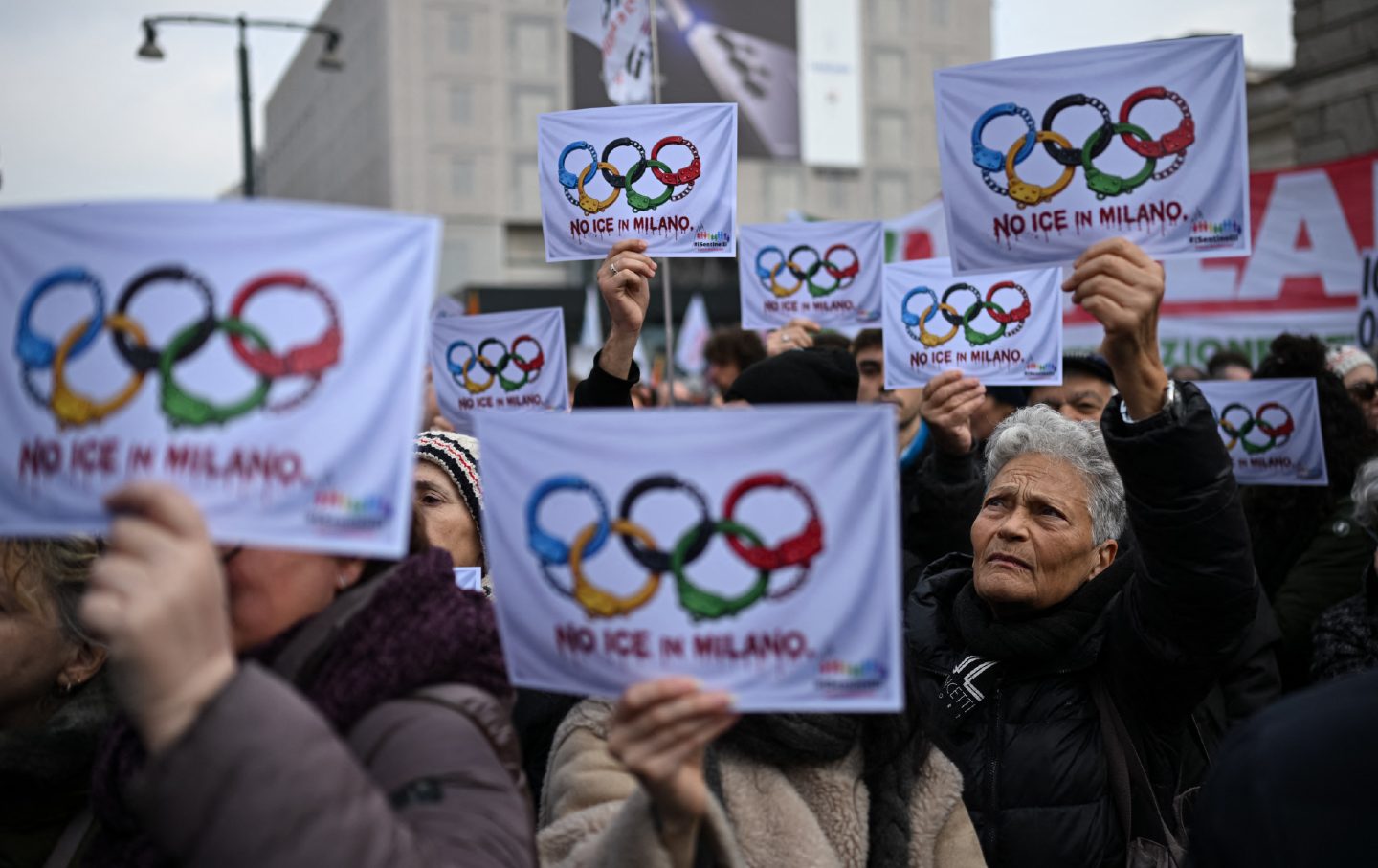
People take part in a demonstration against US Immigration and Customs Enforcement ahead of the Milano Cortina 2026 Olympic Games in Milan, Italy, on January 31, 2026.
(Piero Cruciatti / AFP via Getty Images)On February 6, the Milano Cortina 2026 Winter Olympics kick off with an opening ceremony featuring the likes of Mariah Carey and Italian tenor Andrea Bocelli. With lagging ticket sales among locals and protests clogging the streets of Milan to decry the presence of US Immigration and Customs Enforcement (ICE) as security for JD Vance’s delegation, these Olympics already bear the stink of political discontent. When combined with the Beijing 2022 Winter Games and the Paris 2024 Summer Olympics, Milano Cortina arrives during the Olympics’ most politically charged inflection point since the back-to-back boycotts of the early 1980s.
In the face of controversy, the Olympic propaganda machine, now headed by new IOC president Kirsty Coventry, is cranking up to 11. Giovanni Malago, the president of the Italian National Olympic Committee, enthused that thanks to the Olympics, “2026 will be the year of Italy.” Olympic officials are promising “a once-in-a-lifetime” experience at Milano Cortina. And yet, for something “once in the lifetime,” its problems are all too familiar.
This is the first Olympics staged after a batch of much-ballyhooed “Olympic Agenda” reforms carried out by the International Olympic Committee that were first approved back in 2014. Former IOC president Thomas Bach noted, “Milano Cortina 2026 will be the first…to fully benefit from our Olympic Agenda reforms from start to finish.”
But how different are these Olympics, really? In the 21st century, the Games are beset by ingrained problems such as overspending, corruption, intensified policing, and greenwashing. Despite cosmetic Olympic reforms, the Milano Cortina 2026 Winter Olympics show us that these problems have largely remained unaddressed. Or as sports mega-events scholar Sven Daniel Wolfe wrote, “Olympic reforms risk repeating the crises…that they were ostensibly designed to solve.”
Research from Oxford University has found that every Olympics going back to 1960 has suffered from cost overruns. The Milano Cortina 2026 Games will be no exception. The group Mountain Wilderness found that “costs have risen from the initial estimate of €1.5 billion to €5.72 billion.” This price gouging, as in previous games, is largely due to building the expensive infrastructure required to host the Games, not the sports themselves. According to the watchdog group Open Olympics 2026, launched in 2024 to monitor five-ring spending and promote data transparency, 13 percent of total expenditures go toward “essential Olympic infrastructure.” In other words, “for every €1 spent on something strictly necessary for the Games, €6.6 goes to subsidiary infrastructure.”
With so much money swirling around, it is no surprise that corruption allegations abound. The Italian government’s Anti-Mafia Investigative Directorate found that “the Winter Olympics represent a significant event…for criminal syndicates interested in gaining a foothold in the tender awarding procedures.” “Open Olympics 2026” successfully fought for the creation of a portal to track costs related to the Games, but the group notes, “the portal does not indicate who is paying for the cost increases, because financing sources are missing.” This opens the door to “mafia methods” such as extortion, strong-arming, intimidation, and blackmail. In 2024, two senior officials from the Milan-Cortina 2026 Foundation were accused of misappropriating nearly €2 million through irregular tenders for Olympic construction.
Another source for sky-high costs, as with every Olympics, has been the security state. Back in 2019, the Italian government pledged €415 million toward security, a number that has likely risen considerably. If the Games resemble the Panopticon of Paris 2024 Olympics, heavily armed policing will be omnipresent. According to official plans, the Italian Defense Ministry will be patrolling the skies—with the Air Force on perpetual standby—while between 6,000 and 11,000 military and policing officials will be on the ground. The security plans include a phalanx of hazard-sniffing robots, a fleet of surveillance drones, and a cybersecurity command center. Like every Olympic host, Italy is using the Games to ramp up its security architecture, an architecture that will remain in the wake of the event.
Then there’s the matter of ICE. Members of ICE’s Homeland Security Investigations Division will attend the Milano Cortina Olympics, reportedly in a supporting role for other US law-enforcement agencies in attendance, not as part of President Donald Trump’s brutal immigration crackdown. ICE has played a role in previous Olympics abroad, including the most recent Summer Games in Paris. In truth, the United States has long sent security personnel to oversee the Olympics overseas. For instance, at the 2004 Athens Olympics—the first Summer Games after the 9/11 terrorist attacks—the US sent armed security agents and a bevy of FBI agents.
But in the current political moment, with ICE being used as a gestapo in cities around the country, sending it to Milano Cortina hits very differently. Milan Mayor Giuseppe Sala made his feelings crystal clear when he said of ICE, “This is a militia that kills, a militia that enters into the homes of people, signing their own permission slips. It is clear they are not welcome in Milan.” Elly Schlein, a center-left politician in Italy’s Chamber of Deputies, expressed concern that ICE was “an armed militia that is not respecting the law on American soil.” Therefore, she noted, “There is the concern that they would not respect them on Italian soil either.” There are also concerns that ICE could be used to harass and silence US athletes eager to tell the world just how grim it has become in this country.
But that’s not all. Greenwashing, or talking a big environmental sustainability game without real follow-through, is another problem stalking the Olympics. Spanning almost 10,000 square miles, Milano Cortina is the most sprawling Winter Games in history. Olympic organizers’ decision to rebuild a sliding track in Cortina d’Ampezzo set off alarm bells, not only because it was expensive, but also because doing so meant chopping down hundreds of trees and jeopardizing biodiversity in the area. Local activists have accused the Milano Cortina Olympics of being “the most unsustainable Games ever.” Moreover, according to the watchdog group Open Olympics 2026, 64 percent of the 98 Olympic construction projects have been carried out without a single environmental impact assessment.
Luca Trada, a spokesperson for the anti-Olympics group Il Comitato Insostenibili Olimpiadi (The Unsustainable Olympics Committee)—a coalition created to defend local communities from the downsides of the Milan-Cortina 2026 Winter Olympics—told The Nation, “Milan’s development model certainly has enormous environmental costs that are not sustainable in the long term, and events such as the one currently underway confirm this unfortunate trend.”
Trada said anti-Olympics activists have been proceeding on two tracks. First, they are staging alternative sporting events called the “Utopiads,” which Trada described as “essentially three days of popular sport for all who want to compete, without needing to win.” Activists are also organizing an anti-Games mobilization on the afternoon of February 7. “The march will start from the city center and head to the outskirts, towards the areas most affected by property speculation” stoked by the Olympics, Trada said. The idea is to inject a modicum of democracy into the process. Let’s not forget: Milano-Cortina ended up with hosting rights only after numerous cities dropped out of the bidding for the 2026 Olympics because they lost their public referenda, a luxury that Italians did not enjoy.
We are about to witness an undemocratic, debt-ridden, and mobster-infused Olympics, inundated with armed thugs in the streets, in case anyone dares to dissent. At least JD Vance will feel right at home.
More from The Nation

What’s It Like Inside a Data Center? What’s It Like Inside a Data Center?
Northern Virginia is laden with structures that house data for Fortune 500 companies. I went inside just one of those monstrosities that bothers its neighbors.

What Trump and Tucker Carlson Have in Common What Trump and Tucker Carlson Have in Common
Carlson has broken with Trump largely over the war in Iran. But on Ukraine and immigration, the two speak very much the same language.

The Jewish Case Against AI The Jewish Case Against AI
Haredi rabbis and the secular left agree: This technology is a threat to the entire social fabric.
The Fight for Educational Equality Is Also a Fight for a Just Supreme Court The Fight for Educational Equality Is Also a Fight for a Just Supreme Court
The court has severely weakened our ability to make an education system that fulfills the promise of Brown.

The Fall of “Scientific American” The Fall of “Scientific American”
When the beloved science publication got too political, its corporate owners stepped in. Now its future is uncertain.
The Bookstore Revolution in Taiwan’s Conservative Heartlands The Bookstore Revolution in Taiwan’s Conservative Heartlands
After Taiwan legalized same-sex marriage, gender-themed bookstores are working to build the social acceptance that the law alone couldn’t deliver.

