Citizen Journalists Are Minneapolis’s Unsung Heroes
Without their videos of ICE shootings, we wouldn’t know what is really happening.
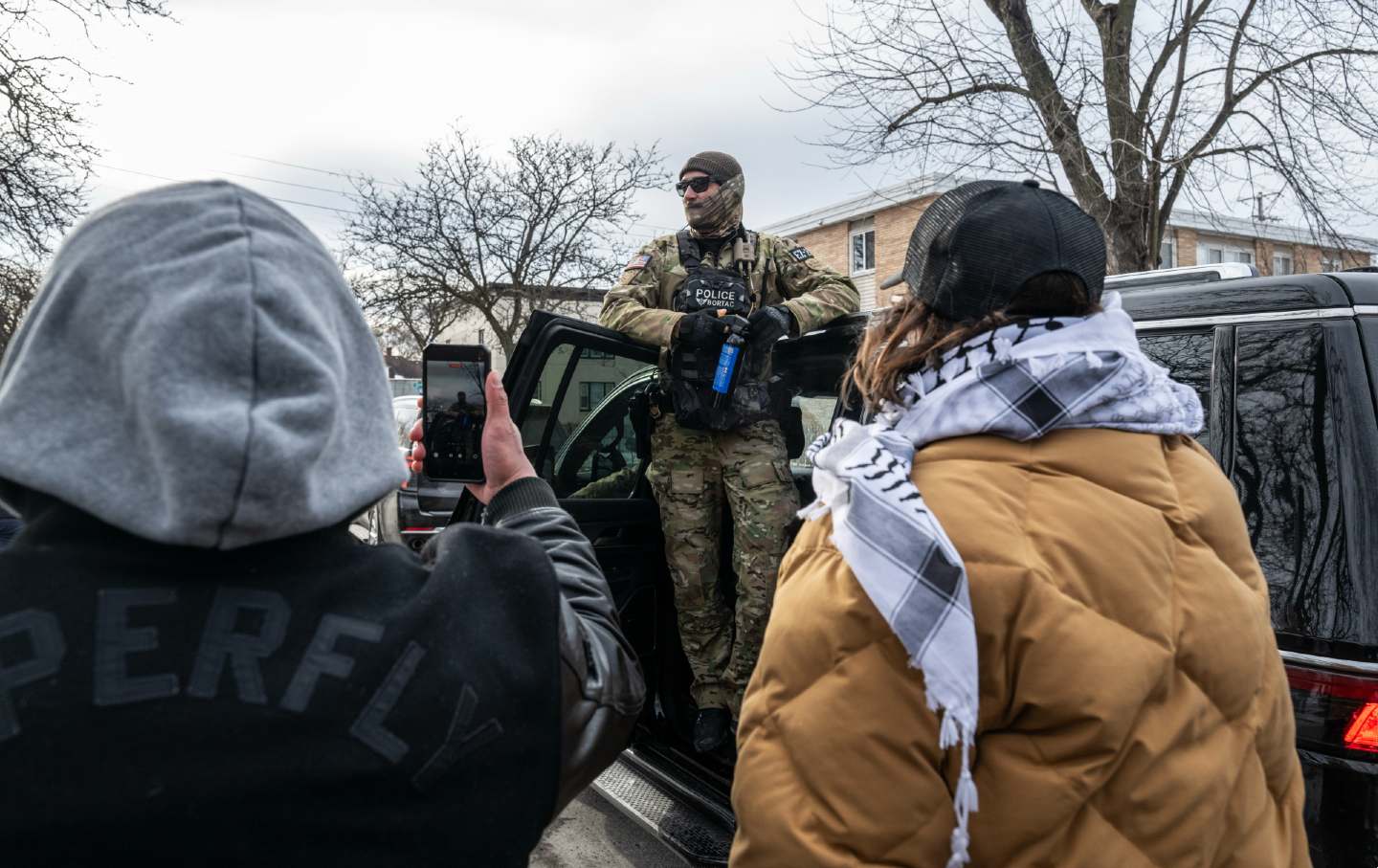
Minnesotans film a federal law enforcement agent during a patrol in Minneapolis, Minnesota, on January 11, 2026.
(Victor J. Blue / Bloomberg via Getty Images)On Sunday afternoon, CNN anchor Jake Tapper was interviewing US Representative Alexandria Ocasio-Cortez hours after Border Patrol agents killed Alex Pretti. Suddenly, CNN cut away to live coverage of Department of Homeland Security Secretary Kristi Noem’s press conference. Noem declared that Pretti had “attacked our officers” while “brandishing” a handgun and planned “to kill law enforcement.” When a reporter tried to ask a question about her claim, she interrupted to say, “That is no claim. It is the facts.” When another reporter noted that the White House had just called Pretti a “domestic terrorist,” Noem forcefully agreed.
By this time, bystanders’ videos of the shooting were appearing online and on news outlets. When Tapper resumed his interview with Ocasio-Cortez, the representative said that Noem and the Trump administration were “asking the American people to not believe their eyes… to instead hand over your belief into anything that they say. I’m not asking the American people to believe me, or her, but to believe themselves.”
Any journalist who’s been paying attention knows that Noem’s boss, President Donald Trump, often doesn’t tell the truth. Trump launched his political career by asserting without evidence that America’s first Black president wasn’t born in the United States, which would have meant Barack Obama was in power illegally. After losing the 2020 election, Trump said he had no plans to leave office because, he insisted, he had actually won. Trump repeats that lie to this day, along with his claim that the January 6, 2021, attack on the US Capitol to keep him in power was a day of “peace” and “love.”
But in spinning their latest web of lies, Trump and his aides didn’t reckon with the ingenuity and courage of Minnesotans who witnessed Border Control officers shooting Pretti—and Renee Good before him—and recorded the encounters on their cell phones. Without that evidence, the government’s version of the facts would have had the upper hand in shaping the public narrative. With that evidence, however, it’s obvious that “Alex is clearly not holding a gun when attacked,” as Pretti’s “heartbroken but also very angry parents” wrote in a statement the next day. “He had his phone in his right hand, and his empty left hand is raised above his head trying to protect the woman ICE just pushed down.” Likewise, bystander videos of Renee Good’s shooting show that she was turning her vehicle away from ICE agent Jonathan Ross when he fired three deadly shots through her windows.
Whether they know it or not, the bystanders who recorded these videos are citizen journalists. They are ordinary people, not trained in conventional journalism, and they were bearing witness to events of utmost importance to their community and country. And they were doing so under dangerous conditions, as was also exemplified by 17-year-old Darnella Frazier, who on May 25, 2020, bravely kept her cell phone focused on police officer Derek Chauvin throughout the nine minutes and 29 seconds that Chauvin’s knee was choking the life out of George Floyd.
The events of recent days have shown that citizen journalists, though not a substitute for professionals, can be an invaluable complement. Without their presence at the scene and steadiness under pressure, the public and the rest of the media would be ignorant of a pivotal aspect of the story unfolding in Minneapolis. We’d be hearing only the government’s version of the truth, which, given the Trump administration’s history of flagrant falsehoods, deserves extreme skepticism. Absent these videos, it is all but inconceivable that the editorial boards at three of America’s most influential newspapers—The New York Times, The Washington Post, and The Wall Street Journal—would be stating that the administration’s narrative defies belief or that the administration itself would be trying to walk back its initial slanders of Pretti.
All parts of the modern information system, from legacy newsrooms to social media influencers, can now present a fuller account of what is happening in Minnesota and let viewers and readers draw their own conclusions. And we can explore urgent questions raised by these videos, such as: How many more people might ICE agents have killed when no cameras were recording? Working in tandem at this critical moment for American democracy, citizen and professional journalists can fulfill the essential mission the nation’s founders envisioned for a free press: to inform the people and hold power to account.