Springsteen Defends the Promised Land Against ICE’s “Gestapo Tactics”
Mourning for Renee Nicole Good, the singer decried the Trump administration and the threat to freedom posed by “heavily armed masked federal troops invading an American city.”

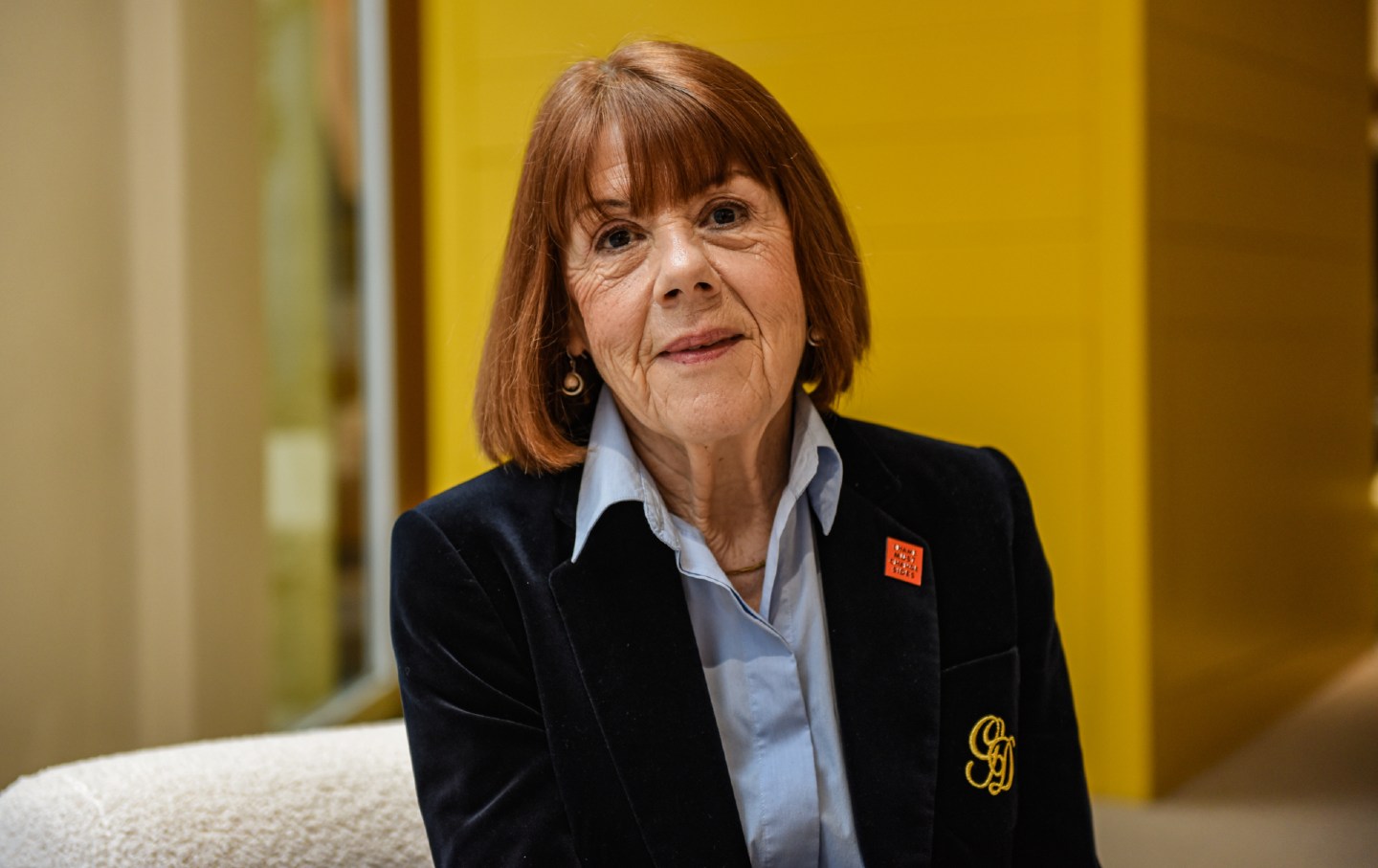
Bruce Springsteen speaking at the Count Basie Theatre in Red Bank, New Jersey, on January 17, 2026.
(WAAY 31 News)Bruce Springsteen took a side against the Trump administration’s authoritarian abuses last May, when he launched his European tour with an impassioned denunciation of the president’s assault on basic civil liberties, and decried an ugly moment in which the United States “is currently in the hands of a corrupt, incompetent, and treasonous administration.” Now Springsteen has brought the complaint home, with a clarity that is all the more immediate and necessary.
Before launching into a fiery rendition of his 1978 classic “The Promised Land” during a Saturday night show in his home state of New Jersey, Springsteen turned the crowd’s attention to Minnesota, where, on January 7, an ICE agent shot and killed Renee Nicole Good, a mother of three who loved to sing, wrote poetry, and evidenced a concern for her neighbors that embodied the spirit of Springsteen’s epic paean to community and solidarity, “We Take Care of Our Own.”
“I wrote [‘The Promised Land’] as an ode to American possibility—both to the beautiful but flawed country that we are, and to the country that we could be,” Springsteen told the crowd. “Right now, we are living through incredibly critical times. The United States, the ideals and the values for which it stood for the past 250 years, is being tested as it has never been in modern times. Those values and those ideals have never been as endangered as they are right now.”
The crowd roared with approval as Springsteen continued:
“So, as we gather tonight in this beautiful display of love and care and thoughtfulness and community, if you believe in democracy and liberty, if you believe that truth still matters, it is worth speaking out. It is worth fighting for. If you believe in the power of the law and that no one stands above it, if you stand against heavily armed masked federal troops invading an American city, using Gestapo tactics against our fellow citizens, if you believe you don’t deserve to be murdered for exercising your American right to protest, then send a message to this president—as the mayor of that city has said—ICE should get the fuck out of Minneapolis.”
Above what had become thunderous applause, Springsteen announced, “This song is for you and the memory of a mother of three and American citizen, Renee Good.”
With that, Springsteen and his band broke into “The Promised Land,” a song that speaks of a storm that will “blow away the lies that leave you nothing but lost and brokenhearted” and “blow everything down that ain’t got the faith to stand its ground”—and about how, against the tempest and through it all, “I believe in a promised land.”
Years ago, Springsteen summed up his mission as an artist when he said, “I have spent my life judging the distance between American reality and the American dream.” The honesty with which Springsteen has conducted this decades-long examination has earned the songwriter the greatest honors the entertainment industry and the nation can grant. In addition to 20 Grammy Awards, two Golden Globes, an Academy Award, and a Special Tony Award for his critically acclaimed Springsteen on Broadway shows, he is an inducted member of both the Songwriters Hall of Fame and the Rock and Roll Hall of Fame. He has also been given the Kennedy Center Honor and, in 2016, was awarded the Presidential Medal of Freedom by President Barack Obama, who hailed him for “carrying the rest of us on his journey: asking us all what is the work for us to do in our short time here.”
It was an appropriate honor for a singer who, like Woody Guthrie and Pete Seeger before him, refused to surrender the dream of a promised land to the crude machinations of billionaire investors and the crooked politicians who serve them. “There is a real patriotism underneath the best of my music,” Springsteen once said, “but it is a critical, questioning and often angry patriotism.”
There are plenty of artists who soften as they age.
Not Springsteen.
With his denunciation of ICE violence in Minneapolis, he has once again proven himself to be as critical, questioning, angry, and, yes, patriotic as the times require.
Support independent journalism that does not fall in line
Even before February 28, the reasons for Donald Trump’s imploding approval rating were abundantly clear: untrammeled corruption and personal enrichment to the tune of billions of dollars during an affordability crisis, a foreign policy guided only by his own derelict sense of morality, and the deployment of a murderous campaign of occupation, detention, and deportation on American streets.
Now an undeclared, unauthorized, unpopular, and unconstitutional war of aggression against Iran has spread like wildfire through the region and into Europe. A new “forever war”—with an ever-increasing likelihood of American troops on the ground—may very well be upon us.
As we’ve seen over and over, this administration uses lies, misdirection, and attempts to flood the zone to justify its abuses of power at home and abroad. Just as Trump, Marco Rubio, and Pete Hegseth offer erratic and contradictory rationales for the attacks on Iran, the administration is also spreading the lie that the upcoming midterm elections are under threat from noncitizens on voter rolls. When these lies go unchecked, they become the basis for further authoritarian encroachment and war.
In these dark times, independent journalism is uniquely able to uncover the falsehoods that threaten our republic—and civilians around the world—and shine a bright light on the truth.
The Nation’s experienced team of writers, editors, and fact-checkers understands the scale of what we’re up against and the urgency with which we have to act. That’s why we’re publishing critical reporting and analysis of the war on Iran, ICE violence at home, new forms of voter suppression emerging in the courts, and much more.
But this journalism is possible only with your support.
This March, The Nation needs to raise $50,000 to ensure that we have the resources for reporting and analysis that sets the record straight and empowers people of conscience to organize. Will you donate today?