
Trump’s Predatory Danger to Latin America
The United States is now a superpower predator on the prowl in its “backyard.”
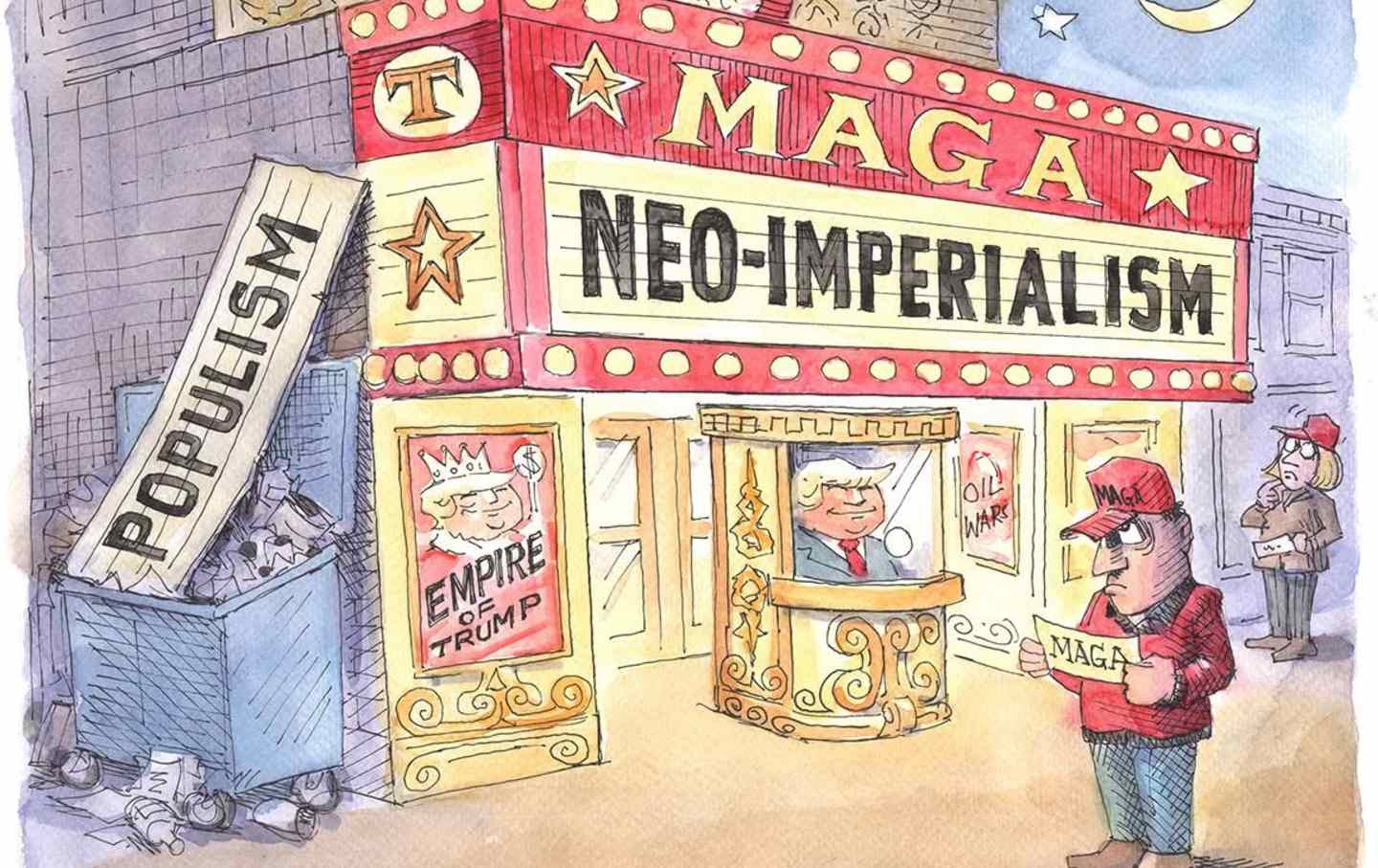
January 3, 2026, marks a history-changing turning point in US–Latin American relations. It is not only the day when the United States used its military might to advance its goal of regime change in Venezuela; it is the historic moment when a US president openly and proudly declared his imperialist aspirations for domination of the entire region. “Under our new national security strategy American dominance in the Western Hemisphere will never be questioned again,” President Trump declared only hours after a US Special Forces unit completed a rendition mission against Nicolás Maduro in Caracas. Only time, and history, will tell if he is correct.
For now, let’s give the US president credit for his supremacist transparency. While previous US leaders have at least paid lip service to advancing the reputable international values of freedom and democracy, Trump has made it crystal clear that the attack on Venezuela was not intended to liberate its citizens from Maduro’s thuggish regime but rather to liberate its vast oil reserves for US profit and plunder. In celebrating the success of “Operation Absolute Resolve”—the codename for the military extraction of Maduro—there has been little talk from the White House about the restoration of Venezuelan democracy nor respect for human rights; only the restoration of US control over Venezuelan petroleum reserves, which the US president claims were “stolen” from American oil corporations. In word and deed, Trump has indicated that he sees himself as overlord of Venezuela as his personal vassal state for the foreseeable future. When asked by reporters this week who will now be “running” Venezuela, Trump responded simply and succinctly: “Me.”
President Trump has made no secret that he aspires to be a modern-day emperor; and to be an emperor obviously requires an empire. The successful attack on Venezuela seems to have empowered and emboldened him to actively pursue that bellicose, grandiose, and lawless ambition. “Let us state it plainly,” as Ben Rhodes, a former national security adviser to President Obama, accurately observes: The United States now has “an autocratic leader seeking power and aggrandizement through the conquest of territory and resources.”
The Donroe Doctrine
It has been almost a full century since the United States openly claimed the might, and the right, to control Latin America for its imperialist pursuits. But the Trump administration seems determined to drag the region back to the era of “gunboat diplomacy,” when US presidents routinely dispatched the Marines to oust uncooperative leaders, secure land and resources for the benefit of US corporations, and seize economic and military control of various Central and South American nations. The US has “superseded” the Monroe Doctrine of 1823, which designated the Americas as the US sphere of influence, as Trump announced at his Mar-a-Lago press conference celebrating the assault on Venezuela; “they now call it the ‘Donroe Doctrine,’” he told reporters.
This doctrine, as The Economist defined it in a major cover story titled “The Donroe Delusion,” is essentially “Mr. Trump’s belief that he can do whatever he likes in the Western Hemisphere, from commandeering Venezuela’s oil to grabbing Greenland.” Intoxicated by the success of his “Operation Absolute Resolve” in Venezuela, Trump has reiterated his absolute resolve to “own” Greenland. In a direct threat to the NATO alliance, he is now threatening that the US can do it “the easy way” or “the hard way.”
Delusional or not, the lethal mixture of Trump’s imperialist agenda to “own” sovereign lands combined with his insatiable narcissistic need to demonstrate his omnipotent power to do so makes him the most dangerous US president the world community has ever faced. With his fixation on audacious displays of raw aggression, Trump has transformed the United States into a superpower predator on the prowl, seeking conquest far and wide. The way he and his national security team have reveled in their merciless and murderous operations—from obliterating dozens of defenseless small boats and their crews in the Caribbean to dropping bombs on Caracas—meets Webster’s Dictionary’s definition of sadistic: “deriving pleasure from inflicting pain, suffering, or humiliation on others, often associated with extreme cruelty.”
Even more disconcerting is the lack of any real constraints on his ability to escalate such abuses of power in the future. As world leaders have pointed out, the assault on Venezuela constitutes a blatant assault on the international legal order. But Trump has not only disregarded the post–World War II framework of international norms; he is determined to destroy it. Venezuela has become his opportunity to obliterate the legal mandates of the UN and OAS charters—to which the United States is a signatory—to respect the sovereignty of states. “I don’t need international law,” Trump openly declared in an interview with The New York Times this past week. Are there any limits on his exercise of global power? he was asked. “Yeah, there is one thing,” Trump replied. “My own morality. My own mind. It’s the only thing that can stop me.”
The Threat to the Region
Through historical experience, Latin Americans know about the “morality” of US intervention. And as a region disparaged as the “backyard” of the United States, Latin America has suffered at the hands of the domineering “Colossus of the North” for centuries. Based on this history, leaders across the continent have every reason to be extremely concerned. “Today it is Venezuela; tomorrow it could be any other country,” as Chilean President Gabriel Boric stated in his denunciation of the US takeover of Caracas. “If they can do it there, why not elsewhere in the future?”
Indeed, every day this past week has brought a new threat of US intervention in the region. Cuba seems to be the next target on Washington’s list of conquests. The US takeover of Venezuela’s oil industry and naval quarantine of tankers has effectively terminated shipments of oil to the island, which threatens to collapse its teetering economy. At 7:27 am this past Sunday, Trump tweeted his first ominous threat against Havana: “THERE WILL BE NO MORE OIL OR MONEY GOING TO CUBA, ZERO [from Venezuela],” he declared with emphasis. “I strongly suggest they make a deal, BEFORE IT IS TOO LATE.”
And despite Mexican President Claudia Sheinbaum’s demands that the United States respect the sovereignty of her country, Trump has escalated threats to launch military raids on Mexico. “We are going to start now hitting land with regard to the cartels,” Trump stated in an interview with Sean Hannity last week, echoing the threats he had made against Venezuela. “The cartels are running Mexico.” Similar warnings have been issued against Colombia and its president, Gustavo Petro, whom Trump has accused of sending drugs into the United States—the same falsehood he leveled against Maduro. “It sounds good to me,” Trump responded when asked if he planned to attack Bogotá as he had attacked Caracas.
Let us state it plainly: The United States is now governed by an authoritarian, imperially minded, self-aggrandizing narcissist who wants to transform the nations of Latin America into submissives—for no real reason other than to demonstrate that he has the dominant power to do so. “Well, we are in danger,” as President Petro has summarized this dire situation. “Because the threat is real. It was made by Trump.”
More from The Nation
Israel’s Extremist Election Israel’s Extremist Election
The run-up to the vote on Tuesday is exposing the façade of Israeli democracy—and the fealty of the country's so-called opposition when it comes to matters of Jewish supremacy.
“NAZA” and Israel’s History of Automated Warfare “NAZA” and Israel’s History of Automated Warfare
As violent technologies like spyware, predictive targeting algorithms, and 2,000-pound warheads become ordinary instruments of military rule, once-abhorred practices become routin...
Brazil’s Workers’ Party Is Not Stopping Brazil’s Workers’ Party Is Not Stopping
With just a few days remaining before the runoff election, supporters of Lula’s party are doing everything possible to rally support behind the president.
Brazil’s Decision Brazil’s Decision
The moral compass and basic humanity of political leaders really does matter.
Albanian Student Strikes Spur a Political Crisis Albanian Student Strikes Spur a Political Crisis
A new round of protests against the ruling party’s corruption has Prime Minister Edi Rama giving cops bonuses to crack down on dissent.

