
The WNBA Makes More Money Than Ever. What About the Players?
WNBA players receive around 10 percent of league revenue, while the NBA gives 51 percent. With their bargaining agreement expiring in January, players want to share in the growth.
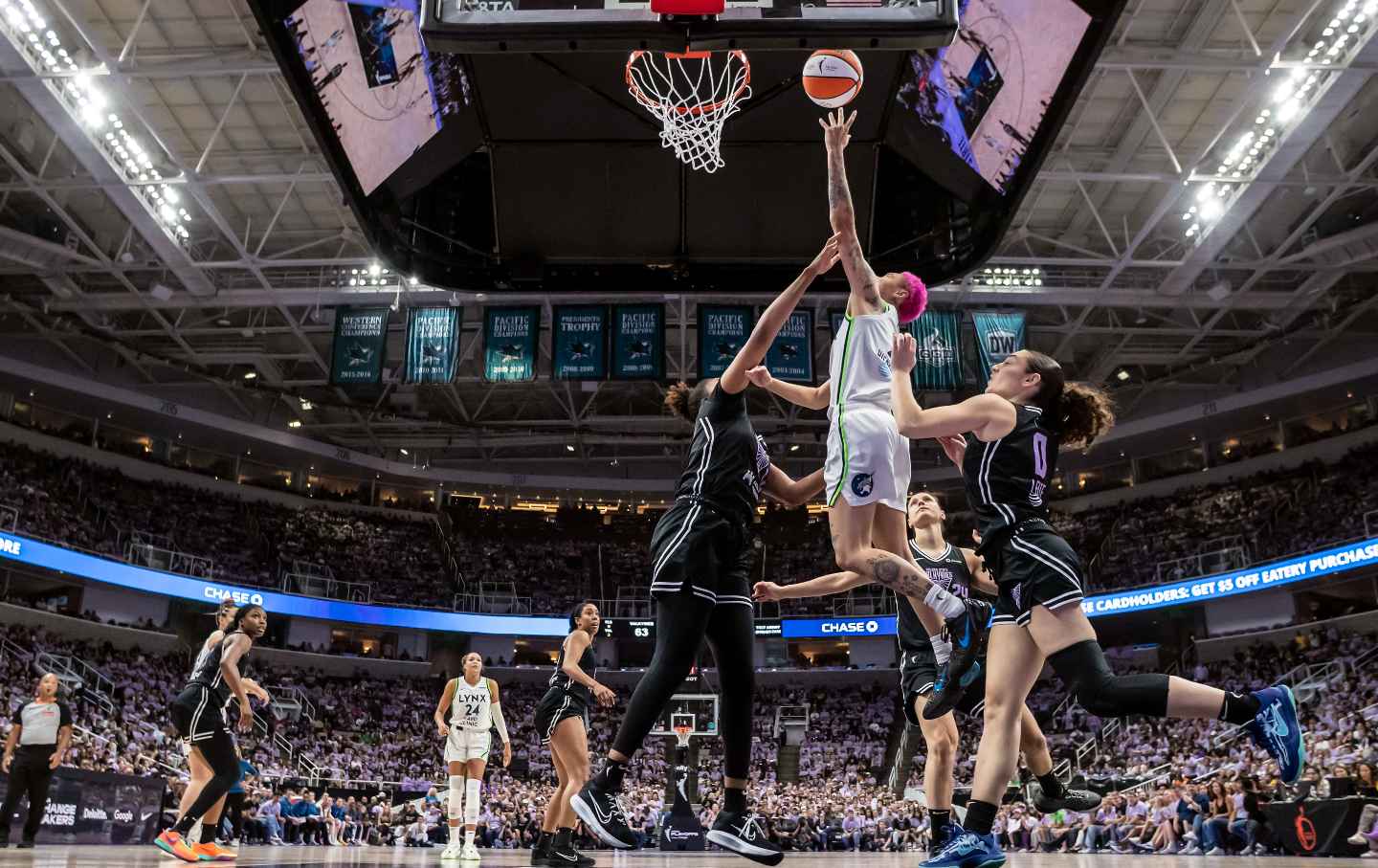
The Golden State Valkyries playing the Minnesota Lynx in Game 2 of the WNBA first round playoffs in September 2025.
(Carlos Avila Gonzalez / Getty)
In 2024, the WNBA delivered its most-watched regular season in 24 years, finished with its highest attendance in 22 years, and set records for digital consumption and merchandise sales. The league is experiencing unprecedented growth, with a $2.2 billion media rights deal and franchise valuations reaching hundreds of millions of dollars. Despite this financial windfall, the athletes driving this success find themselves locked in a pitched battle with league leadership that many see as rooted in corporate greed and a stubborn refusal to share the profits they’ve helped to generate.
As the November 30 deadline for a new collective bargaining agreement approached—following a 30-day extension from the original October 31 expiration—pressure built on both sides, leading to an extension of the current bargaining agreement to January 9, 2026 and buying more time to finalize a new deal.
Now the WNBA finds itself at a crossroads. The 23-year-old Indiana Fever star Caitlin Clark recently called it “the biggest moment the WNBA has ever seen.”
Are Commissioner Cathy Engelbert, NBA Commissioner Adam Silver, and the league’s billionaire owners truly invested in the players who built this cultural movement, or are they simply maximizing profits while maintaining ironfisted control? The owners have proposed a raise in minimum salary from around $66,000 to $225,000, with a $1 million base for the league’s top players. But the union is seeking to have the salary cap tied to the league’s growth, similar to the structure the NBA uses.
The numbers tell a damning story. WNBA players currently receive around 10 percent of league revenue, compared to the NBA’s players’ 51 percent. While league officials note that the WNBA and NBA operate at different scales and stages of development, players argue that their share should grow proportionally as the league’s revenue expands.
Minnesota Lynx star Napheesa Collier alleged that in a February meeting, Commissioner Engelbert told her “players should be on their knees thanking their lucky stars for the media rights deal that I got them.” When asked about the alleged comment, Engelbert did not explicitly deny the “on their knees” remark, instead claiming there were “a lot of inaccuracies” in media reports, but the controversy has highlighted what many players describe as a paternalistic approach from league leadership.
The league’s latest proposal reportedly includes a supermax salary near $1,000,000 and a veteran minimum around $300,000—significant increases from current levels. However, players have criticized the structure of these increases, noting that the proposals feature salary caps that increase by fixed rates rather than being tied to revenue growth. This approach, players argue, means that as the WNBA becomes more profitable, the gap between players’ earnings and overall revenue will continue to widen.
According to multiple reports, the league emphasizes “balancing salary growth and long-term sustainability,” and has stated that players “have yet to offer a viable economic proposal.” The Women’s National Basketball Player’s Association counters that their demands are based on standard revenue-sharing models used in other professional sports leagues.
The ownership structure reveals competing priorities within the league. Several billionaire owners—including Joe Tsai and Clara Wu Tsai of the New York Liberty, Joe Lacob of the Golden State Valkyries, Mark Davis of the Las Vegas Aces, and Matt Ishbia of the Phoenix Mercury—have demonstrated willingness to invest heavily in their franchises. The Tsais famously paid a $500,000 fine in 2021 for illegally chartering flights for their players before it was league-approved, signaling their commitment to player amenities.
However, there are also independent owners who kept the league afloat during financially challenging years and now cite those accumulated losses as justification for more conservative approaches to player compensation. This divide between high-spending NBA-affiliated owners and more cost-conscious independent owners has created tension in CBA negotiations with players questioning whether the league’s financial decisions reflect long-term investment in talent or short-term profit maximization.
NBA Commissioner Adam Silver’s recent comment that revenue share “isn’t the right way to look at it” when discussing player compensation, suggesting instead to focus on “absolute numbers,” has drawn criticism from players who view percentage-based growth as the standard model in professional sports.
Players have also raised concerns about league management that extend beyond compensation. Napheesa Collier criticized persistent officiating problems, stating that “leadership just issues fines and looks the other way” rather than implementing structural improvements. Multiple players have noted that the league’s response to operational challenges often involves punitive measures rather than systemic solutions.
Popular
“swipe left below to view more authors”Swipe →Other reasons include expanding rosters to the current 12-player limit, improving travel standards to reduce back-to-back games where teams play on consecutive days, more flexible scheduling, greater transparency in league decision-making, and consistent enforcement of rules—particularly around officiating. Players argue these improvements would benefit both their health and the quality of play, yet the league has cited financial sustainability concerns in resisting these changes.
The league’s prioritization rules have also become contentious. Players note that the WNBA expects year-round commitment while offering salaries that force many to seek additional income through overseas play or domestic leagues like Unrivaled and Athletes Unlimited. As Collier put it, “You can’t have exclusivity without paying for it.”
“All workers have the right to take collective action to improve their working conditions without retaliation from their employers,” said Katie Miles, a senior trainer at the UC Berkeley Labor Center with over 15 years of union organizing experience. “For WNBA athletes, that includes advocating for better salaries, pensions, and working conditions like roster expansion.”
Miles noted that revenue sharing tied to media rights, ticket sales, and merchandise is standard practice in professional sports. “They’re not asking for NBA salaries,” she said. “They’re asking for a fair share of the pie. And unlike many other industries, these players are both the product and the public face of the league. They have name recognition and star power on top of being the ones who make the league function. That gives them immense leverage.”
That leverage was visible when players wore “Pay Us What You Owe Us” shirts at the 2025 All-Star Game, using their platform to broadcast their demands publicly.
“The WNBA has operated like a small league, and in the past three years, it’s not anymore. It’s big,” said Jane Kenny, a reporter for The San Francisco Standard who covers the Golden State Valkyries. “You’ve got players demanding better conditions, and a league that’s finally drawing the kind of revenue that makes that ask more reasonable, but they’re still operating under a structure that doesn’t reflect that reality.”
Kenny added that, despite the Valkyries’ reported strong revenue performance, owner Joe Lacob isn’t among the six franchise owners at the bargaining table. “The absence of newer, more progressive ownership voices reinforces players’ perception that the league’s power remains concentrated in the hands of a few,” she said.
The expansion timeline has become complicated by CBA uncertainty. With the Toronto Tempo and Portland Fire set to join in 2026, expansion drafts must occur, but their timing depends on a finalized CBA. Nearly 80 percent of WNBA players are free agents this year, having structured their contracts to expire together in anticipation of salary increases from a new agreement.
“All I’ve heard from the Valkyries is that they don’t know anything about anything,” Kenny said in mid-October. “They don’t even know if they’ll be back on the team, if they’ll be protected, if a superstar is coming in during free agency. They’re just kind of like, fingers crossed.”
Collier’s September exit interview, where she called WNBA leadership “the worst in the world,” sparked widespread response from fellow players. Indiana Fever guard Sophie Cunningham suggested people know Cathy Engelbert only because of Caitlin Clark, while Las Vegas Aces star A’ja Wilson said she was “disgusted” by Engelbert’s alleged comments.
Reports surfaced that Engelbert might exit as commissioner after CBA negotiations due to strained relationships with players and some owners, though the league called such reports “categorically false.”
A’ja Wilson recently stated on Good Morning America that players are “tired of the mindset of ‘just be grateful for what you have.’ No, we need to dive into it,” capturing the sentiment among athletes who feel that their contributions have outpaced their compensation.
Players have articulated specific goals for the new CBA. As Las Vegas Aces guard Kelsey Plum explained, “We want a piece of the entire pie. Not a piece of part of the pie.” As the deadline approaches, can a league experiencing unprecedented growth find a way to share that success equitably with the players who made it possible?
“We’re not going to be holding hands through the CBA,” said Natasha Cloud of the New York Liberty in July. “We’re fighting for what we’re due, what we’re worth, our value.”
More from The Nation

What’s It Like Inside a Data Center? What’s It Like Inside a Data Center?
Northern Virginia is laden with structures that house data for Fortune 500 companies. I went inside just one of those monstrosities that bothers its neighbors.
What Trump and Tucker Carlson Have in Common What Trump and Tucker Carlson Have in Common
Carlson has broken with Trump largely over the war in Iran. But on Ukraine and immigration, the two speak very much the same language.

The Jewish Case Against AI The Jewish Case Against AI
Haredi rabbis and the secular left agree: This technology is a threat to the entire social fabric.
The Fight for Educational Equality Is Also a Fight for a Just Supreme Court The Fight for Educational Equality Is Also a Fight for a Just Supreme Court
The court has severely weakened our ability to make an education system that fulfills the promise of Brown.

The Fall of “Scientific American” The Fall of “Scientific American”
When the beloved science publication got too political, its corporate owners stepped in. Now its future is uncertain.
The Bookstore Revolution in Taiwan’s Conservative Heartlands The Bookstore Revolution in Taiwan’s Conservative Heartlands
After Taiwan legalized same-sex marriage, gender-themed bookstores are working to build the social acceptance that the law alone couldn’t deliver.

