
My Dumb Journey Through a Smartphone World
I spent six months with a flip phone. I learned that a more conscious technological future will require much more than just unplugging.
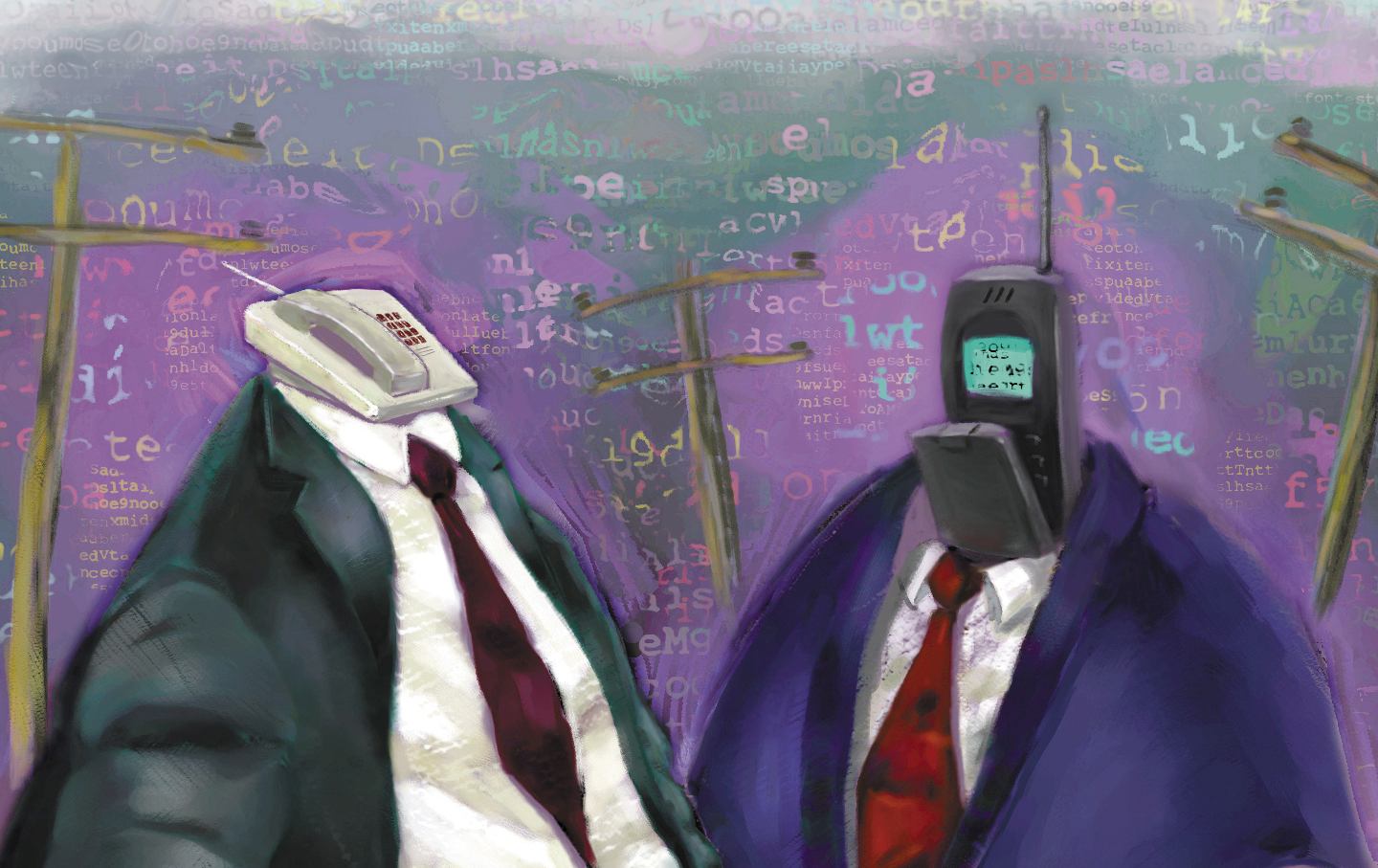
Hector Casanova color illustration of “phone-heads.”
(The Kansas City Star / Tribune News Service / Getty Images)The flip phone thing started as an empty threat. It was late December, the shortest, darkest days of the year, and I was still on new hire probation, cloistered in a mostly empty office building during the week bookended by Christmas and New Year’s. My first desk job meant that I was spending more time than ever alone, with little other than a screen to keep me company. And so, to fill my otherwise empty days, I scrolled.
Trump had just won the election and the media—both social and traditional—was abuzz with all the retributions and funding cuts on his agenda. I’d emerge from my office at 5 o’clock frazzled from all the Times headlines, Twitter hot takes, and short-form videos I’d spent the workday clicking through. The flood of headlines and pull-quotes was bleak. While journalists and pundits were blaming people my age for being too addicted to their phones, I was starting to worry that tech, the way I stayed connected to the wider world, was itself the problem—owned and manipulated by companies who leveraged controversy for engagement. Instead of liberating my mind with around-the-clock access to information, my phone was beginning to feel more like corporal punishment.
And so, the idea of throwing it away—not the bad news, but the vessel through which the bad news got to me—became more and more enticing.
Istarted poking around the Internet for alternatives to the many functions my iPhone performed. I read Wirecutter articles about refurbished mp3 players and Reddit comment threads on car dashboard-mounted GPSs. I asked my parents if they still had their handheld digital camera in a junk drawer somewhere. The trickiest thing to replace, I realized, would be talking and texting.
I browsed eBay for the sliding keyboard phone models I remembered from middle school and, when I learned that those devices were largely incompatible with the 4G and 5G towers that now populate the US, briefly considered spending $700 to preorder the Light Phone III (a “dumb smart phone” that resembles a bike speedometer with a Kindle’s e-ink screen).
These were all options, insofar as they represented an alternative to the central place my iPhone held in my life. But carrying around a half-dozen separate devices would be far from liberating. And the irony of using gadget-obsessed Internet communities for tips on spending less time online wasn’t lost on me, either. And so finally, in February, I settled on the most elegant solution. I went to the Spectrum Mobile store in my local mall in Albany, where I already had a cell service plan, and told them I wanted to purchase a TCL Flip 3, the only flip phone Spectrum listed for sale online. The clerk, a teenager, looked at me with her eyebrows raised. She told me that not only had she never sold a flip phone, but also that she had no idea the store even carried them. Ringing up my purchase, she asked what kind of payment plan I wanted to set up. The TCL cost $79.99. Sheepishly, I told her I’d buy it outright.
Coming from the older half of Generation Z (raised on Xbox Live and Instagram, not iPads or AI), my growing anxiety about technology wasn’t unique. Despite my checkout clerks’ confusion when I asked about the flip phone, there’s been a small but palpable strain of tech-skepticism growing among young people. And while I am still hesitant to call them (us?) a movement, like The New York Times seems to do weekly, today’s “Luddites” look different from those of the past. Once, VPNs and Raspberry Pis were the domain of privacy-obsessed hacktivists and cybercriminals; the vestigial wing of 1980s and ’90s Internet libertarianism. But today’s flip phone–wielding Zoomers evoke a crunchier notion of “conscious consumption,” that the values of what we buy and use reflect our own. It’s a response, I think, to two distinct, though interconnected, worries: that the same companies whose products make us anxious and inattentive are also, on the whole, bad for the world.
If the promise of positive transformation characterized tech in the early 2010s—with user-friendly interfaces allowing even the technologically illiterate to access the Internet’s wares—by the 2020s, what progress has been achieved feels overshadowed by the undeniable negatives. Spotify pays musicians who publish on its platform by the fraction of a penny; Airbnb hollows out vacation towns; and ChatGPT allegedly guzzles a tree’s worth of water per query. Once, Twitter toppled regimes and jump-started journalists’ careers. Now, X hobbles hyperlinks and promotes pay-to-play grifters. These platforms, which pitched themselves as both cultural and business innovators, reneged on the promises that attracted users in the first place. The companies that own them simultaneously exploit individual users, business customers, and the political jurisdictions that were duped into embracing them. In the name of phone-mediated convenience, we’ve signed away our agency on and offline.
Low tech’s answer, then, gestures back to a mythologized past of early Internet hardware. It’s less about abstaining from technology altogether than rewinding the clock. Dumb phones, mp3 players, and digital cameras evoke an era when much of the tech that Zoomers do like—GPS, digital music, texting—existed, but hadn’t yet become co-opted by the cartel of platforms and apps that dominate today. For today’s young people, these comparatively analog electronics are a chance to reintroduce intentionality into their everyday habits. They insert a calculated amount of friction into the phone calls we make, the photos we take, with the idea that having to think twice before turning to tech will make us less dependent. And, importantly, this skepticism of contemporary tech culture cuts both ways: by avoiding apps like Instagram and Instacart, we can put our money toward brick-and-mortar shopping while regaining our attention spans in the process.
And yet, my six months with a flip phone felt less like an exercise in mindfulness and more like a statement of hardheadedness. With effort, I navigated drives upstate using directions printed off Google Maps. When I visited New York City, I couldn’t unlock any Citi Bikes. I’d go out for beers and tell my friends that, yes, I’d Venmo them what I owed, but could it wait until I was back at my laptop? And hours spent on the YouTube and Twitter desktop sites quickly supplanted the screen time I once logged on my phone. In a concession that, in hindsight, is indicative of how uncommitted I was to the whole experiment, I quickly started carrying my cellularly disconnected iPhone with me wherever I went, bouncing between public WiFi networks, adding my iCloud e-mail address to group chats unwilling to tolerate my flip phone’s misspelled green texts.
Compounding these issues was the fact that, though it was designed within the past few years and purchased brand-new, my specific model of flip phone was total junk, nowhere near the hardware quality that it would’ve been built to during the pre-smartphone heyday of the late aughts. The TCL Flip 3 was constructed cheaply, with greyish plastic casing that sounded like a disposable fork snapping every time I shut it. Its menus lagged, its keys were unresponsive, and the voicemail was impossible to set up. Except for its charmingly pixelated camera (the photos from which I uploaded to my laptop via cable, e-mailed to my Wi-Fi-enabled iPhone, then posted to Instagram), the TCL was so shoddily designed that it could only be commercially viable in a market niche like “dumb phones,” where being less functional and user-friendly than the competition was kind of the point. It was the phone you bought for an elderly grandparent who grumbled about how much they missed their landline. Instead of freeing up time and brainpower that had been spent doomscrolling, my flip phone simply replaced that downtime with the indignity of only being able to communicate after jumping through a half-dozen glitchy hoops. My friends and family relentlessly teased me about the phone’s uselessness and my refusal to give it up. They were right. Tapping “3” two times to type “E” got old after about 15 minutes. I missed Strava. The dumb phone, I realized, wasn’t going to help me magically regain my digital agency. If anything, it just drove home how ubiquitous the unspoken contract between tech companies and the rest of the world really was.
In hindsight, my attempt at going low-tech was doomed to fail from the start. Even as I half-heartedly grumbled about algorithms and surveillance, I was too dependent on my phone’s creature comforts to go without it. But, importantly, so was everybody else. Nearly every aspect of American social and professional life is now mediated by a suite of apps—from Teams and Slack to iMessage and Partiful. Not being able to tap-to-pay, or scan a QR code, or pull up a confirmation e-mail doesn’t just inconvenience you; it inconveniences everyone around you. And that, largely, is by design.
Over the 2010s, public adoption of smartphone-native tech platforms reached critical mass. At least in the United States, practically everything new—from media to shopping to transit and even government services—is now designed with the assumption that you have a smartphone. A newer, fancier app might take the place of an outdated competitor, but it’s difficult to imagine any of these industries reversing course to their (recent) low-tech past. I learned that even if, on paper, the phones really are the root of so many problems, ditching yours will only get you so far.
“Dumb” phones and other types of low tech, then, are less a coherent political statement than a sort of conspicuous non-consumption, a way for people to assert their ethics and taste via denying themselves everyday conveniences. It’s an ideological line in the sand that, under any scrutiny, devolves into arbitrariness. So, you won’t download X on your phone, but you’ll check it on your laptop? So, you use DuckDuckGo because you care about “privacy,” but facial recognition software in traffic cameras can track your every movement?
But even if such individual-level attempts at action are superficial, that doesn’t mean the anxieties driving them aren’t worth taking seriously. The real issue when it comes to pushing back against tech is scale: The conscious consumer’s solution of self-policing what gets bought might work when it comes to boycotting retail, but tech permeates almost every aspect of every industry. Any scrutiny directed at the habits of individual users is misplaced. Why is it easier to imagine a future where we deny ourselves technology than one where we regulate companies’ ability to exploit their users?
The tech skeptics among us are so embittered about the quality of digital life that we’re prepared to cede control of it to the businesses and platforms making things bad in the first place. But why should consumers give up the convenience, connectivity, and (as hokey as the sentiment is) transformative potential of the Internet just because of a few bad actors? What’s needed instead is a shift—both in policy and the cultural consciousness—about who technology is really for. Instead of thinking of ourselves as consumers—capable of voting with our wallets, responsible for self-policing—we need to conceptualize ourselves as constituents, capable of organizing and taking the fight to tech companies themselves.
Technology writers and critics, especially those on the left, have already done much to articulate a path of collective, user-driven resistance to big tech’s ubiquity. The most prominent of these works is Cory Doctorow’s Enshittification: Why Everything Suddenly Got Worse and What to Do About it. Titled after Doctorow’s pithy term for how tech platforms attract, trap, and exploit users and business customers alike, Enshittification is deeply critical of the same algorithm-riddled, attention-frying, surveillance-obsessed platforms that led to me getting a flip-phone.
But unlike my brief flirtation with low tech, Doctorow refuses to give up on digital life altogether. The second half of Enshittification outlines a multipronged strategy of resistance to Big Tech’s exploitative business model—anti-trust prosecution, “right to repair” laws, and a major reshaping of how we understand intellectual property. The through line of Doctorow’s solutions is that Big Tech’s current shape—corporate fiefdoms, with power and monetary reserves rivaling many governments, which extort users and business customers for what is functionally rent—isn’t a foregone conclusion. The problem isn’t the technology itself; it’s that a total lack of regulation has allowed companies to grow so monopolistic that customers can be freely exploited.
Today, opting for a flip phone is akin to sticking your head in the sand. But just because you can’t see the crisis doesn’t mean it’s not happening. A game of gadget-driven one-upsmanship about who’s the most ethically unplugged will only lead to a low-tech movement that’s even less coherent than it already is. And if everyone else with not-so-distinguished taste is still rolling around in AI slop, does that even matter? To truly fight for ethical, user-oriented tech, we need to think collectively. Scrutiny must be shifted away from the duped and onto the dupers. Most importantly, we can’t give up on technology altogether—doing so would mean that those already making the world shittier would be given free rein.
More from The Nation
What’s It Like Inside a Data Center? What’s It Like Inside a Data Center?
Northern Virginia is laden with structures that house data for Fortune 500 companies. I went inside just one of those monstrosities that bothers its neighbors.

What Trump and Tucker Carlson Have in Common What Trump and Tucker Carlson Have in Common
Carlson has broken with Trump largely over the war in Iran. But on Ukraine and immigration, the two speak very much the same language.

The Jewish Case Against AI The Jewish Case Against AI
Haredi rabbis and the secular left agree: This technology is a threat to the entire social fabric.

The Fight for Educational Equality Is Also a Fight for a Just Supreme Court The Fight for Educational Equality Is Also a Fight for a Just Supreme Court
The court has severely weakened our ability to make an education system that fulfills the promise of Brown.

The Fall of “Scientific American” The Fall of “Scientific American”
When the beloved science publication got too political, its corporate owners stepped in. Now its future is uncertain.
The Bookstore Revolution in Taiwan’s Conservative Heartlands The Bookstore Revolution in Taiwan’s Conservative Heartlands
After Taiwan legalized same-sex marriage, gender-themed bookstores are working to build the social acceptance that the law alone couldn’t deliver.

