
Mistress of Efficiency
Muriel Spark’s art of compression
Muriel Spark’s Magnetic Pull
What made the Scottish novelist’s antic novels so appealing?
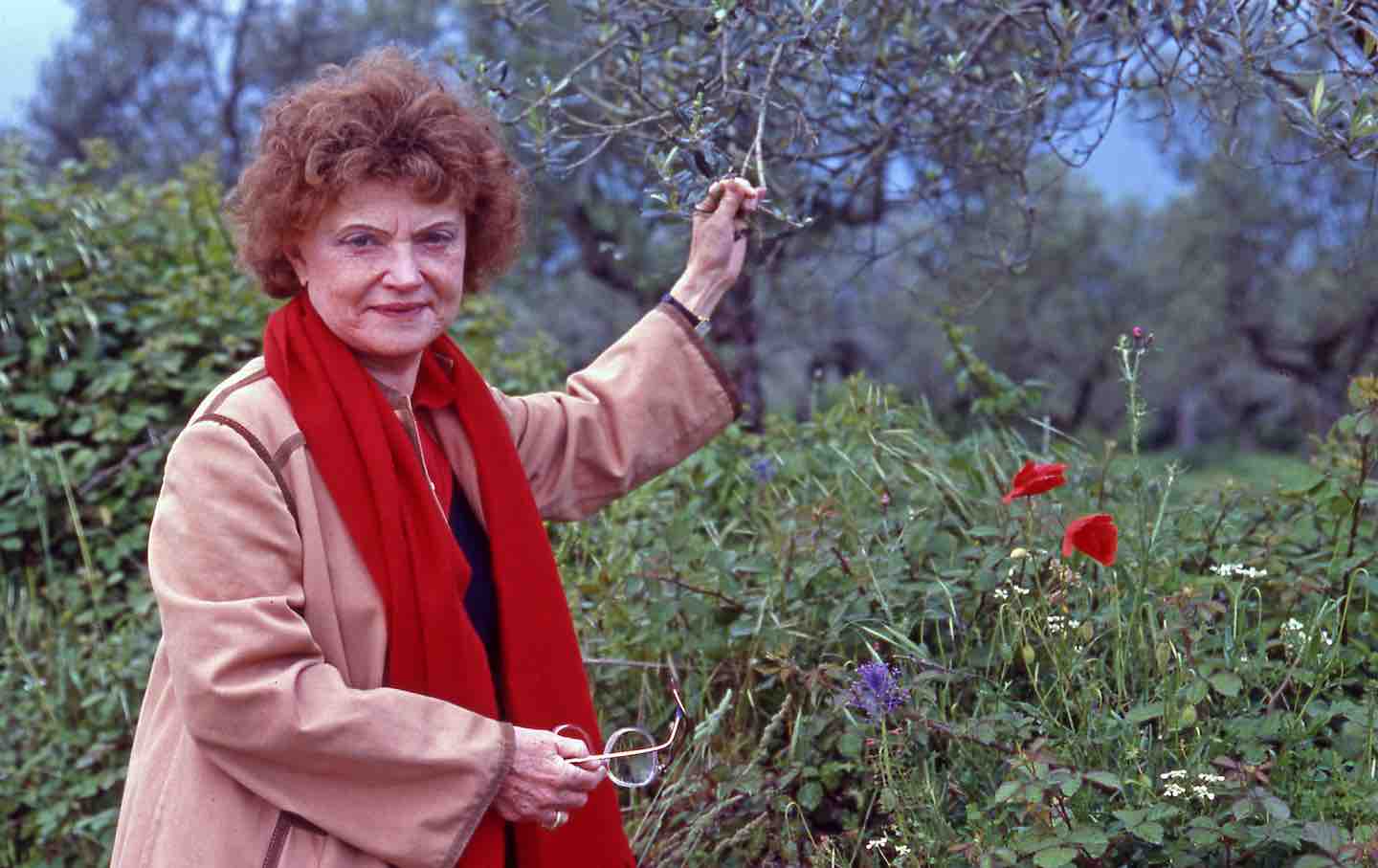
Muriel Spark, 1983.
(Edoardo Fornaciari / Getty Images)Death comes for us all, but if you’re a character in a Muriel Spark novel, it may come faster than you think. In Not to Disturb, a poetry-quoting butler orchestrating the murder-suicide of his master and mistress says of two intruders that they are nothing more than minor characters: “They don’t come into the story.” The unhappy pair is later dispatched, as if by afterthought, in a subordinate clause: “Meanwhile the lightning, which strikes the clump of trees so that the two friends huddled there are killed instantly without pain, zig-zags across the lawns…”
Books in review
Electric Spark: The Enigma of Dame Muriel
Buy this bookOther denouements are equally violent, equally quick. One woman meets her fate, in The Ballad of Peckham Rye, when her lover “came towards her with the corkscrew and stabbed it into her long neck nine times, and killed her. Then he took his hat and went home to his wife.” In The Driver’s Seat, a woman whose idea of a perfect holiday involves finding a man to murder her orders her assailant to “Kill me” and repeats the command in four languages. But as the knife descends, “she screams, evidently perceiving how final is finality.”
Spark’s kill count is often taken as proof of authorial sadism. (The technique of assassination-by-lightning is lifted straight from the Marquis de Sade’s novel Justine.) “I love them all,” Spark once said of her characters, “like a cat loves a bird.”
Alternatively, some readers have seen Spark’s tense, twisted novels as acts of piety. She kills her creations because she can, much as God in the Book of Job commands the wind to rise, the hawk to soar, and boasts that he can “draw out Leviathan with a fishhook.” Viewed in the light of her ardent Catholicism, Spark’s novels offer meditations on Providence, the artist’s sovereignty over her fictional universe faintly reflecting the authority of God-who-decides-all.
There is, however, another way to make sense of these quick deaths, which is to see them as the unfolding of an aesthetic principle, the consequences of a law of efficiency that rules Spark’s corpus. John Updike compared her sharp and slender novels to shards of glass. Many hover around 120 pages; a few barely crack 80. Her sentences are precise, epigrammatic. James Wood describes her fiction as “devoutly starved,” saying of her “brilliantly reduced style” that it refuses explanation. Depth, motive, and psychological interiority, among other preoccupations of the realist novel, are chiseled away.
What’s astonishing is that Spark’s novels, compact as they are, strike the reader as fully realized and intricately imagined. They have large casts of characters, complex plots, and details that linger in the mind, such as the chinchilla fur and dark red, talon-like fingernails sported by the Dickensian dowager Lady Edwina in Loitering With Intent, or the tender way in which a handsome medical student in A Far Cry From Kensington circles his arm around the heroine’s ample waist “as far as it could reach.” It is Spark’s gift for accordion-like compression that Frances Wilson, in her new biography, Electric Spark: The Enigma of Dame Muriel, identifies as utterly distinctive. Spark “altered the novel’s space-time dimensions,” Wilson contends, so that, like a magic box, “her books are bigger on the inside.”
Spark was born in 1918 in Edinburgh, Scotland, a dense, vertical city with “stairways straight as ladders,” its denizens “piled on top of one another.” She grew up in a crowded apartment, sleeping on the kitchen sofa. Her roots were working-class (though she preferred the term “ordinary class”). The family was Jewish—a rarity in Edinburgh—but eclectically so: Spark’s mother kept an image of Christ in her locket, displayed a Buddha in the living room, and went to synagogue on Yom Kippur.
Precocious and attentive, Spark found early encouragement as a poet. She was already publishing poems by age 11, and through early adulthood she won, with apparent effortlessness, virtually every poetry contest she entered.
In 1937, she moved to Southern Rhodesia (now Zimbabwe) to marry Sydney Oswald Spark (S.O.S.), a violent paranoiac who threatened her with a pistol. Ten months later, at the age of 20, she had a son and almost died while in labor. Her Africa years are as strange as any of her novels. During a stint in Cape Town, for example, she befriended the flamboyant Princess Maria Bonaparte, a descendant of Napoleon and former patient of Freud whose unorthodox sexual escapades included bedding a homosexual Danish prince while her husband—the prince’s nephew—looked on in queasy rapture. For nearly two years, after deserting S.O.S. and moving to Salisbury (now Harare), Spark fell off the map; Wilson speculates that she worked as a spy for the British colonial government, pointing to the ease with which she later gained passage to England.
In 1944, Spark joined the war effort in London, assisting in propaganda designed to confuse and demoralize the Germans, such as radio broadcasts containing discreet falsehoods about military losses or the debauchery of Nazi elites. In 1945, she dropped off her son in Edinburgh, in the flat where she grew up, to be raised by his grandparents. He would die at the same address seven decades later.
After the war, Spark sought, with increasing seriousness, to establish herself as a writer. But the literary career for which she’d abandoned her son was not, at first, terribly promising. She edged her way into the literary world when, at 29, she secured a job editing a journal run by an organization called the Poetry Society. Unfortunately, the Poetry Society was ruled by a board of imperious weirdos, including a composer arrested during the war for plotting a pro-Nazi uprising in Britain, and an oversexed eugenicist and birth-control pioneer who refused to wear a bra and predicted that she would, in 200 years, be canonized as a saint. Spark worked until her hands and cheeks were covered with ink and sold her winter coat to survive on her tiny salary, but no matter: She was hounded from her position by an old guard that disparaged T.S. Eliot in favor of the tinkling verse of P.G. Wodehouse. There followed a series of collaborations with her sometime lover Derek Stanford, a critic of such modest talent that Wilson likens their relationship to that between Mozart and Salieri.
During these years, there was one thing that Spark was not doing: writing novels. One of the “enigmas” of Wilson’s book is how early Spark identified literature as her vocation but how late she arrived at the novel as her chosen form. Well into her 30s, Spark had distinguished herself as a poet, critic, biographer, and belletrist (producing studies of, among other figures, Mary Shelley and Emily Brontë). It is true that these genres were held in higher esteem than they are now. (We read of Spark as a struggling freelancer: “Determined to live by her pen, she then proposed a study of [August] Strindberg”—a plan that, if expressed by a writer today, would indicate delusion bordering on madness.) Still, the impression we get is of destiny deferred. “Between 1944 and 1955,” Wilson writes, “Spark tried her hand at every genre except the novel, despite the fact that the novels were piling up in her mind like aircraft circling in a landing pattern.” (Wilson focuses on Spark’s formative years, up through the writing of her first novel, but gives a sense of the entire life, making this energetic biography itself a time-bending triumph of Sparkian compression.)
Spark’s emergence as a novelist is one of literary history’s more dramatic examples of spiritual and artistic rebirth. She converted to Catholicism in 1954, in the wake of a Dexedrine-fueled breakdown during which she believed herself to be receiving cryptographic messages encoded in the work of T.S. Eliot. (In the throes of paranoia, she warned friends that Eliot was posing as a window cleaner to pry into their papers and suspected the poet of having broken into her apartment to steal food.) Severed, for a time, from ordinary psychological experience, Spark found in the Catholic Church a portal into the divine mysteries of existence. While convalescing in a tiny redbrick cottage on the grounds of Allington Castle, a 12th-century moated fortification once occupied by the poet Thomas Wyatt, Spark began writing her first novel, The Comforters.
Published in 1957 with endorsements from Graham Greene and Evelyn Waugh, The Comforters—now recognized as a landmark of metafiction—tells the story of a woman discovering a higher order of reality. A literary critic who has suffered a breakdown while writing a study, Form in the Modern Novel, begins to hear the clackety-clack of a typewriter and comes to realize (accurately) that she herself is a character in a novel (and a rather sordid, pulpy novel at that). As Wilson notes, Spark drew the story’s outlines from the Book of Job (a lifelong fascination for her): “An upright and God-fearing woman…is mocked in her suffering by an invisible author.” Spark loved exploring the congruities between gods and novelists, though she never doubted who was really in charge. “As an artist,” Wilson writes, Spark “was not, like Joyce’s Stephen Dedalus, pitched in rivalry against God; it was God who now guided her hand.”
Yet, describing the fierce creativity that drove Spark’s half-century of novel-writing, Wilson also says this: “Muriel had a demon inside her.”
All this brings me to my confession: I believed, for years, that Spark was not “my” writer.
I found her too harsh, too cruel, her ironic miniatures verging on the cartoonish. The novelists I favored were committed to plumbing interiority rather than stripping it bare; an exchange of glances in a drawing room might be dilated across several pages, made to last and last.
But upon returning to Spark in my harried early 30s, I became an addict, a convert. For months I hid my teetering stack of slim paperbacks from my increasingly concerned husband, who was as baffled by my ungovernable obsession as I was. I asked myself: How could I become so enamored with a writer who wasn’t even my type?
I’m not the first reader to find Spark’s brevity addictive. “The pleasure she gives is instant,” Wilson writes, “like a hit.”
Spark transformed the novel into an efficient art. As I read her more deeply, I saw with pleasure and dismay that her narrative techniques threatened to disrupt some of my long-cherished ideas about time, labor, and literary creation.
Literature might seem like the domain of culture least touched by, most resistant to, the imperatives of efficiency that govern our professional and intimate lives. Reading is a slow form of leisure: Every novel we pick up asks for hours given over to mesmerized imagining (which is what novel-reading is). Sometimes, absorbed in a book, we feel we have dropped out of time altogether. And the idea that idleness can be stylish, even heroic, is itself a literary invention, whether we think of the flaneurs of 19th-century Paris or Oscar Wilde’s languid aesthetes or John Keats’s “delicious diligent Indolence” that ripens the imagination. Literature has long been one of the ways in which society argues with itself about work. And this argument, when conducted on literary terrain, is inevitably colored by the uncertain status of artistic creation—is novel-writing productive labor, serious play, or something else?—as well as by the fact that literature depends on leisure for its consumption and dissemination.
Nevertheless, writers practice on the page a rigorous economy, slashing paragraphs and sentences and superfluous adjectives and tearing down characters at a stroke, as when Charles Dickens, in his working notes for Bleak House, decides the fate of an impoverished young street sweeper: “Jo—Yes—Kill him.”
This verbal economizing is particularly demanded of poets. Spark began as a poet, and she ended as one, too: The gravestone under which she lies buried, in Italy, bears the legend “MURIEL SPARK / POETA.” On the level of the line, Spark wrote a poet’s prose, though of a stark, unadorned kind: “Like an Imagist,” Wilson says, “she used the exact word to create a hard and clear surface.” And she discovered the shape of her novels through a process of paring down. “Each of Spark’s brief, light books grew out of a mountain of paperwork,” Wilson remarks, having studied the manuscripts, “firming up the plot, pinning down the characters, lacing it all together with the elegance of a sonnet.”
Spark’s demon—or was it her God?—made her an artist of efficiency, her wild imagination finding voice in an economical style. Once she began producing novels, she wrote at a furious pace, sometimes pulling off more than a book a year. (One of the writers she most admired was Georges Simenon, the author of nearly 400 novels, whom she praised for his “self-discipline.”) In a 1960 radio talk, Spark said that novel-writing “was the easiest thing I’d ever done,” so easy that she “was in some doubt about its value.” Composing fiction, she repeated elsewhere, struck her as “a lazy way of writing poetry,” “less like work than play.” “I love economical prose,” Spark wrote in her autobiography, Curriculum Vitae, and “always try to find the briefest way to express a meaning.”
Spark’s resolute economizing yields a paradox, that of a major novelist who wrote only “minor” novels. In an interview, she claimed that she wrote “minor novels deliberately”: “It is no good filling a little glass with a pint of beer.” The undersized containers into which Spark poured her genius “seem larger than they are,” Wilson writes, “and survey their subject as if from the wrong end of a telescope.”
Spark developed certain techniques to achieve this effect of foreshortening. She will sometimes telegraph the destiny of a character far in advance, as when we learn, in the second chapter of The Prime of Miss Jean Brodie, that Mary Macgregor, the dullest member of the Brodie “set,” will die at age 24 in a hotel fire, the blaze roaring so loudly that she can’t hear the other victims screaming. Spark’s flash-forwards, instead of spoiling the action, help build suspense and pathos, as in the terrible, darkly comic scene when young Mary, in a science classroom filled with Bunsen burners, runs back and forth in a panic, caught between two tongues of flame.
Then there is her resistance to depth, her ability to create characters who are quickly and vividly delineated, often through a tic or mannerism (as in Dickens), but lack “inner lives or intelligible motivation.” Readers must infer interiority from the action and reported speech. Reading a Spark novel is, in this respect, somewhat like reading a play (drama being another genre to which she was drawn).
In The Girls of Slender Means, Spark “perfected the art of concealing several big books inside one small volume.” Perhaps her most extraordinary novel, this composite portrait of a group of young women living together in a London hostel just after the Second World War shows that, for Spark, austerity and frugality were not just aesthetic imperatives but real human constraints. The novel evokes a London of postwar scarcity, of powdered eggs and dried milk divvied up in freezing rooms near bombed-out buildings. Yet in this cramped setting there is still beauty, and desire, and aspiration. The girls share among themselves a single resplendent evening gown. They take turns trying to slip through the lavatory window, a narrow slit measuring “seven inches wide by fourteen inches long.” One girl makes it through naked and slicked with margarine. (This game of slenderness returns, at the novel’s climax, with life-and-death stakes.) Other novels, too, dramatize the pressures of economizing, as when a character in Memento Mori doubles his supply of matches by splitting each one in half with a razor blade, or when, in A Far Cry From Kensington, Mrs. Hawkins—perhaps Spark’s warmest, most winning heroine—decides to halve her meals to go from fat to thin.
Even so, it’s clear that Spark saw efficiency as a contestable ideal. Her characters are frequently profligate, negligent, disobedient, and reckless. They skip work, fire off expensively lengthy telegrams, and spend afternoons writing poems in graveyards. In The Ballad of Peckham Rye, the diabolical Dougal Douglas is the “Arts man” hired to boost industrial efficiency at a textile firm. “Industry and the Arts must walk hand in hand,” his supervisor declares. Dougal sows chaos, encourages absenteeism, and imagines turning time-and-motion studies into a demonic choreography, the factory girls dancing “as they sort, stack, pack, check.” Even in Spark, there is an abiding tension between art and labor. It is worth pondering that the same woman who approached her writing with such intensity of resolve also described wage labor as “slavery,” had relatives who died in the workhouse, nursed a special loathing for housework, and refused throughout her life to make her bed. Her art was hard labor—and an escape from it.
In The Abbess of Crewe, a power-hungry abbess, seen in church, seems to be chanting the Latin Vespers. But Spark with her roving microphone brings us closer, and we hear the abbess declaiming a poem by Andrew Marvell:
Thy beauty shall no more be found,
Nor, in thy marble vault shall sound
My echoing song; then worms shall try
That long preserved virginity….
In Not to Disturb, the poetry-besotted butler intones lines from the same poem:
But at my back I always hear
Time’s wingèd chariot hurrying near….
Spark’s aesthetic of efficiency conveys the pace of life: how fast it runs through our fingers, how soon we slam into the end. Her novels pay tribute to Death, the consummate artist, the selector and rearranger. Her artist characters sometimes succeed in reshaping the world, as when, in Loitering With Intent, the stories the heroine writes eerily come true. But no art can stave off mortality.
That Spark’s surpassingly odd oeuvre continues to attract readers is an outcome few would have predicted. She’s that rare thing, an experimental novelist who became popular without sacrificing her strangeness. Her time-warping innovations, her capacity for wrapping whole worlds in tiny packages, may be the key to her enduring magnetism.
Become a Sustaining Donor This September
Between the reemergence of right-wing red-baiting and Donald Trump’s use of the chilling National Security Presidential Memorandum–7 to criminalize left political organizing, we’re seeing McCarthyism reborn before our eyes.
This assault on democracy cannot be ignored or wished away. Resisting it requires bravery in the face of threats and repression, a steadfast commitment to the truth, and the unwavering belief that we can—and will—overcome this darkness.
We must have an independent media that sets the record straight, unearths corruption and abuses of power, and advances a politics of justice and dignity for all if we’re to win this fight.
That’s why I’m writing to you today. This September, The Nation needs to add 100 monthly donors to sustain our progressive journalism. Your contribution makes the next investigative report, the next truth-speaking column, and the next pathbreaking essay all possible.
I hope you’ll support our work with a recurring donation today. If you donate $10 or more a month, we’ll send you a brand new “Hands Off the Free Press!” sticker to recognise your commitment to our cause. Please, donate today.
Onward,
Katrina vanden Heuvel
Editor and Publisher, The Nation
More from The Nation

America Without the NFL America Without the NFL
Chuck Klosterman’s Football is a eulogy for the sport on the eve of its decline.
Edward Said: Between Worlds Edward Said: Between Worlds
A new film biography depicts the Palestinian writer as still out of place—and ahead of his time.

Imani Thompson’s Grad-School Thriller Imani Thompson’s Grad-School Thriller
In Honey, the novelist offers a different take on the campus satire.
Love and Literature in Leslie Fiedler’s America Love and Literature in Leslie Fiedler’s America
When will the American novel grow up?

