Rethinking Nuremberg for the 21st Century
The new film Nuremberg may tell us as much about the present as about the past.
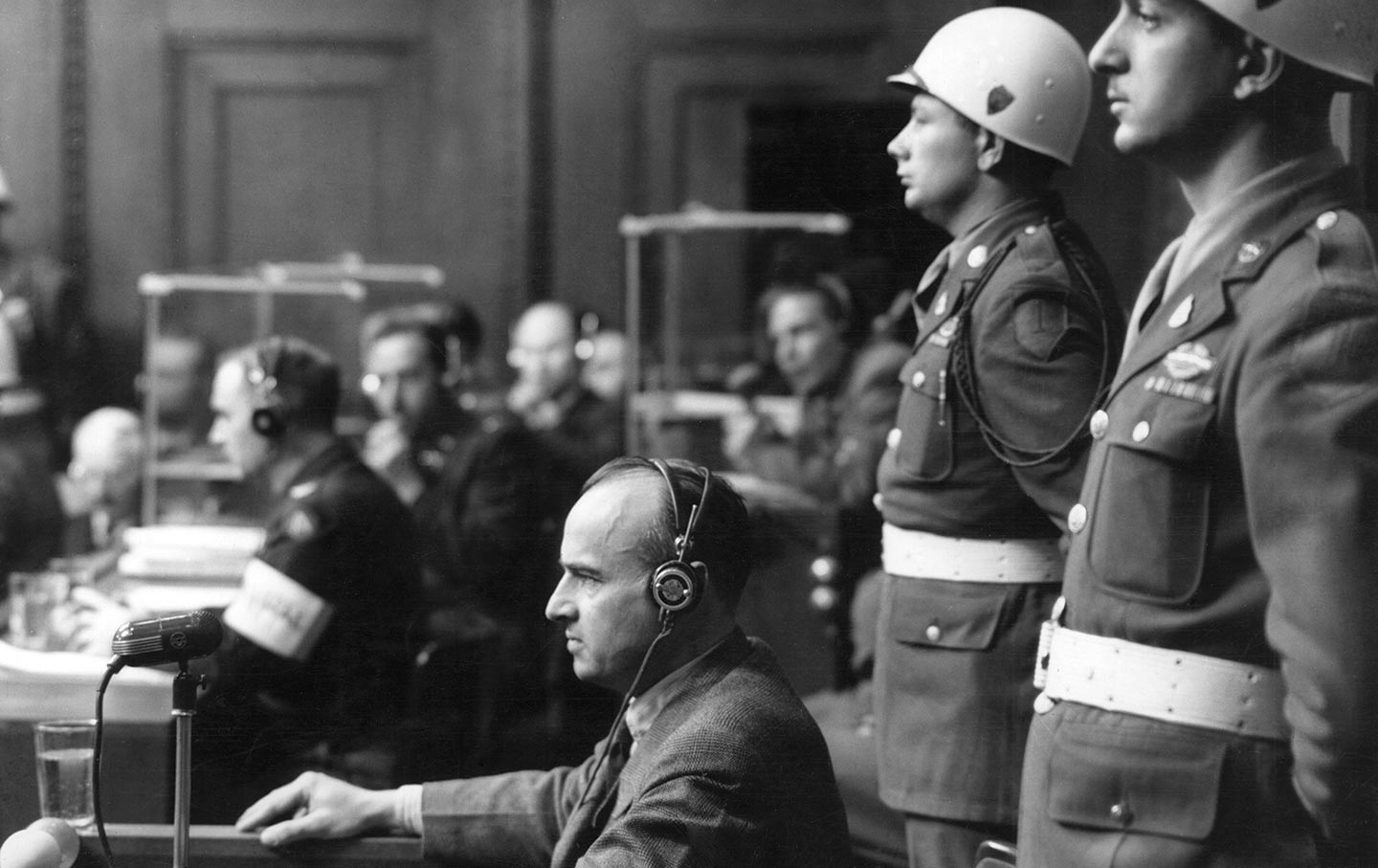
Sometimes “history” tells us at least as much about the present as it does the past. James Vanderbilt’s Nuremberg—the latest filmed depiction of the Allied International Military Tribunal at Nuremberg—vividly illustrates this idea. That is, what we choose to emphasize about the main Nuremberg trial speaks to our current political preoccupations as well as how we understand the wrap-up of World War II in Europe.
Vanderbilt’s vision of the trial for 22 of the surviving Nazi leaders—21 were in fact in the dock—by the United Sates, the USSR, Britain, and France telegraphs its anxieties across the 80 years from the trial’s opening to today. At Nuremberg’s first public session, on November 20, 1945, journalists heralded the opening of “the trial of the century.” Nuremberg’s message to the law and politics of the previous century was that claiming to be “just following orders” shouldn’t cancel individual responsibility for widespread atrocities.
“I was just following orders” became a meme before there were memes. It featured as a recognizable tagline for Nuremberg’s legacy in a variety of cultural, legal, and even scientific contexts of the 20th century—from Stanley Milgram’s electric shock experiments to comic books—and an was an especially poignant headline for activists protesting the conduct of America’s war in Vietnam.
Vanderbilt’s film suggests that it’s time for some new messaging, in terms of Nuremberg’s meaning for the 21st century. The Nuremberg of today—that is, the film version—highlights how no one should be above the law, because the dark side of humanity exists in all of us. That is to say, debates about the wider application of ideas about accountability need to apply to everyone, including “men who possess themselves of great power” everywhere, in the evocative phrase of the US chief prosecutor, Supreme Court Justice Robert H. Jackson.
By highlighting this message, this Nuremberg film also aims to settle another outmoded debate sparked by the trial, namely, whether there was something uniquely evil about the Germans. Today this question sounds merely naïve; at the time of the trial, it was a fierce controversy.
It’s not just that evil is banal (a slogan derived, not entirely fairly, from Hannah Arendt’s writings about another famous trial featuring a roster of crimes against humanity). It’s that exalting the moral authority of the Allies—and particularly of the Americans—resulted in suppressing, contorting, or ignoring accountability to the law in highly selective ways. The Nuremberg trial’s governing charter defined some international crimes as essentially “things the Nazis did” for a reason. There was simply no way to define a concept like illegal aggression in ways that included the Third Reich but excluded the Soviets and the British in Finland, for example. Nuremberg raises this problem of hypocrisy in one of the fierce arguments between the highest-ranking Nazi defendant, Hermann Goering (a superbly smirking, sausage-fingered Russell Crowe) and one of the prison psychiatrists, Douglas Kelley (Rami Malek, in a compellingly pugnacious performance).
Ideas about the role of law are central to Vanderbilt’s rendering. He deftly summits the mountain of exposition about international law necessary to understand why the trial was innovative and why it was so controversial, even among Allies who were ostensibly in agreement about Nazi criminality.
Swiftly spelling out this background is one of Vanderbilt’s bravest decisions. It seemed clear to him, he recounted in a recent interview, that even widely understood 20th-century labels like “the Final Solution” would need to be explained for many young people, as incredible as this initially seemed to him. So he explains. Occasionally, it’s awkward, but he underlines that his goal was to create a film that was not exclusively for history buffs. It’s a brave move because he risks alienating experts, but he is clear: He wants anyone to be able to come to the film and take something away, even people who had never heard of the Nuremberg trial.
The film also zeros in effectively on the essential lawlessness of the Third Reich’s governance of its own population, even as that regime robed itself in the pretense of legality. The so-called Nuremberg Laws of 1935 stripped Jewish Germans (and later Black Germans and Germans of Sinti-Roma heritage) of their citizenship and civil rights. The screenplay suggests that casting people into legal limbo is a harbinger of darker times to come. In other words, it could happen here—and just maybe, it will.
Become a Sustaining Donor This September
Between the reemergence of right-wing red-baiting and Donald Trump’s use of the chilling National Security Presidential Memorandum–7 to criminalize left political organizing, we’re seeing McCarthyism reborn before our eyes.
This assault on democracy cannot be ignored or wished away. Resisting it requires bravery in the face of threats and repression, a steadfast commitment to the truth, and the unwavering belief that we can—and will—overcome this darkness.
We must have an independent media that sets the record straight, unearths corruption and abuses of power, and advances a politics of justice and dignity for all if we’re to win this fight.
That’s why I’m writing to you today. This September, The Nation needs to add 100 monthly donors to sustain our progressive journalism. Your contribution makes the next investigative report, the next truth-speaking column, and the next pathbreaking essay all possible.
I hope you’ll support our work with a recurring donation today. If you donate $10 or more a month, we’ll send you a brand new “Hands Off the Free Press!” sticker to recognise your commitment to our cause. Please, donate today.
Onward,
Katrina vanden Heuvel
Editor and Publisher, The Nation