
At COP30, Will Lula Be a Rain Forest Champion?
During this term, Brazil’s president has reduced deforestation but he is government is pushing projects that would open up the Amazon to extractivism.
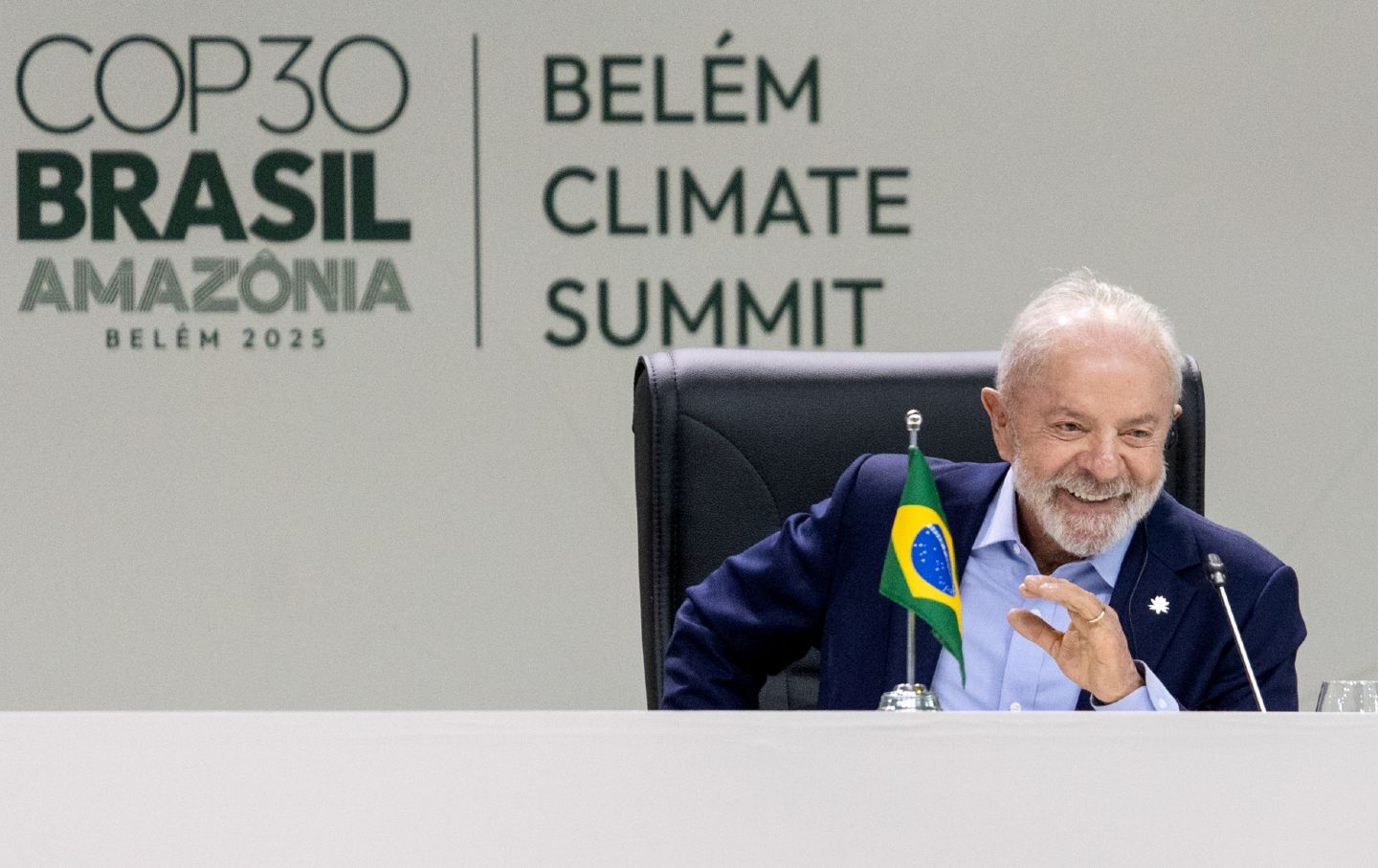
Luiz Inacio Lula da Silva, Brazil’s president, speaks during the COP30 Leaders Summit in Belem, Para state, Brazil, on November. 6, 2025.
(Dado Galdeiri / Bloomberg via Getty Images)Brazil’s president, Luiz Inácio Lula da Silva, has welcomed world leaders to Belém for the first climate summit in the Amazon, where conservationists hope he can be a champion for the rain forest and its people.
But with a divided administration, a hostile Congress, and 20th-century developmentalist instincts, this global figurehead of the center left has a balancing act to perform in advocating protection of nature and a reduction of emissions.
At the opening of the summit on Thursday, he made clear that his priority was social development, but he was clear that humanity had to make an energy transition and halt the lost of forests: “I am convinced that, despite our difficulties and contradictions, we need road maps to—in a fair and planned way—reverse deforestation, overcome dependence on fossil fuels, and mobilize the resources necessary for these objectives.”
Those difficulties and contradictions have been starkly apparent in recent months, in which the government has announced impressive progress in reducing deforestation, while also pushing forward a number of projects that would open up the Amazon to extractivism.
First, the good news. Forest clearance in the Brazilian Amazon has fallen by 50 percent over the full three years of Lula’s third term in office. The latest annual government figures show the smallest area of clearance in 11 years. This is largely thanks to Lula’s environment minister, Marina Silva, who has applied robust measures to counter land invasions, illegal logging, and wildcat mining.
As a result, the Climate Observatory estimates that Brazil’s emissions—which are mainly determined by the health of its forests—have fallen by 16.7 percent, likely to be the steepest fall of any of the G20 group of the world’s 20 biggest economies.
These gains were front and center as Lula pitched for more nations to sign up to Brazil’s flagship initiative at COP30: the Tropical Forest Forever Facility, which aims to raise $125 billion for the protection of standing forests. So far, the initiative has raised about $5.5 billion, with investments of $3 billion from Norway, $1 billion each from Brazil and Indonesia, and smaller sums from Portugal, the Netherlands, and other countries.
The money is desperately needed to stave off the rapidly growing danger that the world’s biggest tropical forest will decline beyond a point of no return, after which it will be condemned to desiccate into a savannah and lose much of its globally important functions of climate stabilization, water transport, and habitat provision.
Senior scientists have warned that this is already happening in wide areas of the Amazon, particularly in the states of Matto Grosso, which has seen a rapid expansion of soy plantations, and Pará, where the primary cause of destruction in the beef industry. The weakening of the forest has also been accelerated by fire (widely used for land clearance) and the contamination of rivers with mercury (which is used in gold mining).
Antonio Donato Nobre, an earth-system scientist who worked in the Amazon for 20 years, said the forest is already showing signs of breakdown. He said droughts are increasingly severe, temperatures in some cleared areas have increased by up to 7 C and degradation is accelerating even as deforestation slows. This poses a global threat, he said, not only because of a reduced carbon sequestration capacity, but because a weaker rain forest means less cloud cover to reflect the sun’s heat back into space, which is potentially a greater warming threat than greenhouse gases.
Nobre said the first climate summit in the Amazon was an opportunity to put nature at the heart of climate solutions but could also be a disaster if leaders paid only lip service to the importance of the forest, while pushing ahead with destructive projects. “My main message is, get serious,” he said. “The most successful enterprise on the planet is called life. We have in our hands a technology that is 4 billion years old and has gone through multiple cycles of destruction and rebirth and refixing.”
But Lula relies on support from the agribusiness and mining sectors to maintain power. Ruralista politicians dominate Congress, control several ministries, and are pushing an aggressive extractivist agenda that runs counter to forest conservation. This lobby is now the driving force in Brazilian politics.
While Lula has vetoed some of its most radical plans to eradicate swaths of environmental licensing requirements, he has also appeared more than willing to support other elements of its agenda to carve up the Amazon and other biomes for the production of fossil fuels and monoculture crops.
Three weeks ago, his government approved drilling licenses for oil and gas exploration at the Foz do Amazonas, off the coast of the rain forest, a move that adds to the contamination risks facing the forest, increases the likelihood of vegetation destruction by related industries and runs contrary to advice from the International Energy Agency that it will be impossible to achieve the Paris Agreement goals of limiting global heating unless countries completely halt new fossil fuel development.
Then there are the government’s plans to upgrade the BR-319 highway between Manaus and Porto Velho, which will put unprecedented pressure on the western regions of the Brazilian Amazon, which have—until now—been one of the last healthy regions of the forest.
Another large intact area is close to the northwest border with Venezuela, but this too is menaced by plans to permit industrial mining in the Yanomami Indigenous territory.
“We’re very worried,” said one of those in the region, Ehuana Yaira Yanomami, who has come to Belém to relay the fears of the women of her community. “We don’t want our people to suffer, we are very worried and that’s why we are speaking out, because illegal mining only brings suffering to our communities. We want to see our children healthy, without mud and without the fish being contaminated.”
Popular
“swipe left below to view more authors”Swipe →Farther south, the government announced in late August that it would “de-statize” the federal waterways of three major rivers; the Tapajós, Madeira, and Tocantins, which is seen as a first step toward their privatization and transformation into a hydrovia water transport route for soy shipped from Mato Grosso.
Lula, who cut his political teeth as a union negotiator, has tended to focus more on the social benefits that can come from increased investment in the Amazon, while skirting the far greater risks that the climate crisis poses to its human and nonhuman residents.
That was evident last week at a pre-COP30 publicity tour of forest communities along the Tapajos river. At the Vista Alegre do Capixauã village of the Kumaruara people, the president said he was ready to stand up for those who protect the forests, and promised to improve local healthcare, education and housing. This was very much in keeping with one of Brazil’s declared objectives in the summit: to make social protection a foundation of resilience.
But during the parts of his visit open to the press, Lula did not make a single mention of the climate, even though this is a growing concern for local people—and a huge majority of the world’s population.
The head of a neighboring village, Luis Antonio Bentes de Sousa, said that much of the river dried up during last year’s record drought, leaving the communities here stranded and struggling to feed themselves. He said his vegetable garden had shriveled up, most of his fruit trees died and for the first time in his 70-year-life he was unable to grow manioc, the primary staple of the Amazon diet.
“It is getting hotter and drier,” he said.” I worry for my children and grandchildren.”
Others spoke of mass fish deaths due to the heat, contamination, and low water levels, and expressed fears that this will become worse when the river they depend on is privatized and turned into a canal for soy barges.
These uncomfortable topics—and their politically difficult solutions—were not raised during the speeches and glad-handing of Lula’s visit until the very end, when Environment Minister Marina Silva asked for the microphone and reminded the president why they are in the Amazon this month: “COP30 is a place for us to say that Brazil will do its part, eliminating deforestation. And the world needs to do its part, reducing emissions of coal, oil, and gas. That is why I like it when, sir, you say it’s necessary to stop depending on fossil fuels.”
This was a reminder that in Belém, Lula—like many world leaders—will have a good forest angel on one shoulder and a fossil fuel demon on the other. The question is which will hold sway.
Become a Sustaining Donor This September
Between the reemergence of right-wing red-baiting and Donald Trump’s use of the chilling National Security Presidential Memorandum–7 to criminalize left political organizing, we’re seeing McCarthyism reborn before our eyes.
This assault on democracy cannot be ignored or wished away. Resisting it requires bravery in the face of threats and repression, a steadfast commitment to the truth, and the unwavering belief that we can—and will—overcome this darkness.
We must have an independent media that sets the record straight, unearths corruption and abuses of power, and advances a politics of justice and dignity for all if we’re to win this fight.
That’s why I’m writing to you today. This September, The Nation needs to add 100 monthly donors to sustain our progressive journalism. Your contribution makes the next investigative report, the next truth-speaking column, and the next pathbreaking essay all possible.
I hope you’ll support our work with a recurring donation today. If you donate $10 or more a month, we’ll send you a brand new “Hands Off the Free Press!” sticker to recognise your commitment to our cause. Please, donate today.
Onward,
Katrina vanden Heuvel
Editor and Publisher, The Nation
More from The Nation
Big Oil’s Origin Story Big Oil’s Origin Story
Amy Westervelt’s new book, Brought to You By, exposes the deep history of today’s “information pollution.”
Is Nepal a Turning Point in Climate Coverage? Is Nepal a Turning Point in Climate Coverage?
Even CBS News and Bari Weiss, who fired the outlet’s entire climate unit, have used Nepal as a watchword for environmental disaster.

Oatly Says Climate Action Now Oatly Says Climate Action Now
The world’s largest oat drink company is printing summaries of what it calls “the ultimate climate solution” on every carton it produces.

Have We Forgotten Covid’s Lessons? Have We Forgotten Covid’s Lessons?
This summer’s deadly heat calls for news coverage based on science, not ideology.
As Europe Burns, a Climate Cover-Up Continues As Europe Burns, a Climate Cover-Up Continues
The UK’s Labour Party seems afraid to talk about the climate emergency.

World Cup Hydration Breaks Were Not About Commercials World Cup Hydration Breaks Were Not About Commercials
As the world gets hotter, playing sports in the heat gets more dangerous. Telemundo is the only publication that got this right.

