This Heat is Fatal. We Need to Talk About it.
“When people die during heat waves, there’s no sort of gunshot wound.”
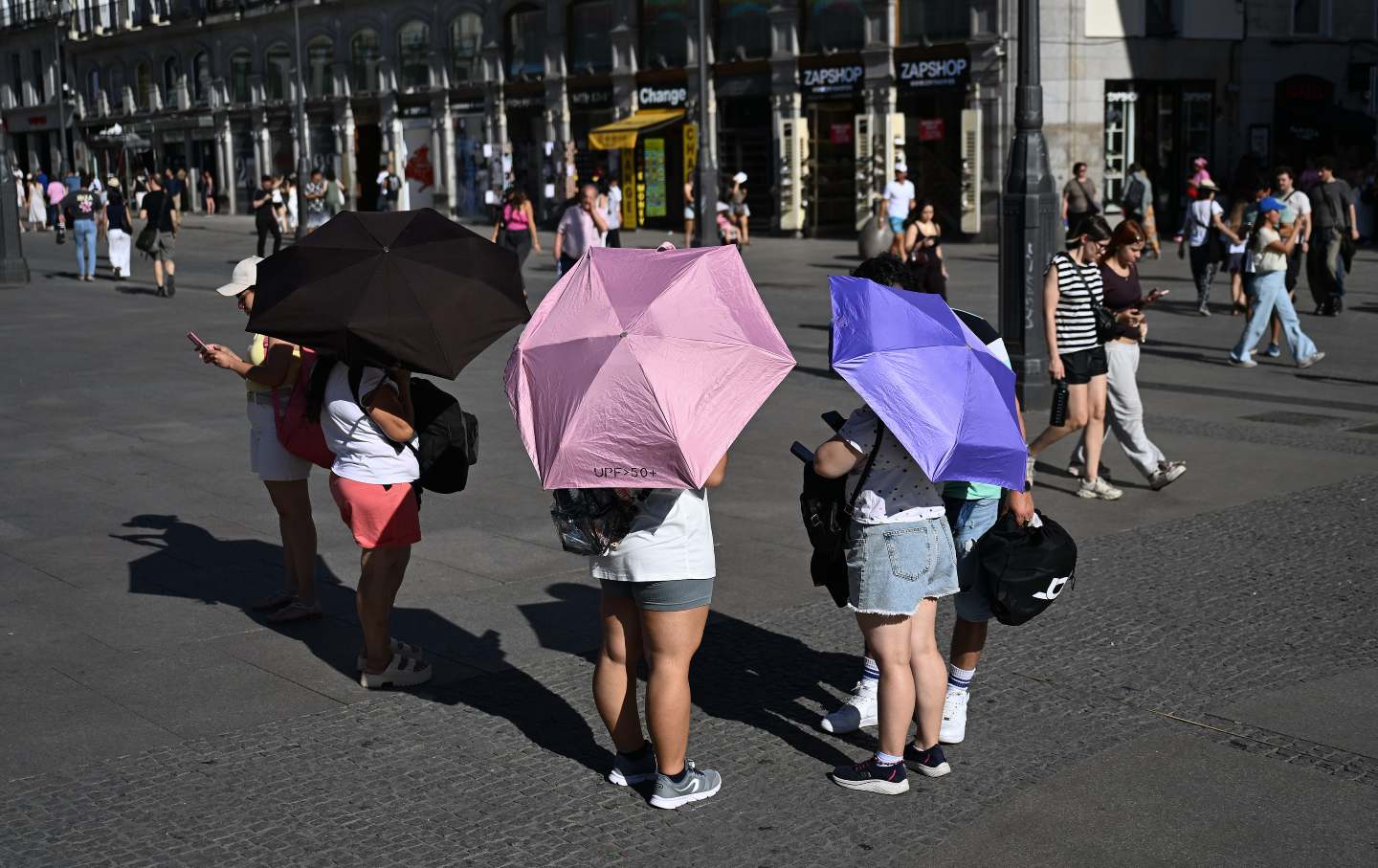
People protect themselves from the heat wave that affects daily life as high temperatures continue, on June 26, 2026, in Madrid, Spain.
(Burak Akbulut / Anadolu via Getty Images)
Fifty years ago, the recent deadly heat wave that shattered temperature records across Europe would have been virtually impossible. That’s according to a new scientific study by the nonprofit World Weather Attribution. And they’re not the only ones saying this. “Driven by climate change and global warming, the phenomenon of the ‘once-in-a-generation’ heatwave is now occurring nearly annual[ly],” said Tedros Adhanom Ghebreyesus, the director-general of the World Health Organization. At least 1,300 people have died, an initial WHO accounting estimated, as France, Germany, and other countries reel from the hottest temperatures on record.
Now it’s North America’s turn. This weekend, an estimated 250 million people across the eastern half of the US will face a ferocious heat wave, with temperatures above 100 degrees Fahrenheit in many places. Then it will be Europe’s turn again, as another surge of extreme heat is projected to hit the continent.
It’s the same story in Asia: China, Japan, and Korea all experienced their hottest summers on record last year. And in May, India was home to 97 of the world’s 100 hottest cities, as temperatures of 45 to 48 degrees Celsius (113 to 118 degrees F), became routine. A report by the Carnegie Endowment for International Peace highlighted the scale of human suffering, pointing out that “roughly three-quarters of India’s workforce—about 380 million people—labors in heat-exposed sectors, agriculture and construction above all.”
It’s too soon to know how many people will die from all this heat. Partly that’s because heat “is invisible,” said Jeff Goodell, the author of The Heat Will Kill You First, at a webinar that Covering Climate Now hosted on June 30 to help journalists cover extreme heat. “When people die during heat waves, there’s no sort of gunshot wound…. So it takes some detective work on the part of officials and others to come up with good numbers about mortality rates.”
Indeed, initial reports estimated that the landmark 2003 European heat wave had killed 15,000 people, a figure sometimes still repeated today. However, subsequent epidemiological analysis concluded that the actual death toll was nearly five times higher. Today, one expert has calculated that more than 20,000 people likely died during the June 2026 European heat wave. Although the study has not yet been peer-reviewed, its author, Christopher Callahan of Indiana University, applied vetted methods for estimating heat mortality to conclude that 5,210 people likely died in France, 4,543 in Germany, 3,163 in Spain, and 2,709 in Italy.
Despite the unequivocal link between climate change and extreme heat, a distressing number of news stories have not made the climate connection to this unfolding disaster. In the United States, the evening news shows of ABC, CBS, and NBC led their June 23 broadcasts with the European heat wave but “failed to mention climate change even in passing,” reported the media watchdog Fairness and Accuracy in Reporting. Given the advanced state of climate attribution science in 2026, that is simply not journalistically defensible.
Civic-minded reporting can literally save lives. Journalists are part of what scholars call the “social infrastructure” that shapes how communities experience and respond to extreme weather. In the short term, that means providing accurate, timely information about the dangers facing people and how they can stay safe. But the best reporting also explains why this deadly heat is happening in the first place: Humans have overheated the planet, primarily by burning fossil fuels, and this is making heat waves hotter, longer, and more frequent.
One mistake journalists should particularly avoid is pairing extreme heat stories with photos or videos that portray the heat as positive, even fun, Saffron O’Neill, a professor at the University of Exeter, said during the webinar. A peer-reviewed study O’Neill and colleagues conducted of news coverage of the 2019 European heat wave found that “fun in the sun [images] of people splashing around in city fountains, having fun at the beach,” was common, she said. Scholarly analysis, she added, has discovered that “if you have a story that pulls in different narrative directions—[if] you have text that says one thing, this is a public health emergency, and you have a visual that says something else—people tend to go with the visual, they’ll see [extreme heat] as not…something they need to care about.”
What’s indisputable is that more heat is coming. The soaring temperatures and sticky humidity brutalizing so much of the planet today are happening after average global temperatures have risen “only” 1.4 degrees C above preindustrial levels. But global temperatures are on track to rise 2.7 degrees Celsius and will keep rising, scientists say, until humans phase out the burning of fossil fuels. “What scares me most,” Patrick Galey, the head of fossil fuels investigations for the nonprofit Global Witness, said at the webinar, “is that, if we continue to allow the fossil fuel industry to profitably poison us to death, this will be the coolest summer for the rest of our lives.”
Become a Sustaining Donor This September
Between the reemergence of right-wing red-baiting and Donald Trump’s use of the chilling National Security Presidential Memorandum–7 to criminalize left political organizing, we’re seeing McCarthyism reborn before our eyes.
This assault on democracy cannot be ignored or wished away. Resisting it requires bravery in the face of threats and repression, a steadfast commitment to the truth, and the unwavering belief that we can—and will—overcome this darkness.
We must have an independent media that sets the record straight, unearths corruption and abuses of power, and advances a politics of justice and dignity for all if we’re to win this fight.
That’s why I’m writing to you today. This September, The Nation needs to add 100 monthly donors to sustain our progressive journalism. Your contribution makes the next investigative report, the next truth-speaking column, and the next pathbreaking essay all possible.
I hope you’ll support our work with a recurring donation today. If you donate $10 or more a month, we’ll send you a brand new “Hands Off the Free Press!” sticker to recognise your commitment to our cause. Please, donate today.
Onward,
Katrina vanden Heuvel
Editor and Publisher, The Nation