
Winning a Fossil Fuel Divestment Pledge Is Hard. Keeping It Is Harder.
Nearly a decade after promising to withdraw millions in fossil fuel investments, the University of Massachusetts has stalled on its clean energy transition. What happened?
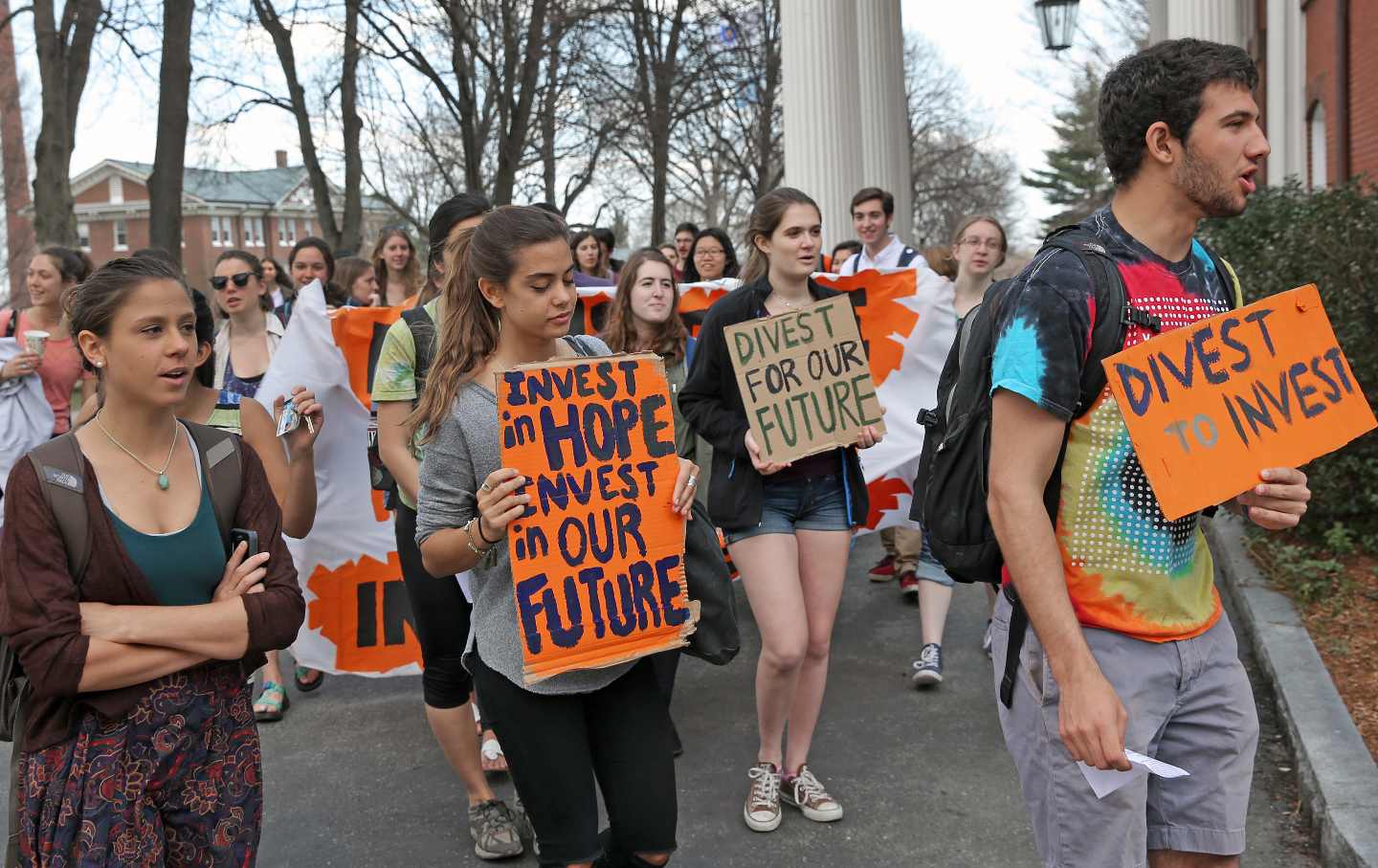
Students and alumni at Tufts University demonstrate for fossil fuel divestment in April 2015.
(David L. Ryan / Getty)In 2016, the University of Massachusetts became the first major public university in the United States to sever direct financial ties with the fossil fuel industry. For years, relentless student organizing had been met with administrative intransigence and repeated rejection. But the Divest UMass campaign only grew larger, louder, and more determined.
When protests escalated into sit-ins, administrators called police to break them up. Students refused to back down, and within a month, UMass pledged to withdraw an estimated $5–8 million in fossil fuel holdings from its endowment, having already been pressured to dump $400,000 in coal stocks months earlier.
After years of obstruction, the administration seemingly embraced divestment. President Marty Meehan lauded the students’ “principled persistence,” crediting them with having “put divestment on the agenda.” Then-chancellor Kumble Subbaswamy praised their “passionate commitment to social justice and the environment.”
Eager to capitalize on the positive press that portrayed UMass as a progressive climate leader, administrators repackaged a grassroots victory as institutional branding. Co-opting the storied history of campus activism from anti-Vietnam protests to anti-apartheid campaigns, they rolled out its latest slogan: “Be Revolutionary.” It was introduced alongside a new strategic plan promising a just transition to renewable energy and a pledge to achieve carbon neutrality by 2032. A student referendum endorsed the proposal with 92 percent support.
But what appeared as an unambiguous victory for students and the planet—an example of the university as a laboratory of democracy and social change—has soured into institutional hypocrisy. Rather than deepen commitment to civic engagement, they have instead cultivated a culture of opacity and repression, designed to ensure that such campaigns never succeed again. Nearly a decade after the divestment pledge, UMass has stalled on its clean energy transition, and the university continues to maintain indirect fossil fuel investments.
In 2016, the administration conceded that complicity with such industries was both unsustainable and indefensible. Today it clings to a narrow definition of fiduciary responsibility, treating indirect investments as occupying a separate moral and ethical category, detached from the social and ecological harm they perpetuate.
The full financial picture is difficult to discern. While UMass is a public university, its endowment is managed by the private UMass Foundation, a bureaucratic arrangement that shields investments and operations from scrutiny. The limited records available reveal millions invested in oil and gas giants, including at least $1.1 million in ExxonMobil alone, not only one of the world’s largest polluters but sits atop the list of 100 corporations responsible for 71 percent of global greenhouse emissions since 1988. Investing in Exxon, or financial institutions like JPMorgan Chase that bankroll fossil fuel expansion, violates the spirit if not the letter of divestment.
Universities often defend such indirect holdings as too complex to untangle, or too vital to protect returns. At UMass, however, that defense collapses. First, as Meehan himself acknowledged, the decision was never primarily financial: “Higher education institutions have an obligation to show leadership on moral issues facing our society,” he said. “I think it sends the right message.” Second, far from UMass suffering losses, its endowment has nearly doubled over the past decade, from roughly $789 million in 2014 to $1.5 billion today.
Indirect holdings might be understandable, though not excusable, in isolation. But UMass’s refusal to confront them is part of a broader retreat from its stated democratic principles and climate commitments. Even as the endowment has ballooned, little has been directed toward the promised clean energy transition, which has all but ground to a halt.
Lori Goldner, a professor emerita of physics and a member of the campus decarbonization subcommittee has grown increasingly frustrated. Electrification, she acknowledges, is “massively expensive,” but, she insists, “it is what they promised to do. They need to find a way to make the transition.”
Most harmful has been the adoption of so-called “renewable” diesel. “There really is no such thing,” Goldner explains. Once conceived as a temporary solution for sectors such as transportation, it has morphed into a lucrative market for waste oil, fueling deforestation and land dispossession in places like Brazil and Indonesia. If UMass embraces such “solutions,” she warns, it will incentivize others to do the same, legitimizing “the oil companies’ new scam for survival” and prolonging the fossil-fuel economy under the guise of sustainability.
The administration has also internally tried to shift metrics to justify this backsliding. While total campus CO2 emissions rose by 7 percent last year, a members of the Chancellor’s Sustainability Advisory Committee attempted to claim progress by citing per-capita reductions. “That is not how anybody measures it,” Goldner stresses. The committee did not respond to request for comment.
History professor Kevin Young recalls administrators justifying renewable diesel on the grounds that campus solar capacity was “virtually maxed out.” But staff in the Physical Plant, responsible for handling campus energy usage, counter that claim, reporting that UMass “could at least double the number of solar panels” already installed.
In its attempts to mask its failures, the university has now redefined success downward, while true alternatives remain neglected for lack of political will and amid a growing culture of impunity. Posters touting a “carbon-zero campus” remain visible at construction sites across campus, but as Goldner puts it: “Carbon zero no longer exists. They should take those down.”
The retreat from transparency has been paired with rising repression of free expression—especially around Gaza solidarity protests. In the 2023–24 academic year, nearly 200 students were arrested and faced charges and disciplinary proceedings for employing many of the same tactics once celebrated as part of the Divest UMass campaign. Only this time, their demand was divestment from Israeli apartheid and from war profiteers such as Raytheon.
After it became clear that students were now treating the university’s slogan, “Be Revolutionary,” as a genuine call to action, the administration quietly retired it, marking not only the abandonment of climate commitments but also the erosion of any pretense of democratic accountability.
Whether pressing for fossil-fuel divestment or ending ties with war profiteers, campus coalitions have continued to exhaust official channels: submitting reports, circulating petitions, and in the fossil-fuel campaign case, collecting more than 1,100 signatures. Yet each time, the answer has been identical: “respectfully denied,” without explanation, without appeal, and without disclosure of who made the decision or on what grounds.
This sense of stalled progress has led members of the Sunrise Movement at UMass Amherst, an organization originally launched by then–UMass undergraduate Varshini Prakash at the height of the fossil fuel divestment campaign, to conclude that the university has “failed to act as responsible stewards of the environment.”
Administrators continue to insist that sustainability is central to their identity. Yet, as Sunrise organizers argue, “we have seen them so shamelessly bend to the will of climate-destroying profiteers,” a pattern they say “further corroborates their position as a predatory corporation that has betrayed students, faculty, and the Commonwealth of Massachusetts.”
What explains this shift? To some extent, the Trump administration emboldened antidemocratic tendencies across institutions nationwide. Yet the transformation at UMass cannot be reduced to external pressures alone. It reflects a longer trajectory that dates back to the 1970s, as universities increasingly embraced corporate logic and profit-seeking at the expense of their public mission.
The erosion of democracy on campus is thus emerging as much from within as without. As Young observes, at UMass “our trustees and administrators have responded to external attacks by leaning harder into the corporate model. That means tailoring curriculum and research more closely to the desires of corporations, repressing those who protest genocide, and cutting back on superfluities like clean energy and climate justice.”
Popular
“swipe left below to view more authors”Swipe →This is not a question of scarcity. It is a question of priorities. “It is not that there is no money,” Young insists. “UMass Amherst has run regular surpluses of $100 million or more. Administrators spend lavishly on football stadiums and their own salaries while telling everyone else to tighten their belts.”
What has expanded alongside these surpluses is a managerial class of careerist administrators and trustees whose commitments lie not with the university’s historical mission as much as with the incentives of profit. The current chancellor, Javier Reyes, appointed in 2023, has overseen a period marked by open hostility to dissent and a fixation on short-term financial performance at the expense of long-term institutional and environmental sustainability.
“We are caught in the pincers of external ideologues and internal careerists,” Young warns. The result is a public university increasingly governed as if it were a private corporation, accountable neither to its students nor to the broader community it was created to serve.
In less than a decade, UMass has gone from celebrating student activism as a source of renewal to criminalizing it. Climate pledges have been hollowed into marketing slogans, and campus has been remade as a site of repression rather than democratic engagement.
In the process, students have realized that democratic backsliding is not confined to Washington. It is reproduced in their own institutions, creating a vicious cycle in which unelected boards and unaccountable administrators operate with contempt for the communities they claim to serve.
“We see the student struggle today not only as a push for divestment itself, but as a push for the democratization of our campus,” explained student organizer Eric Strong. It is a matter of “putting decision-making power back in the hands of students, faculty, and staff where it belongs.”
Become a Sustaining Donor This September
Between the reemergence of right-wing red-baiting and Donald Trump’s use of the chilling National Security Presidential Memorandum–7 to criminalize left political organizing, we’re seeing McCarthyism reborn before our eyes.
This assault on democracy cannot be ignored or wished away. Resisting it requires bravery in the face of threats and repression, a steadfast commitment to the truth, and the unwavering belief that we can—and will—overcome this darkness.
We must have an independent media that sets the record straight, unearths corruption and abuses of power, and advances a politics of justice and dignity for all if we’re to win this fight.
That’s why I’m writing to you today. This September, The Nation needs to add 100 monthly donors to sustain our progressive journalism. Your contribution makes the next investigative report, the next truth-speaking column, and the next pathbreaking essay all possible.
I hope you’ll support our work with a recurring donation today. If you donate $10 or more a month, we’ll send you a brand new “Hands Off the Free Press!” sticker to recognise your commitment to our cause. Please, donate today.
Onward,
Katrina vanden Heuvel
Editor and Publisher, The Nation
More from The Nation
The Impossible Will Take a Little While: The Power of Persistence The Impossible Will Take a Little While: The Power of Persistence
In troubled times, history offers a lesson: Seemingly impossible change can begin with ordinary people who refuse to give up.
Gloria Steinem’s Many-Splendored Feminist Life Gloria Steinem’s Many-Splendored Feminist Life
The feminist icon lived the struggle for gender equality and always found time to lend support and solidarity to other women leaders, even in her final days.
No, Woke 1 Was Not Crazy No, Woke 1 Was Not Crazy
AOC and others are laughing off 2020 as a wild, isolated moment. None of that is true.
How Occupy Wall Street Still Explains Politics Today How Occupy Wall Street Still Explains Politics Today
It sowed the seeds for a new era of social movements—but its politics of powerlessness should act as a cautionary tale.

Abdul El-Sayed’s Win Is a Landmark. But the Fight Is Far From Over. Abdul El-Sayed’s Win Is a Landmark. But the Fight Is Far From Over.
Even though the Palestine movement is on the march, we can’t afford any complacency.

Mamdani’s Team Redefined Political Video. Now They’re Betting on Short Films. Mamdani’s Team Redefined Political Video. Now They’re Betting on Short Films.
Premiering exclusively in The Nation, a new short film produced by City Hall and narrated by Morgan Spector highlights the efforts of the biggest tenant-led union in New York City...

