
“We’re Asking the Voters to Have a Say”: Inside California’s Redistricting Fight
Proposition 50 is an opportunity to “restore fairness in our democratic process,” according to organizers, by countering gerrymandering in other states.
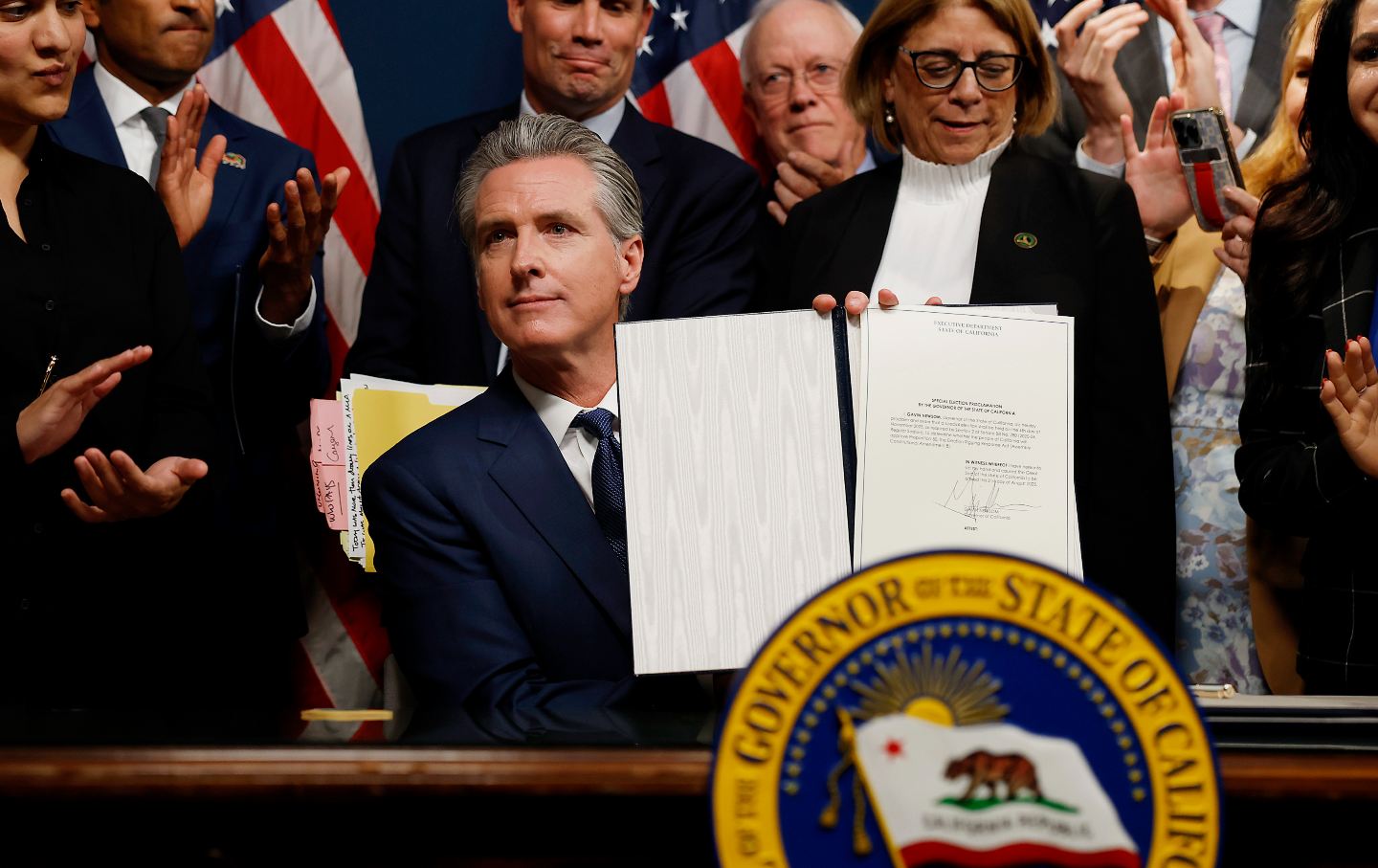
California Gov. Gavin Newsom signs bills related to redrawing the state’s congressional maps on August 21, 2025 in Sacramento, California.
(Justin Sullivan / Getty)
This November, California voters will decide who gets the power to draw the state’s political maps.
Proposition 50, which appears on the 2025 ballot, would amend California’s Constitution to give the legislature temporary authority to redraw the state’s congressional districts. If passed, it would suspend the work of the state’s current Independent Redistricting Commission for the next three election cycles, before returning control to the commission in 2030.
Supporters describe Prop. 50 as a short-term correction meant to safeguard representation after Republican-led states such as Texas, Florida, and Ohio passed aggressive redistricting laws. Former president Barack Obama and Governor Gavin Newsom have publicly backed the initiative, framing it as a necessary counterweight to Republican redistricting efforts.
At its core, Prop. 50 raises fundamental questions about how democracy functions in California and beyond: Who should hold the pen when political power is being divided?
For groups like Third Act, a national democracy and climate organization that works with older activists, it’s an opportunity to “restore fairness in our democratic process,” according to Mike Johnson, the group’s democracy campaigns manager. Voters are “the ultimate deciders in our democracy,” he said. “Everything from housing costs to climate policy comes back to whether voters are being fairly represented.”
Prop. 50 is a defensive measure, according to Johnson, a way to ensure California’s voice in Congress isn’t weakened by gerrymandered maps in other states, allowing the Legislature to redraw congressional boundaries for the 2026, 2028, and 2030 elections. These new maps would replace those created by California’s Independent Redistricting Commission, which voters established in 2008 and expanded in 2010 to cover congressional districts.
Susan Shelley, the vice president of communications for the Howard Jarvis Taxpayers Association, an organization opposing Prop. 50, argues that comparing the proposal to redistricting efforts in Texas, where Republican lawmakers redrew congressional maps widely criticized as gerrymandered, is misleading. “Texas never adopted an independent redistricting commission. So the voters of Texas want their legislature to draw the lines, and it’s that way in many other states. They use the traditional procedure of having the legislature draw the lines in a political way,” Shelley said. “But the voters of California reformed that process. They didn’t want that, and they did it very thoughtfully.”
While a 2008 initiative in CA created an independent commission to draw the state office boundaries, a vote in 2010 also appointed an independent commission to draw map boundaries for congressional races as well. “Californians said they don’t want politicians drawing the maps,” said Shelley. “Prop. 50 says, ‘Let’s give the politicians the power to draw the maps again.’ Certainly, the voters could decide that’s what they want, but this is a snap decision in a special election with a minimum amount of information.”
Of course, the move would be temporary, said R.L. Miller, chair of the California Democratic Party’s Environmental Caucus and the founder of Climate Hawks Vote, who calls Proposition 50 “the most important thing on the ballot” in 2025. “We’re going to revert back to the Independent Commission in 2030,” he said. “We’re asking the voters to have a say. What they did in Texas—they ran through it without asking the voters.”
Miller argues that Prop 50 will have national implications. “If we don’t pass Proposition 50, it would be very difficult for Democrats to flip the House before the gerrymandering started,” she said. “California needs to pass Prop. 50 just to give us an equal shot at possibly flipping the House—and if we flip the House, we can stop the Trump agenda, conduct oversight, and restore checks and balances.”
While Shelley’s main arguments against Prop 50 revolve around its “undermining” of constitutional legitimacy, she also referenced the cost of this special election. Proposition 50 is the only measure on this November’s special ballot. “It’s a special election which is costing the taxpayers in excess of $280 million at a time when the state is in a budget emergency and dipping into reserves to cover spending,” Shelley said. “We don’t think the Constitution should be so lightly amended in a special election on short notice.”
Supporters of Prop. 50 say those criticisms miss the bigger picture. “The budget stuff—honestly, it’s just a drop in the bucket,” Miller said. “Talking about a couple of million dollars is absolutely a red herring. It’s trivial compared to the stakes.”
Proponents also note that Prop. 50 explicitly endorses the idea of a national anti-gerrymandering law—something Miller and other advocates believe could finally level the playing field between blue and red states. “Blue states have been disarming while red states have been arming up,” Miller said. “If Democrats take the House and Senate, we need to pass an anti-gerrymandering bill nationwide.”
Student organizers said the initiative has become “a lightning rod” and “focal point” for young democratic activists. In San Francisco’s “No Kings!” protest on October 18, for example, Prop. 50 was often the main motive for many young people participating in the march.
Student groups have channeled that energy into their own campaigns. For the first time, members of the Harvard Democrats have partnered with groups across the country, like the Stanford Democrats, to host phone banks encouraging Californians to vote yes on Prop. 50. “What happens in the US Congress as a result of Prop. 50 is going to affect me in Rhode Island, even if they aren’t my elected officials,” said Dominick Lombard, the Harvard chapter’s campaign director. “We’re seeing a lot of broad coalitions forming. Because we have so many students from California and Texas, we’ve heard firsthand accounts about how this will impact them,” said Lombard. He sees the national organizing around the issue as a collective effort. “What happens in the US Congress as a result of Prop. 50 is going to affect me in Rhode Island, even if they aren’t my elected officials.”
Popular
“swipe left below to view more authors”Swipe →More from The Nation

We Were Warned in 2001 We Were Warned in 2001
Science-fiction nightmares are now current events.

2028 Democratic Hopefuls Take on Data Centers 2028 Democratic Hopefuls Take on Data Centers
Data center opposition can foster a bigger Democratic tent by aligning red and blue, and rural and urban communities.

Making America Accountable Again Making America Accountable Again
Corporate leaders say they should be shielded from congressional inquiries because they had no alternative but to collaborate with the Trump administration. History says otherwise...

Minnesota Has Ilhan Omar’s Back Minnesota Has Ilhan Omar’s Back
Minnesotans say the raid on Omar’s home was all about politics. They also argue that it will backfire and generate boosted turnout for DFL candidates.

A Horrific ICE Shooting Is Testing Mamdani’s Approach to Trump A Horrific ICE Shooting Is Testing Mamdani’s Approach to Trump
After a federal agent shot an immigrant in New York, activists are questioning Mamdani’s handling of the NYPD and his relationship with the White House.

Jane Doe: Courage and Dignity Jane Doe: Courage and Dignity
Allegations of gang rape and sex trafficking at Cornell University highlight persistent concerns about rape culture, even years after the #MeToo movement.

