
We’re Thinking About College Rankings All Wrong
The annual list from U.S. News and World Report is helpful for affluent families and those with the resources to compete for a spot at elite universities. What about everyone else?
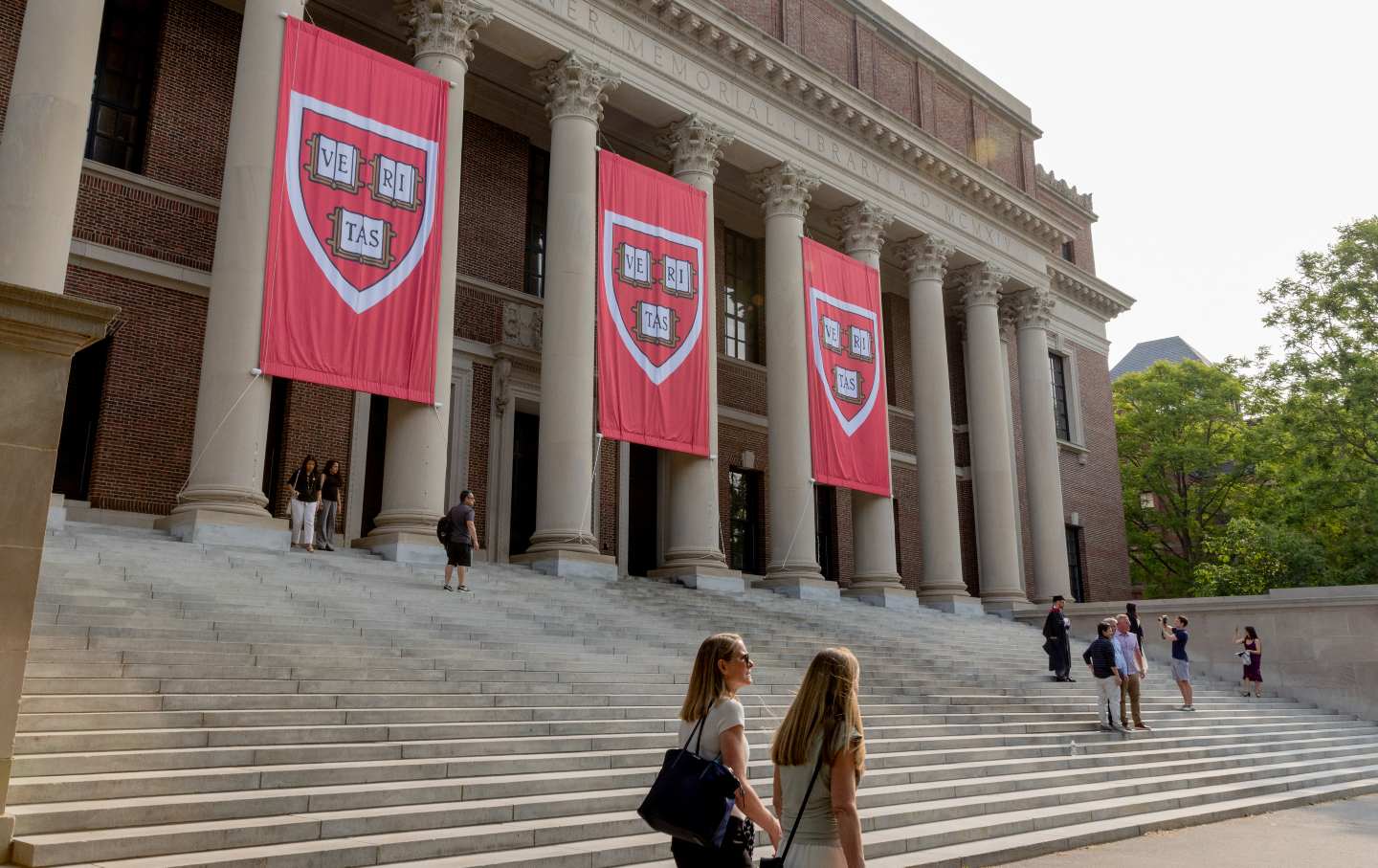
The Widener Library on the Harvard Campus in Cambridge, Massachusetts.
(Cassandra Klos / Getty)The ostensible arbiter of college rankings—U.S. News and World Report—has released its annual list of the top institutions of higher education. The 2026 report is predictable, with minor changes, ranking elite Ivy League schools like Princeton and Harvard in their top five.
The U.S. News ranking isn’t a goblet of fire from which colleges are cryptically chosen. It claims to base its choices on 17 different categories, including retention rates, financial resources, and standardized test scores. Most universities send in their own data, but statistics from the US Department of Education are also taken into account. In the 19th century, it was initially the responsibility of the Bureau of Education—the Department’s predecessor—to publish annual reports ranking institutions of higher education. That practice ended in 1890.
In 1983, U.S. News published its first college ranking. For nearly 45 years, the list has shaped the perception of higher education as we know it, impacting application rates, enrollment rates, and marketing efforts by universities. For the past eight years, my school UCLA has been leveraging its “#1 public research university” rank placed upon it by U.S. News, publicizing it through banners on campus and online posts to boost applicant appeal (this year UCLA moved to number 2, falling short to UC Berkeley).
But while many rely on the ratings for guidance on where to apply, many others question whether creating such a hierarchy of educational institutions is helpful for the American public at all.
Paul Glastris, editor in chief of Washington Monthly, says the U.S. News rankings are based on values that are unhealthy for students and for society, giving a “hot nightclub idea of what a college is” and rewarding institutions primarily based on exclusivity, wealth, and prestige. He explained that the U.S. News rankings help compel other colleges to arrange themselves based on these factors in order to climb the list. “That would mean all the colleges are trying to be more selective, more expensive, and more brand-oriented,” Glastris said.
U.S. News aside, a majority of platforms use similar college rankings metrics, and have a comparable lineup of “top 10” schools. But many experts agree that such rankings are of primary relevance to those who come from affluent families and have the resources to compete for positions in elite universities. Harvard Medical School and Yale Law School have boycotted the U.S. News rankings, declining to give their data because of concerns about institutions’ placing metrics over educational mission.
Washington Monthly publishes its own rankings, which Glastris says sort institutions based on “upward mobility, research, and service.” According to its “Best Colleges for Your Tuition (and Tax) Dollars” List, Berea College in Kentucky is 28 spots above Harvard University. The list—which uses data provided by federal records—prioritizes institutions on factors like affordability, promotion of public service, and accessibility to non-wealthy students. With these metrics, Berea College (where a majority of students pay no tuition and graduate debt-free) outranks Harvard.
“Focusing on elite, selective universities—Harvard, Yale—makes selective elite universities the locus of energy, money, and attention,” Glastris said. “It takes away those resources from the colleges that 90 percent of students go to.”
Glastris emphasized how the rankings provided by U.S. News do not cater to the majority of college-going students in the United States, who may not have a top-tier SAT score or come from a wealthy background. The Washington Monthly list, in contrast, tries to rank colleges and universities by how much they help the average student, an outcome most Americans—students and taxpayers alike—should want from the higher education system.
The U.S. News report also lacks information about affordability, and how the degree one obtains there translates to future employment—factors for which Washington Monthly tries to account.
Since the 1960s, the cost of tuition at public, four-year institutions has nearly quadruped, and more and more people believe that the usefulness of a college degree is evaporating. “The U.S. News methodology encourages colleges to throw money at the problem and makes college more expensive,” said Glastris. Lining up institutions based on un-necessary metrics—which emphasize wealth and set quixotic expectations—fuels unnecessary competition rather than illuminating higher education’s true value for every student.
Become a Sustaining Donor This September
Between the reemergence of right-wing red-baiting and Donald Trump’s use of the chilling National Security Presidential Memorandum–7 to criminalize left political organizing, we’re seeing McCarthyism reborn before our eyes.
This assault on democracy cannot be ignored or wished away. Resisting it requires bravery in the face of threats and repression, a steadfast commitment to the truth, and the unwavering belief that we can—and will—overcome this darkness.
We must have an independent media that sets the record straight, unearths corruption and abuses of power, and advances a politics of justice and dignity for all if we’re to win this fight.
That’s why I’m writing to you today. This September, The Nation needs to add 100 monthly donors to sustain our progressive journalism. Your contribution makes the next investigative report, the next truth-speaking column, and the next pathbreaking essay all possible.
I hope you’ll support our work with a recurring donation today. If you donate $10 or more a month, we’ll send you a brand new “Hands Off the Free Press!” sticker to recognise your commitment to our cause. Please, donate today.
Onward,
Katrina vanden Heuvel
Editor and Publisher, The Nation
More from The Nation
How Trump’s Crackdown on Speech Has Damaged the Student Press How Trump’s Crackdown on Speech Has Damaged the Student Press
I serve as editor in chief and president of The Stanford Daily. Our newsroom has keenly felt the effects of Trump’s campus crackdown, which is why we sued the federal government.
Nationalize Spotify Nationalize Spotify
Music streaming platforms have way too much control over musicians and music lovers. It’s time to rein them in.
What’s the Matter With Effective Altruism? What’s the Matter With Effective Altruism?
President Trump has decried the techbro creed for indulging in AI doomerism, but its excesses are far worse than that.

As Morale Sags, More Military Service Members Are Having a Crisis of Conscience As Morale Sags, More Military Service Members Are Having a Crisis of Conscience
According to multiple GI rights organizations, service members are inquiring in unprecedented numbers about seeking conscientious objector status.
What Remains of Riis? What Remains of Riis?
A new members’ club has revived Riis Park’s long-vacant bathhouse, reopening old questions about whom the People’s Beach is really for.

When Texas Sex Ed Falls Short, Gen Z Women Turn to Social Media When Texas Sex Ed Falls Short, Gen Z Women Turn to Social Media
A 2025 study found that 70 percent of adolescents sought reproductive health information through social media platforms.

