
No, the White House Is Not Getting a 90,000-Foot Extension
But Trump’s doomed proposal does give us a revealing glimpse into his state of mind.
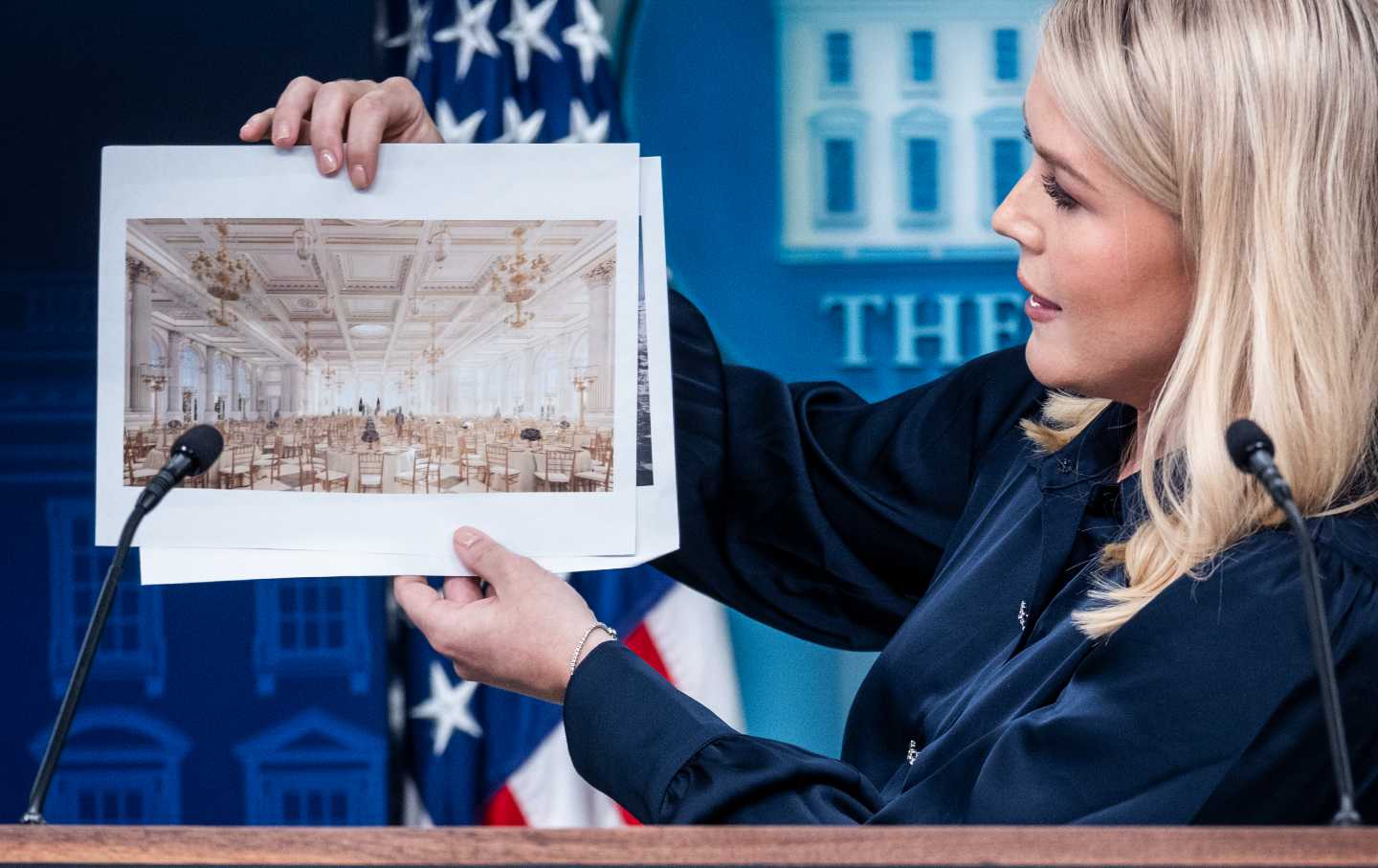
White House Press Secretary Karoline Leavitt shows off this pipe dream.
(Pete Marovich / Getty)When it was announced on August 1 that the president was planning to build a 90,000-square-foot ballroom off the White House’s East Wing, I already knew what it would look like before even clicking the press release. When I saw who the architect was—James McCrery, one of the great warhorses of the neoclassical revival, a Trump 1.0 Fine Arts Commission appointee, and a professor at the Catholic University of America—I was utterly unsurprised. That AECOM, perhaps the architecture and construction world’s most unethical firm, would be providing the engineering work? Almost inevitable.
It all makes sense. There are not many architects working full-time to build Neo-Palladian churches in the nation’s greenest suburbs, and the coterie of “trad” architectural thinkers who have inserted themselves in the president’s orbit for the last 10 years is not very large. (Perhaps there is no other group in the field that punches so far above its weight.) McCrery, best known for huge religious buildings, is one of the few people in this select group feasibly capable of working at scales of 90,000 square feet.
When the announcement dropped, the architectural press scrambled to respond. (It’s not often that we get opportunities like these.) The American Institute of Architects immediately released a statement that basically amounted to “he can’t do that”—and it’s true, he technically can’t. Changes to the exterior of the White House are exceedingly rare. The last major update was the second-floor balcony on the front façade added by Harry S. Truman in 1948. This is in part because the White House and its grounds, while excluded from the National Historic Preservation Act of 1966, have their own guidelines set by the Committee for the Preservation of the White House. The director of the National Park Service chairs this committee, which is staffed by federal officials and some members, such as those from the Fine Arts Commission, selected by the president. While each administration modifies the White House’s interiors to their own taste (or, in Trump’s case, lack thereof), national preciousness about the building, combined with the practical need to meticulously insulate it from terrorist attacks, makes major exterior facelifts effectively impossible.
Much has already been said about the renderings McCrery has supplied to the media. (He has since scrubbed his website of his firm’s previous work, but images of it can still be found on the Wayback Machine.) The proposed building vastly out-scales its companion; the entire White House complex is around 55,000 square feet. The ballroom’s domineering rows of large arched windows are more 19th century than 18th, more Eastern Europe than East Wing. The interior is replete with tsarist chandeliers and Corinthian columns, and falls neatly within Trump’s penchant for white-and-gold pseudo-Baroque. It is to McCrery’s credit that he keeps the references within Gilded Age range rather than gilded-toilet range.
That Trump wants to build the ballroom in the first place speaks to his penchant for the trappings of authoritarianism and his view of himself as the king sitting atop his rightful throne in his rightful castle. It’s his house, can’t he do what he wants with it? While they share some commonality with existing iterations of “dictator chic,” both the ballroom and its modified neoclassicism are a wistful paean to a 19th-century statesmanship predicated on the closed, intimate gatherings of noblemen and industrialists that may or may not have involved dancing. The project finds, uneasily, a broader analogy in how the world’s great imperial superpowers continue to act in increasingly undemocratic ways. Like it or not, this may very well be the architecture of the post-neoliberal order.
However, what McCrery has actually given us so far are only a handful of images: the mockup of the exterior, rendered in the ghostlike mode that’s basically the default setting on a lot of architectural software, and the glowy interior shots with their infinitely repeated wedding chairs. Any practicing architect can tell you that neither of these are serious renderings. They were made quickly and are not comprehensive in what they are trying to convey to either the client or the public. Were this a competition in which a legitimate client was being presented with a standard competition entry, these images simply would not pass muster. (Presently, I am serving as an adjudicator for an early-career architectural competition, and the under-30s who have turned in work are running circles around Mr. McCrery.) But we are not talking about a legitimate endeavor here but rather the architectural equivalent of vaporware (i.e., software or hardware that is advertised but never comes to fruition). Trump wants this thing done by 2029, which is farcical. (It’s so farcical that I suspect it’s mostly a distraction tactic.)
The truth is, Donald Trump is a man of his time, and his time was the 1980s. If you want to understand the man’s architectural thinking and doings, don’t look to either 1890s Gilded Age opulence or 1930s high fascism, but to ’80s glitz and tackiness.
This “’80s-ness” isn’t limited to just Trump’s Liberace-chic penthouse interiors and his wheelings and dealings as a developer. It’s that the height of his pre-political cultural power coincided with the peak of architectural postmodernism. Postmodernism, most famous for its pastel colors, exaggerated architectural features, use of irony, and integration of historical forms with contemporary construction practices, showed up in everything from grocery stores to Manhattan skyscrapers. Trump’s neo-trad personal style falls roughly into this category, though the buildings he developed are more on the corporate-modern side of things. (As always, he talks out of both sides of his mouth.)
While later much maligned, postmodernism was once a more cerebral enterprise, one that took to task modernism’s form-follows-function ethos (which had begun to undermine itself through over-complex structures and excessive formal articulation). It interrogated architecture’s relationship with language and symbology. Signs and signification were the order of the day, whether in the fry-shaped mansards of McDonald’s or in the pediment of Philip Johnson’s AT&T Building. By the late ’80s, however, the movement had split. Its neoclassical side, once the purview of pastel whimsy peddlers like Michael Graves, took a reactionary and anti-intellectual turn. This was epitomized by architects like Leon Krier, whose pseudo-ethnographical defenses of classicism didn’t look so different from the work of Charles Murray, and by projects such as then-Prince Charles’s Poundbury, a (rather sad) neo-Georgian town built from scratch. This was the group that gave us “people like Disney World because it has walkable urbanism” as though it were a genuine intellectual contribution. In fact, Disney itself was the major bankroller of late pomo, not only its parks but also its planned community of Celebration, Florida—a kind of Columbus, Indiana, for Mousketeers.
The other half of this split were the architects more interested in the theoretical side, drawing on the work of poststructuralists like Jacques Derrida. These architects, best represented by Peter Eisenman, sought to architecturally render concepts from philosophy and literary studies, in particular Derrida’s idea of deconstruction, which interrogates binaries and hierarchies within literary texts. The architectural work of this cohort was more abstracted and less, well, pedimented. Eventually the term “deconstructivism” would be associated with the likes of Frank Gehry, whose buildings appeared to be literally blown apart, but that’s neither here nor there.
McCrery, who graduated from the Ohio State University in the 1980s (where he was surely enveloped in these kinds of debates), ended up at Eisenman’s New York office in the 1990s and pretty much immediately revolted. He swiftly took a different job with the classicist Alan Greenberg, all the while pooh-poohing his “postmodern” training as being “rigorous” but “spiritually empty.” (For what it’s worth, the architecture critic Christopher Hawthorne called up Eisenman and asked him what he thought of his former employee’s proposed White House extension, to which he responded that “putting a portico at the end of a long façade and not in the center is what one might call untutored.” The man’s still got it!)
I don’t doubt McCrery’s spiritual attachment to classical architecture. However, one cannot understand the present situation and the players involved without the necessary context of the pomo style wars. In terms of architectural history, far from being an academic attempt to revive Greco-Roman ornamental language or an out-of-the-blue Trump 2.0 phenomenon, what we are seeing with the White House ballroom is merely the latest round in a boxing match that’s been going on since before I was even born. But postmodernism—including postmodern neoclassicism—petered out in the ’90s and was replaced with Gehry’s exploding beer cans and the slick, cool Dutch stylings of Rem Koolhaas. The postmodernists may have won the battle, but the modernists, for all intents and purposes, won the war. What’s ridiculous about all of this, however, is that one side—not dissimilar to the rest of Trump’s quixotic culture warrior fantasies—never stopped fighting.
Become a Sustaining Donor This September
Between the reemergence of right-wing red-baiting and Donald Trump’s use of the chilling National Security Presidential Memorandum–7 to criminalize left political organizing, we’re seeing McCarthyism reborn before our eyes.
This assault on democracy cannot be ignored or wished away. Resisting it requires bravery in the face of threats and repression, a steadfast commitment to the truth, and the unwavering belief that we can—and will—overcome this darkness.
We must have an independent media that sets the record straight, unearths corruption and abuses of power, and advances a politics of justice and dignity for all if we’re to win this fight.
That’s why I’m writing to you today. This September, The Nation needs to add 100 monthly donors to sustain our progressive journalism. Your contribution makes the next investigative report, the next truth-speaking column, and the next pathbreaking essay all possible.
I hope you’ll support our work with a recurring donation today. If you donate $10 or more a month, we’ll send you a brand new “Hands Off the Free Press!” sticker to recognise your commitment to our cause. Please, donate today.
Onward,
Katrina vanden Heuvel
Editor and Publisher, The Nation
More from The Nation

America Without the NFL America Without the NFL
Chuck Klosterman’s Football is a eulogy for the sport on the eve of its decline.
Edward Said: Between Worlds Edward Said: Between Worlds
A new film biography depicts the Palestinian writer as still out of place—and ahead of his time.

Imani Thompson’s Grad-School Thriller Imani Thompson’s Grad-School Thriller
In Honey, the novelist offers a different take on the campus satire.

Love and Literature in Leslie Fiedler’s America Love and Literature in Leslie Fiedler’s America
When will the American novel grow up?

