Can Solar Energy Save Us?
Bill McKibben’s new book argues that sun power can displace fossil fuels.
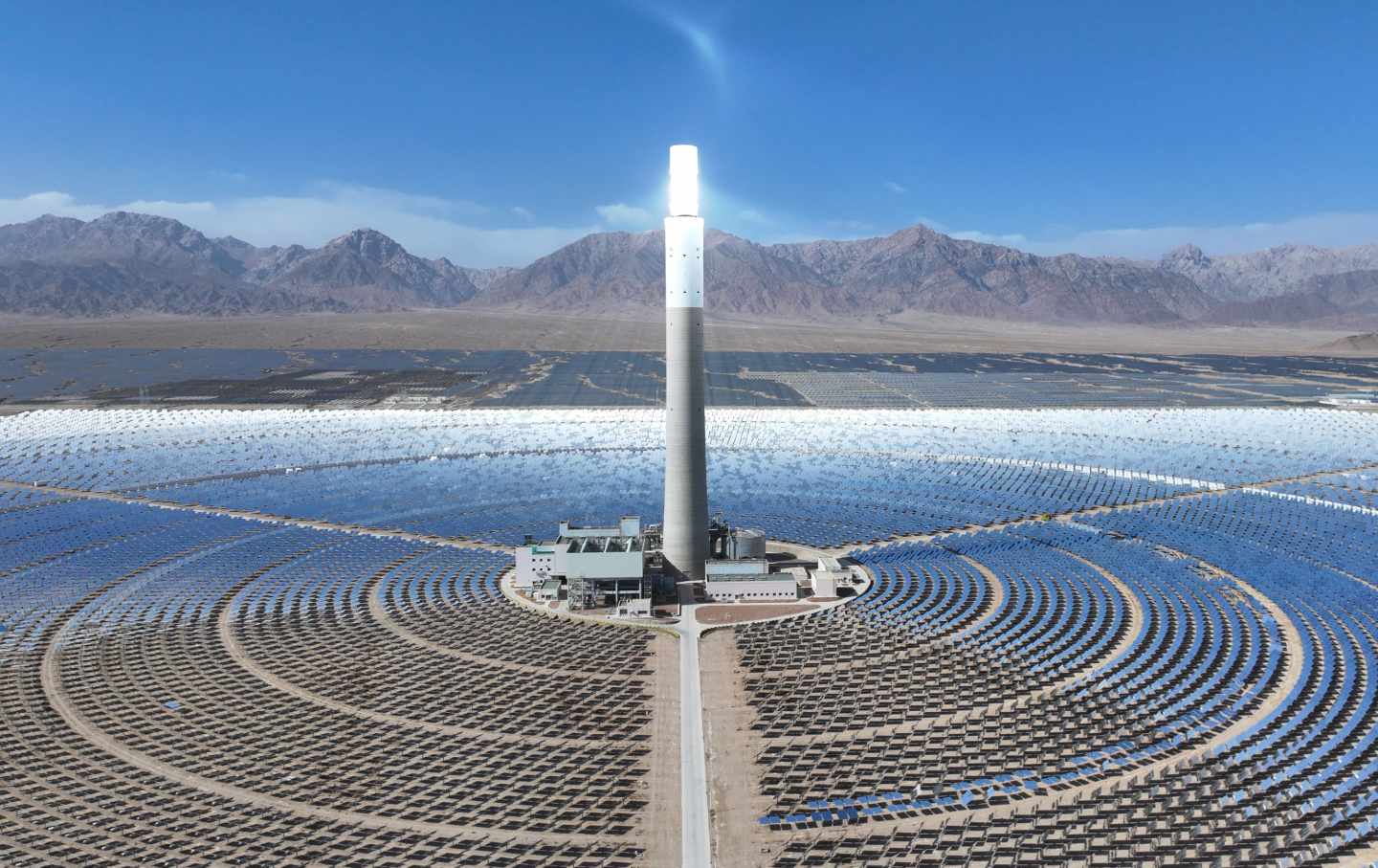
An aerial view of the CGN Delingha Solar Thermal Plant, a 50 megawatt energy storage project, on April 15, 2025 in Qinghai province, China.
(Ma Mingyan/China News Service / VCG via Getty Images)
No journalist has covered the climate story longer or better than Bill McKibben. In 1989, as a 27-year-old staff writer at The New Yorker, he published the first mass-market book on the subject, The End of Nature. Since then, he has reported from around the world, covering all aspects of the issue—science, economics, politics, ethics—with an output other writers can’t help but envy. He has done his share of calling out the fossil fuel chieftains and their government and financial enablers, but he has also paid special attention to the scientists, activists, and other civil society representatives pushing against climate breakdown.
Indeed, almost 20 years ago, McKibben did something traditional journalists frown upon: He became an activist himself. With some of his students at Middlebury College in Vermont, he formed 350.org, a group named after the atmospheric level of carbon dioxide known to be compatible with civilization as we know it. When 350.org was founded in 2008, Earth’s atmosphere contained 385 parts per million of CO2. Today, it’s 427 ppm—the highest in at least 3 million years—and rising fast.
In his new book, Here Comes the Sun, McKibben wears both his journalist and activist hats. His core argument is that the sun’s rays, transformed into electricity, might still help humanity to escape the worst of climate change. It won’t be easy, but shifting from fossil fuels to solar energy fast enough “to stay on anything like a survivable path” is “on the bleeding edge of the technically possible.”
That path, scientists have said, requires slashing emissions by half over the next five years. That could happen, McKibben suggests, because of a game-changing but underappreciated economic development. “Sometime in the early part of the 2020s,” he writes, civilization “crossed an invisible line where the cost of producing energy from the sun dropped below the cost of fossil fuel. That’s not yet common knowledge”—mainly because “so much of [the solar revolution] is taking place in China”—but it makes a rapid, global phase out of fossil fuels not just technically possible but economically advantageous.
But if economics now favor solar, politics remain a towering challenge. The entrenched interests behind fossil fuels intend to burn “every last molecule of oil and gas” beneath the earth’s crust, Vicki Hollub, the CEO of Occidental Petroleum, said in 2024. So, citizen activism, McKibben adds, remains imperative.
All this and more makes Here Comes the Sun an essential read for anyone interested in where the climate story is heading. McKibben’s reporting is thorough and thought-provoking. He investigates a number of concerns about solar—are there enough raw materials and land to produce all the panels and electricity needed?—and concludes that such concerns are overstated. (More solar will indeed mean more mining for lithium and other minerals, he notes, but it will also put a halt to the vastly greater amount of mining for coal, gas, and oil.)
For journalists, Here Comes the Sun proffers a cornucopia of story ideas and a bracing re-evaluation of the future of the climate fight. It refutes the notion that society can’t afford to stop burning fossil fuels, while emphasizing that the decisive question is how quickly those fuels get left behind. “I have little doubt we will run the world on sun and wind 40 years from now,” McKibben writes, “but if it takes us anything like 40 years to get there, then it will be a broken planet; our energy sources will hardly matter.”
Become a Sustaining Donor This September
Between the reemergence of right-wing red-baiting and Donald Trump’s use of the chilling National Security Presidential Memorandum–7 to criminalize left political organizing, we’re seeing McCarthyism reborn before our eyes.
This assault on democracy cannot be ignored or wished away. Resisting it requires bravery in the face of threats and repression, a steadfast commitment to the truth, and the unwavering belief that we can—and will—overcome this darkness.
We must have an independent media that sets the record straight, unearths corruption and abuses of power, and advances a politics of justice and dignity for all if we’re to win this fight.
That’s why I’m writing to you today. This September, The Nation needs to add 100 monthly donors to sustain our progressive journalism. Your contribution makes the next investigative report, the next truth-speaking column, and the next pathbreaking essay all possible.
I hope you’ll support our work with a recurring donation today. If you donate $10 or more a month, we’ll send you a brand new “Hands Off the Free Press!” sticker to recognise your commitment to our cause. Please, donate today.
Onward,
Katrina vanden Heuvel
Editor and Publisher, The Nation