The Rule of Law Is Dead in the US
The rule of law presupposes that there are rules that provide a consistent, repeatable, and knowable set of outcomes. That’s no longer the case.
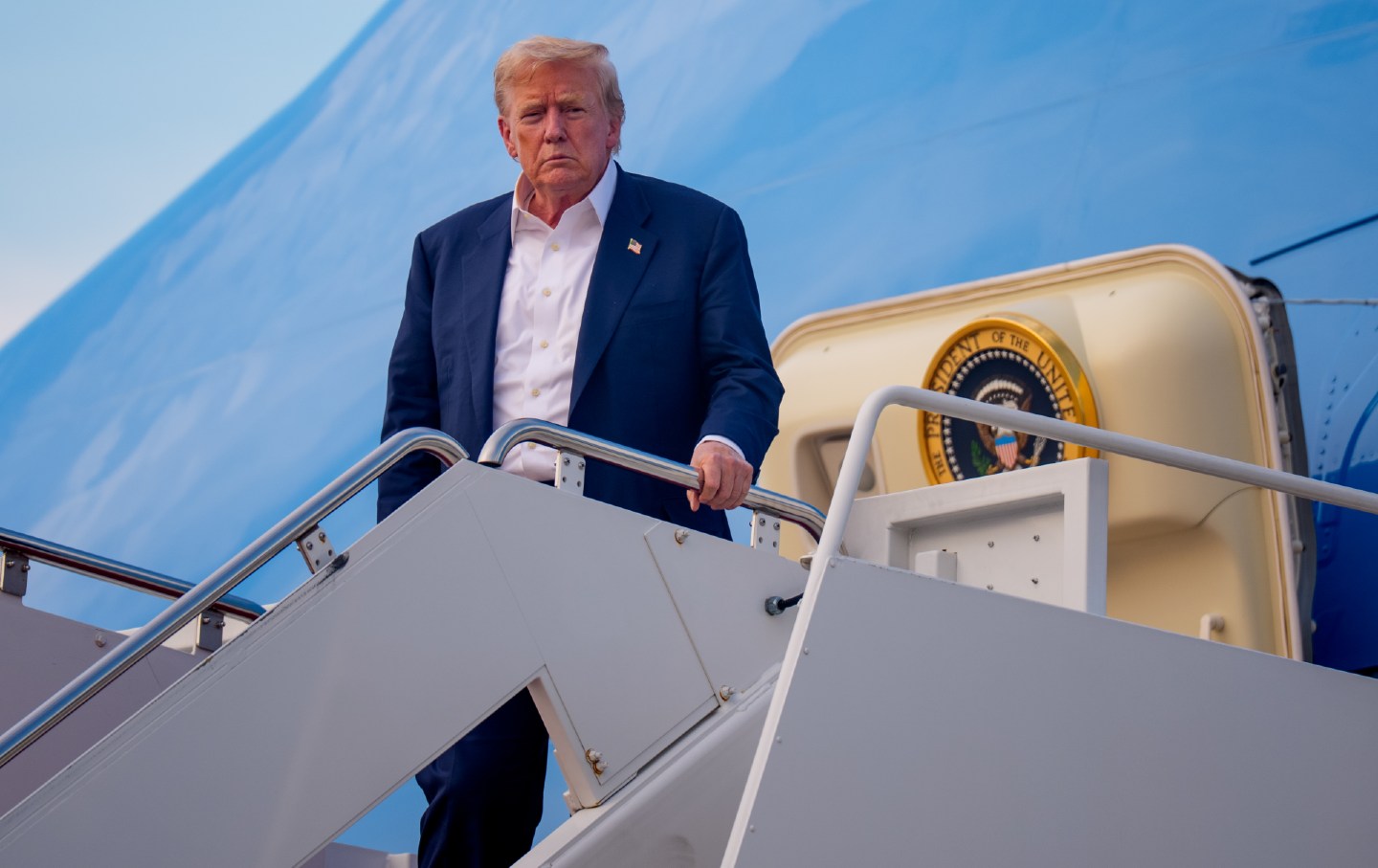
US President Donald Trump walks on the South Lawn of the White House after arriving on Marine One in Washington.
(Bonnie Cash / UPI/Bloomberg via Getty Images)Idid not write an “end of term” Supreme Court review piece this year because… what’s the point? The intellectual exercise of parsing how the conservative supermajority bends and breaks legal principles to achieve the Republican agenda feels unimportant when plotted against the court’s refusal to apply any legal standards whatsoever to Donald Trump or his administration. Complaining about the Supreme Court’s decisions in this case or that case feels like a guy on the Titanic complaining about the song selection from the band.
The rule of law presupposes that there are, well, rules. These rules are supposed to provide a consistent, repeatable, and, most important, knowable set of outcomes. Predictability is the key feature of a functioning rules-based system, because people have to know the rules—and the consequences of breaking them—before they act. The difference between living under the rule or law and living by the whims of a madman is that the rights, responsibilities, prohibitions, and privileges of your situation do not change radically every time a person in power throws a hissy fit.
But the Supreme Court has decided that rules and laws do not apply to Trump, and they don’t protect anybody from Trump. That means that the rule of law is functionally dead in this country (which shouldn’t be entirely surprising, given that this country almost never respects the rule of law in other countries). Nobody can know if the rights they have today will be the rights they have tomorrow. Nobody can know if a thing that is illegal for the government to do to them today will be illegal for the government to do to them tomorrow.
We see the truth of this country’s descent into lawlessness every single day. All you have to do is pick up a newspaper, turn on the television, or go to Trump’s social media account. Nearly every “news” story you’ll see falls into one of two categories: Trump did something, or Trump threatens to do something. Nobody can reliably say whether those actions or threats are “legal” because everybody knows (whether they will admit that to you are not) that rules and laws no longer apply to the Trump regime.
That is why following the news feels the way it does right now. Humans like predictability. It’s hardcoded into our species. But Trump can threaten anything, literally anything at all, and nobody can know if he can be stopped. Whether or not Trump’s policies come to fruition is more about how serious Trump is about making that policy happen, not about whether there are any rules or structures in place that will prevent those policies from happening.
I’m a freaking expert on “the law” and I can no longer tell you if the latest thought bubble out of Trump’s mouth is “constitutional.” Anybody who claims they can is straight-up lying to you at this point. I can perhaps tell you how the Supreme Court will make whatever thing Trump wants to do legal. What I can’t tell you is what would happen if the court told Trump “no.” Would such a ruling stop him? Would he ignore it? Right now, there just isn’t a lot of evidence that Trump would be stopped by an adverse Supreme Court ruling. To the contrary, there is a mountain of evidence that Trump would ignore a decision that he didn’t like: A new study showed that the Trump administration has defied one in three judicial orders.
When it comes to the rule of law, two out of three is indeed very bad. You do not live in a lawful society if the laws apply only two out of three times. A rule that works only 66 percent of the time is not a law but a suggestion. The fact that Trump follows the law sometimes, but not other times, means that laws only matter if Trump thinks they should.
I can imagine some people arguing that the fact that the president operates beyond the rule of law does not mean that the rule of law is dead. These people would be wrong: The rule of law exists in opposition to the rule of one man. If the president can change the rules at will and is also not himself subject to consequences for breaking the law, then the rule of law does not functionally exist.
I am not naïve: I am well aware that the rich and powerful generally operate outside the rules and laws as they are applied to most regular people. What makes the Trump administration unique (in the American context) is that the lawlessness doesn’t just apply to him personally; it applies to any person, official, or institution he bestows his favor on. Homeland Security Secretary Kirsti Noem operates outside the rule of law as long as what she’s doing pleases Trump. Elon Musk operated outside the rule of law until he displeased Trump. ICE seemingly has the power to abduct people and brutalize citizens, noncitizens, and even elected officials that get in their way. And thanks to the ubiquitous pardons Trump has granted to his cronies and cult followers who attacked the Capitol on January 6, any barbeque-splattered thug in a MAGA hat might also operate beyond the rule of law as long as they’re doing something Trump wants them to do.
We see this in the news all the time. Is Alina Habba allowed to be the US Attorney for New Jersey? Based on the rule of law, no, of course not. Based on the rule of Trump, who can know? Can RFK Jr. make measles great again? Can Lee Zeldin overturn the Clean Air Act? Can Pete Hegseth orchestrate bombing operations over Signal? Can Sean Duffy run NASA? The answer to all these questions is “maybe?” because whether or not Trump or anybody in his administration can do this or that thing is not based on any rule or law governing that thing.
The analogy I’ve often used to explain our current legal system comes from the first Pirates of the Caribbean movie. I’m being entirely serious. There’s a brilliant little scene where Captain Jack Sparrow is trying to explain the law of the high seas to the naïve Will Turner. Sparrow says, “The only rules that really matter are these: what a man can do and what a man can’t do.” He explains that he can kill Turner right there on the spot, but that he can’t bring the ship they’re on into port all by himself. Sparrow’s inability to do what he wants long-term is the only thing constraining him from doing what he wants to do right now.
A pirate ship is not a democracy; it is a dictatorship. So too is the current American ship of state. The only thing constraining what Trump does today is what he wants to do tomorrow. The only people and institutions allowed to function are the ones Trump needs to help him accomplish his future aims. And the rules and laws do not exist to limit Trump, his officials, or his supporters; they exist to limit the options of people and forces who oppose Trump.
Again, if you don’t believe me, just pick up a paper. Point to the thing you are sure Trump is not allowed to do, and tell me who you imagine is going to stop him. You will quickly realize that what we’re pinning our hopes on is not the rule of law. What we’re hoping for is a mutiny.
Disobey authoritarians, support The Nation
Over the past year you’ve read Nation writers like Elie Mystal, Kaveh Akbar, John Nichols, Joan Walsh, Bryce Covert, Dave Zirin, Jeet Heer, Michael T. Klare, Katha Pollitt, Amy Littlefield, Gregg Gonsalves, and Sasha Abramsky take on the Trump family’s corruption, set the record straight about Robert F. Kennedy Jr.’s catastrophic Make America Healthy Again movement, survey the fallout and human cost of the DOGE wrecking ball, anticipate the Supreme Court’s dangerous antidemocratic rulings, and amplify successful tactics of resistance on the streets and in Congress.
We publish these stories because when members of our communities are being abducted, household debt is climbing, and AI data centers are causing water and electricity shortages, we have a duty as journalists to do all we can to inform the public.
In 2026, our aim is to do more than ever before—but we need your support to make that happen.
Through December 31, a generous donor will match all donations up to $75,000. That means that your contribution will be doubled, dollar for dollar. If we hit the full match, we’ll be starting 2026 with $150,000 to invest in the stories that impact real people’s lives—the kinds of stories that billionaire-owned, corporate-backed outlets aren’t covering.
With your support, our team will publish major stories that the president and his allies won’t want you to read. We’ll cover the emerging military-tech industrial complex and matters of war, peace, and surveillance, as well as the affordability crisis, hunger, housing, healthcare, the environment, attacks on reproductive rights, and much more. At the same time, we’ll imagine alternatives to Trumpian rule and uplift efforts to create a better world, here and now.
While your gift has twice the impact, I’m asking you to support The Nation with a donation today. You’ll empower the journalists, editors, and fact-checkers best equipped to hold this authoritarian administration to account.
I hope you won’t miss this moment—donate to The Nation today.
Onward,
Katrina vanden Heuvel
Editor and publisher, The Nation
More from The Nation
Trump’s “Warrior Dividend” Might Be His Scariest Idea Yet Trump’s “Warrior Dividend” Might Be His Scariest Idea Yet
This week’s “Elie v. US” explores the authoritarian threat beneath Trump’s bonuses for military families. Plus, a case for getting rid of the Second Amendment.

HUD Is Refusing to Enforce Anti-Discrimination Law—and Won’t Let Anyone Else Do It, Either HUD Is Refusing to Enforce Anti-Discrimination Law—and Won’t Let Anyone Else Do It, Either
The initial chaos of layoffs has been followed by a concerted effort by the Trump administration to halt the enforcement of the Fair Housing Act.
Why Ilhan Omar Makes the Right Lose Its Mind Why Ilhan Omar Makes the Right Lose Its Mind
Trump and his MAGA allies want people like Omar to vanish from this country—and they hate her for refusing to do so.

Brad Lander on What It Takes to Win as a Progressive Brad Lander on What It Takes to Win as a Progressive
The outgoing New York City comptroller discusses governing on the left, his run for Congress, and why housing and affordability should define the next Democratic fight.

