Desperate for Fuel in Gaza
An extraordinary eyewitness report reveals that food isn’t the only thing Palestinians are starved of. Fuel is almost as scarce.
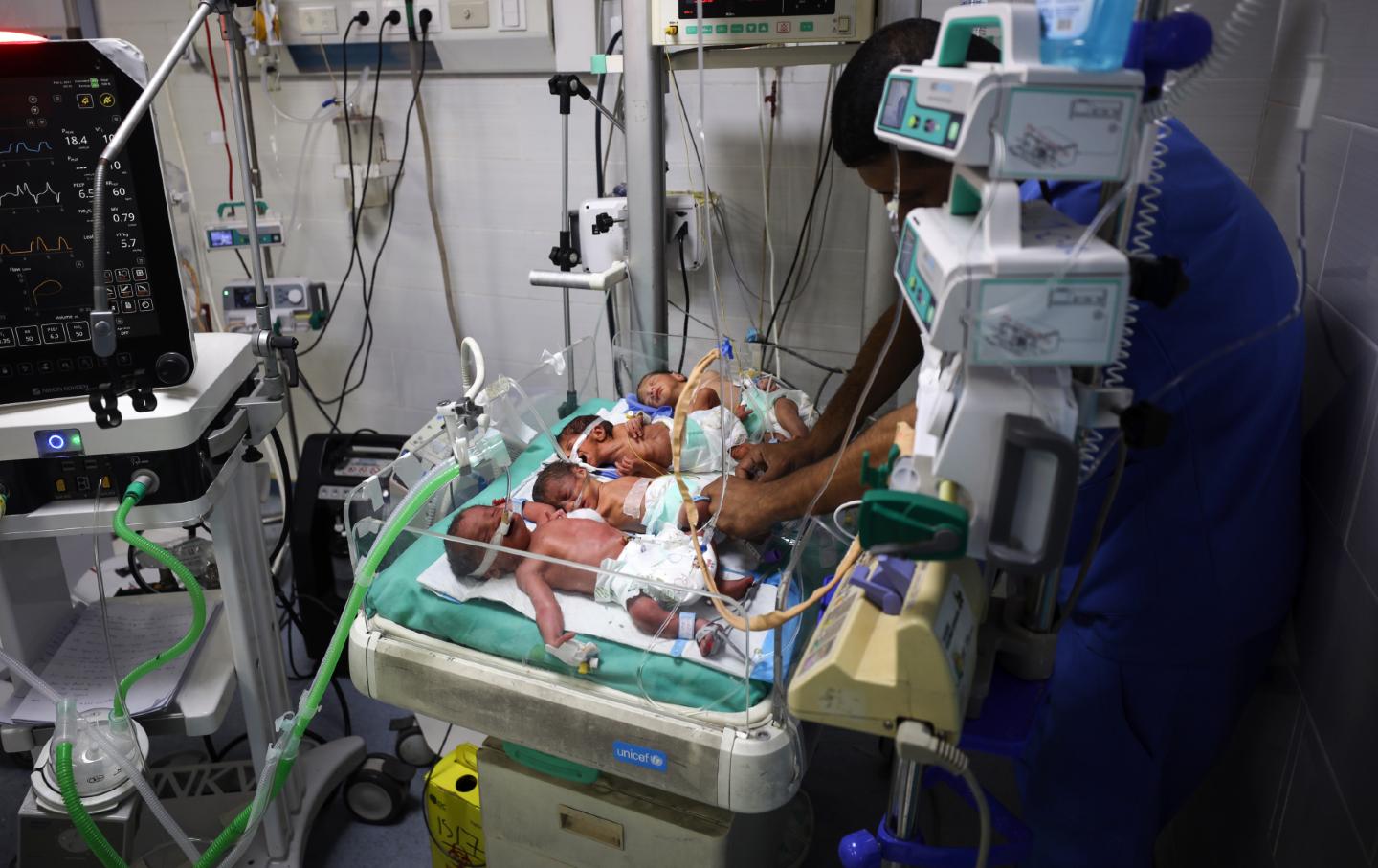
Premature babies receive care in an incubator at Al-Helou Hospital, where they are at risk due to fuel shortages, in Gaza City, on July 17, 2025. The fuel crisis affecting all hospitals may lead to the shutdown of generators and vital medical equipment.
(Majdi Fathi / NurPhoto via Getty Images)“You cough and it’s all black. Blackness in blackness,” says a Palestinian man wearing a blue cotton Covid mask in Toxic Fumes: Gaza Under Siege, a six-minute video shot inside Gaza and presented on Al Jazeera English. The video is part of “Climate & War,” a series of eyewitness reports commissioned by Arab Reporters for Investigative Journalism that highlights how war, beyond its terrible human costs, “drives carbon emissions, destroys ecosystems, and spreads toxic pollution.” The reports provide valuable context for yesterday’s landmark International Court of Justice ruling requiring all countries to reduce planet-heating emissions sufficiently to limit global temperature rise to the Paris Agreement’s 1.5 degree Celsius target.
Toxic Fumes opens with billowing refugee tents against a blackened landscape. Smoke wafts over piles of concrete rubble and twisted metal, the remains of bombed buildings. The camera zooms to a worker raking a fire in a makeshift furnace. The man in the Covid mask and a third worker feed pieces of plastic scavenged from the bombed buildings into an air-tight barrel. Plastics are made from petroleum; these men are, in effect, reversing the refining process, vaporizing plastic into crude forms of gasoline and diesel that will be sold in liter bottles at roadside stands.
Israel’s blocking of food supplies into Gaza has sparked widespread condemnation, with 28 nations on Monday taking the extraordinary step of calling for an immediate end to Israel’s war in Gaza and rebuking the “drip feeding of aid” that has left two-thirds of Gaza’s prewar population at risk of severe malnutrition or starvation, with children particularly suffering. “There is no case since World War II of starvation that has been so minutely designed and controlled,” said famine scholar Alex De Wall. Toxic Fumes brings an additional dimension to the story, revealing that fuel is almost as scarce in Gaza as food is and what desperate things people will do to cope.
The men burning plastic know their work is very dangerous. Incinerating plastic produces some of the most carcinogenic pollution known to man, and their work site could “catch on fire at any moment,” says one crew member. Nevertheless, the man tells the interviewer, “Don’t ask about danger. It’s not as dangerous as the bombs that fall on us.”
Gaza has become the most dangerous place on Earth to be a journalist. “Almost 200 reporters were killed in Gaza by the Israeli army over the first 18 months of the war,” Reporters Without Borders said in May. Because Israel has forbidden international media from entering Gaza, virtually the only firsthand reporting has come from journalists already on the ground, many if not most of them Palestinian.
The director of Toxic Fumes is Mohammed al-Sawwaf, a veteran documentary maker who has won an Edward R. Murrow Award and a Royal Television Society award. In 2006, his father founded Felesteen, the largest-circulation daily newspaper in Gaza. Both of al-Sawaf’s parents, along with two of his four brothers and the brothers’ children, were killed when Israel bombed their family home in November 2023. Al-Sawwaf’s two remaining brothers were killed in a second Israeli attack that also left him temporarily paralyzed. “Their deaths drained my desire for life,” al-Sawwaf told The Intercept. “Yet, I am still trying to rise and continue our work and mission.”