People Want Climate Action. This Data Shows It.
It’s an extraordinary popular mandate that extends across partisan divides and national borders.
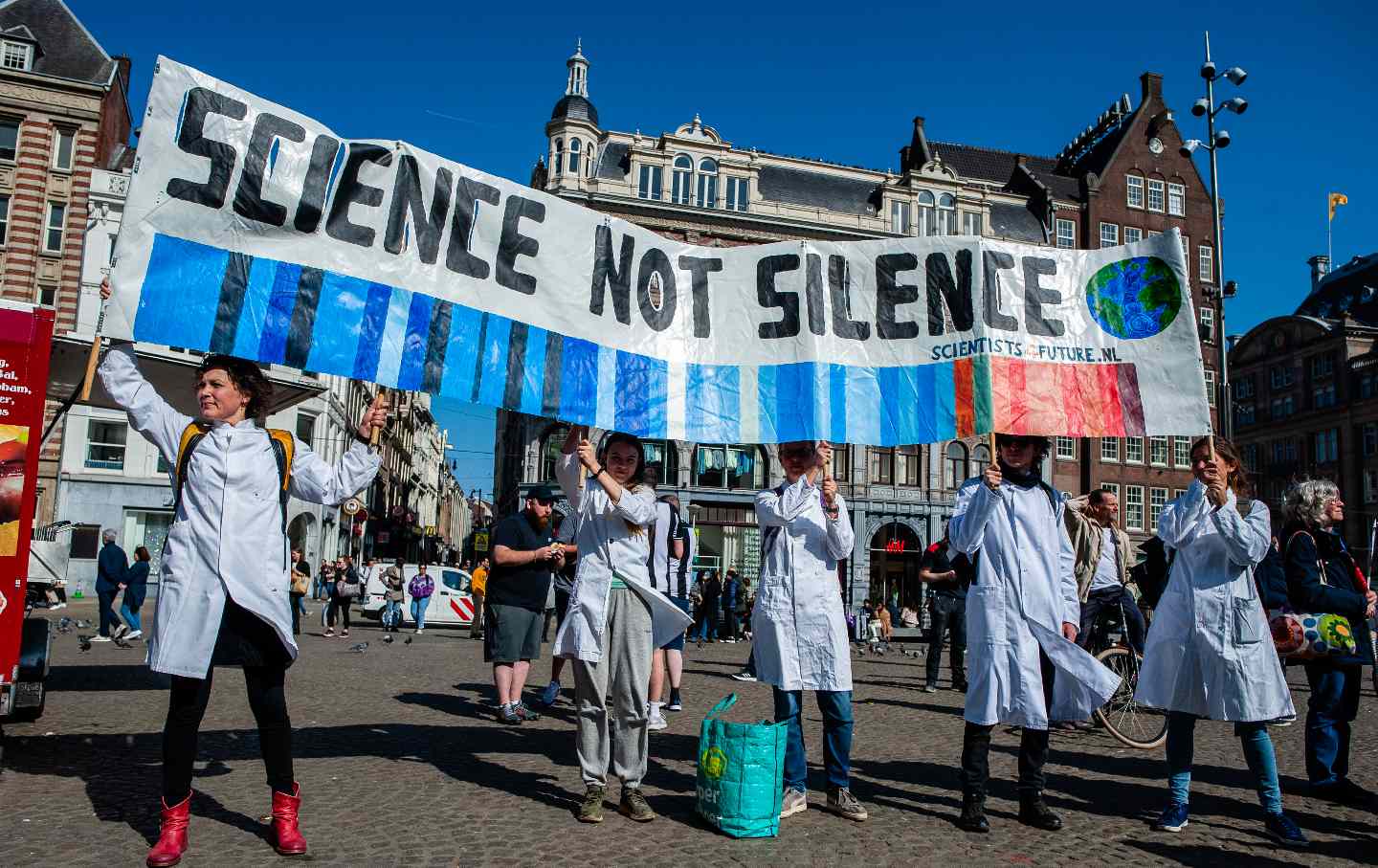
Protesters in Amsterdam demanding better climate policy, March 25, 2022.
(Romy Arroyo Fernandez / Getty)
When The Guardian, Agence France-Presse, and dozens more of the world’s leading news organizations began reporting the 89 percent story in April, it was because new peer-reviewed science had affirmed a potentially game-changing fact: Eighty to 89 percent of the world’s people think their governments should “do more” to tackle climate change. At a time when many elections are decided by a tiny margin and a 60 percent result is routinely labeled a “landslide,” this 80 to 89 percent tally represents an extraordinary popular mandate that extends across partisan divides and national borders. And it runs counter to most media narratives about climate change, which is that it’s a deeply polarized issue, evenly split.
More evidence of this popular mandate keeps emerging. This week, the European Commission released the latest issue of the Eurobarometer, which has been surveying the beliefs of European Union residents since the EU’s founding in 1993. Across the EU’s 27 member states, 85 percent of people said climate change is “a serious problem” and tackling it “should be a priority.” Two out of three people (67 percent) said their national government was “not doing enough.” The survey also contradicted the notion that, despite such stated support, climate is not a priority for voters. People in most EU countries ranked climate change among the top three problems facing humanity—tied with “the economic situation” and trailing only “armed conflict” and “poverty.”
Earlier in June, still more evidence came from the firm Dynata, which does market research for private and public sector clients. Commissioned by the nonprofits Oxfam International and Greenpeace International, the survey gathered opinions from 13 countries across the world’s biggest economies and the Global South. Dynata too found that eight out of 10 people are disappointed with their government’s response to climate change. The specific wording of Dynata’s questions put an extra twist on that popular discontent: Three out of four people (77 percent) said they’d be “more willing to support a political candidate who prioritizes taxing the super-rich and polluting companies like oil, gas, and coal companies.”
If climate change can, wrongly, seem like a polarized issue, it’s because it is somewhat polarizing in the US, which wields outsized influence on the global climate discourse. A survey of 23 countries representing 70 percent of the world’s population and conducted by the nonprofit Potential Energy in collaboration with the Yale Program on Climate Change Communication found that 71 percent of people agreed with the statement “I support immediate action by the government to address climate change.” That percentage drops to 61 percent in the US, which has “four times the polarization of the average country.”
As the next phase of Covering Climate Now’s 89 Percent Project rolls out in the coming weeks, these findings invite journalists everywhere to recognize the overwhelming silent majority of people who want action, even as political leaders at COP30 and beyond will be making life-and-death decisions about the future trajectory of climate change. As we approach this opportunity, here’s one last data point from the Eurobarometer survey: “Just over half (52 percent) of EU citizens don’t think the traditional media from their country provides clear information on climate change and its causes and impacts.” New data is telling us it’s time for that to change.
Become a Sustaining Donor This September
Between the reemergence of right-wing red-baiting and Donald Trump’s use of the chilling National Security Presidential Memorandum–7 to criminalize left political organizing, we’re seeing McCarthyism reborn before our eyes.
This assault on democracy cannot be ignored or wished away. Resisting it requires bravery in the face of threats and repression, a steadfast commitment to the truth, and the unwavering belief that we can—and will—overcome this darkness.
We must have an independent media that sets the record straight, unearths corruption and abuses of power, and advances a politics of justice and dignity for all if we’re to win this fight.
That’s why I’m writing to you today. This September, The Nation needs to add 100 monthly donors to sustain our progressive journalism. Your contribution makes the next investigative report, the next truth-speaking column, and the next pathbreaking essay all possible.
I hope you’ll support our work with a recurring donation today. If you donate $10 or more a month, we’ll send you a brand new “Hands Off the Free Press!” sticker to recognise your commitment to our cause. Please, donate today.
Onward,
Katrina vanden Heuvel
Editor and Publisher, The Nation