The Smear Campaign Against Zohran Mamdani Failed. That’s a Huge Deal.
Mamdani understood what the people who tried to demonize him did not: that voters aren’t buying the same old smears about Palestine anymore.
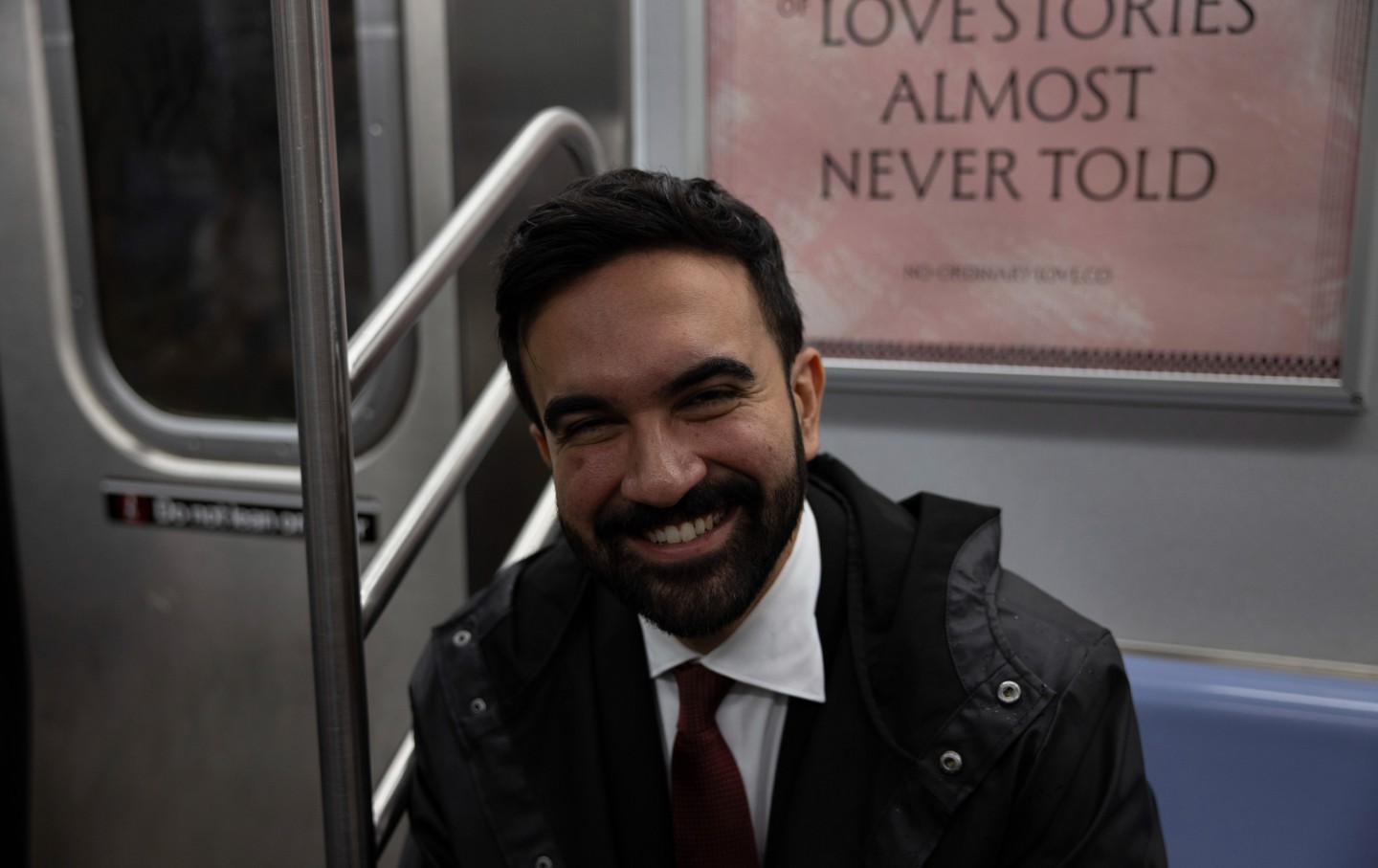
New York City mayoral candidate Zohran Mamdani travels by subway to the “No Kings” protest in Bryant Park, New York City, on June 14, 2025.
(Melissa Bender / NurPhoto via AP)Zohran Mamdani has shocked the country by winning New York City’s Democratic mayoral primary with ease. His resounding victory over rival Andrew Cuomo—which both pundits and polls had utterly failed to predict—has not only set him up as a potentially crucial figure on the American left in the years to come. It’s also caused people to look at the many ways Mamdani broke with conventional wisdom on running a Democratic campaign. Nowhere was that more evident than on the issue of Israel and Palestine—where the failed attempts by Cuomo and the establishment media to stir fear about Mamdani’s views should serve as a wake-up call about how much the Democratic Party’s base has changed.
Mamdani’s campaign was first and foremost centered around cost-of-living issues like rent and bus fares. But Cuomo tried very hard to turn it into a referendum on Mamdani’s views on Israel and Palestine—and the media establishment took the bait.
At every turn, whether it was during an appearance on Stephen Colbert’s talk show, a podcast with The Bulwark, or even the mayoral debates, Mamdani was pestered with question after question about Israel. Mamdani’s long-held views on the subject—he has accurately said that Israel is guilty of apartheid and genocide and he supported the BDS movement, among other things—were no secret. It didn’t matter. Israel dominated the conversation about him, mostly centered around the premise that a heavily Jewish city like New York would automatically recoil from Mamdani’s support for Palestine.
Zohranpalooza!
For instance, at the first mayoral debate, Mamdani was the only candidate who said that he would not visit any foreign country if he won the mayoralty—unlike most of his rivals, who promised to visit Israel. Immediately, the moderators seized upon the opportunity to press Mamdani on whether he recognizes Israel’s “right to exist as a Jewish state.”
No one else was asked that question. Perhaps more importantly, no one else onstage was asked if they believed that Palestine had a right to exist, let alone as an “Arab state.” And nobody asked Cuomo why he’d chosen to join the legal team trying to keep Benjamin Netanyahu out of The Hague. The fact that the sole Muslim candidate for the office of mayor was singled out for his views on Israel-Palestine was indicative of just how dirty the political environment remains for Arabs, South Asians, and anyone else who tries to stand with Palestine.
But Mamdani had a perfect answer prepared. In response to the moderator’s bad-faith question, he said, “I believe Israel has the right to exist as a state with equal rights…. I believe every state should be a state of equal rights.” Rather than giving in to the premise of the question, that any state has the right to an ethnically particularist legal and political character, he invoked the concept of universal freedom and rights for all. This language resonates well with Americans, especially younger and non-white Americans, who see what Israeli rule over Palestinians looks like and think of apartheid South Africa or the Jim Crow South.
Likewise, when pressed by The Bulwark’s Tim Miller on whether he was comfortable with phrases like “globalize the intifada” or “from the river to the sea,” Mamdani did not equivocate or apologize for his support of Palestinian liberation. Instead, he calmly explained what he thought about the Palestinian struggle for freedom. This didn’t stop the likes of David Frum or Jonathan Chait from alleging that Mamdani is an antisemite, but it didn’t end up providing the media with the sound bite they were hoping for either.
Mamdani’s communicative discipline was on full display from the first to the final bell, and it paid off for him. But it wasn’t good messaging alone that helped. Mamdani also understood what his attackers did not: that tarring someone for holding pro-Palestinian views is just not as effective as it used to be if you’re running as a Democrat.
The evidence for this continues to mount. A Quinnipac poll released earlier this month found an “all-time low” in sympathy “for the Israelis and an all-time high for Palestinians” since December 2001. Despite what some in the pro-Israel bloc might want to believe, the reason for this is simple: People don’t like genocide.
A University of Maryland poll from March of this year found that 56 percent of Democratic voters felt Israel has committed war crimes in Gaza, and 44 percent say that Israel’s actions constitute genocide or something like it. Perhaps most interestingly, negative views of Israel have risen among Democrats in every single age demographic. According to Pew, 71 percent of Democrats of ages 18–49 have a negative view of Israel in 2025, and 66 percent of Democrats 50 or older do too.
It is thus abundantly clear that being pro-Palestinian is no longer an albatross among US liberal voters. Mamdani’s refusal to compromise on this issue wasn’t just principled and morally correct. It was also smart politics, tailored to a new media and political landscape that his rivals refused to see.
However, it would be a mistake to over-extend the argument and to say that Mamdani won the nomination because of his strong pro-Palestinian convictions. After all, Cuomo is a man with an exceptionally tarnished reputation: sexual misconduct, mismanagement of public health, racism, indifference to the very city he was running to lead. Name recognition can only carry you so far in a race if your name is associated with these things. And Mamdani ran an exceptional campaign that focused almost exclusively on the cost of living, with an optimistic tone and style to boot. Mamdani built up a coalition that united around rejecting Cuomo; the Jewish American progressive Brad Lander was almost constantly on the offense and took an admirable stand against Trump’s authoritarianism. These factors likely mattered a lot more than Mamdani’s personal views on the minutiae of Israel’s regime of apartheid over 7 million Palestinians.
And yet, it can’t be said that the issue had no bearing on the result at all. Despite Mamdani’s best (and overall successful) efforts to make this race about kitchen table issues, Cuomo, The New York Times, and others really wanted it to be about Mamdani’s supposedly “radical” views on Israel. It is often said that left-wing activists are the ones who turn Palestine into a litmus test for office, but the last few months have shown that there is a pro-Israel consensus that demands support for an untenable status quo in the Middle East. Attempts to impose these demands onto Zohran failed, and they failed to derail his candidacy in the end as well. It is clear that being pro-Palestine is not as much of a deal-breaker for Democratic voters as it has been hypothesized to be.
As Abe Silberstein put it in Haaretz the day before the primary, the establishment doesn’t fear a mayor who will be antisemitic but one “who will symbolize the ongoing collapse of pro-Israel hegemony in the Democratic Party, and perhaps in U.S. politics more generally.”
In fairness, the establishment is right to fear that. While the mayor of New York City is never going to be a de facto secretary of state, or oversee the end of conflict abroad, it matters that the largest city in the country—and the city with more Jews than any other city on earth—will have a leader that believes Palestinians and Jews are equally deserving of freedom and self-determination. It matters that, as sentiment both within and outside the base of the Democratic Party continues to shift towards a more pro-Palestinian point of view, a politician like Mamdani will be there to help articulate it. Previous attempts to stifle this perspective may have worked in the short term, but over the next decade or two there will likely be more Mamdanis than Scoop Jacksons entering the political arena.
Popular
“swipe left below to view more authors”Swipe →Sooner or later, Democratic policy on Palestine will have to begin reflecting that.
More from The Nation
The Left Can Win in Small Cities. David Morales Is Showing How. The Left Can Win in Small Cities. David Morales Is Showing How.
David Morales’s campaign for mayor of Providence, Rhode Island, is providing a model for how a progressive candidate can oust an incumbent.
Dolly Parton Understood That Working 9 to 5 Doesn’t Really Pay the Bills in Today’s America Dolly Parton Understood That Working 9 to 5 Doesn’t Really Pay the Bills in Today’s America
Social mobility has ground to a halt. Why that’s lousy for American music.
Can Senator Jon Ossoff Hold Onto His Seat? Can Senator Jon Ossoff Hold Onto His Seat?
He’s the most vulnerable incumbent in the Senate race, and his state is ground zero for the new Jim Crow attacks on voting rights.
The UAW Wave Has Hit Our Shores The UAW Wave Has Hit Our Shores
The union’s endorsements of insurgent candidates led to big wins this summer. It’s all part of a strategy to remake American politics for the working class.

“Gray Money” Is Fueling a Bipartisan Arms Race for Control of Congress “Gray Money” Is Fueling a Bipartisan Arms Race for Control of Congress
Nonprofits that don’t disclose their donors have funneled at least $642 million to PACs so far in the midterms.