
McCarthyism 2.0: Reflections on Testifying in the House Antisemitism Hearings
I soon realized that neither the law nor the facts matter to the Committee on Education’s Republican inquisitors.
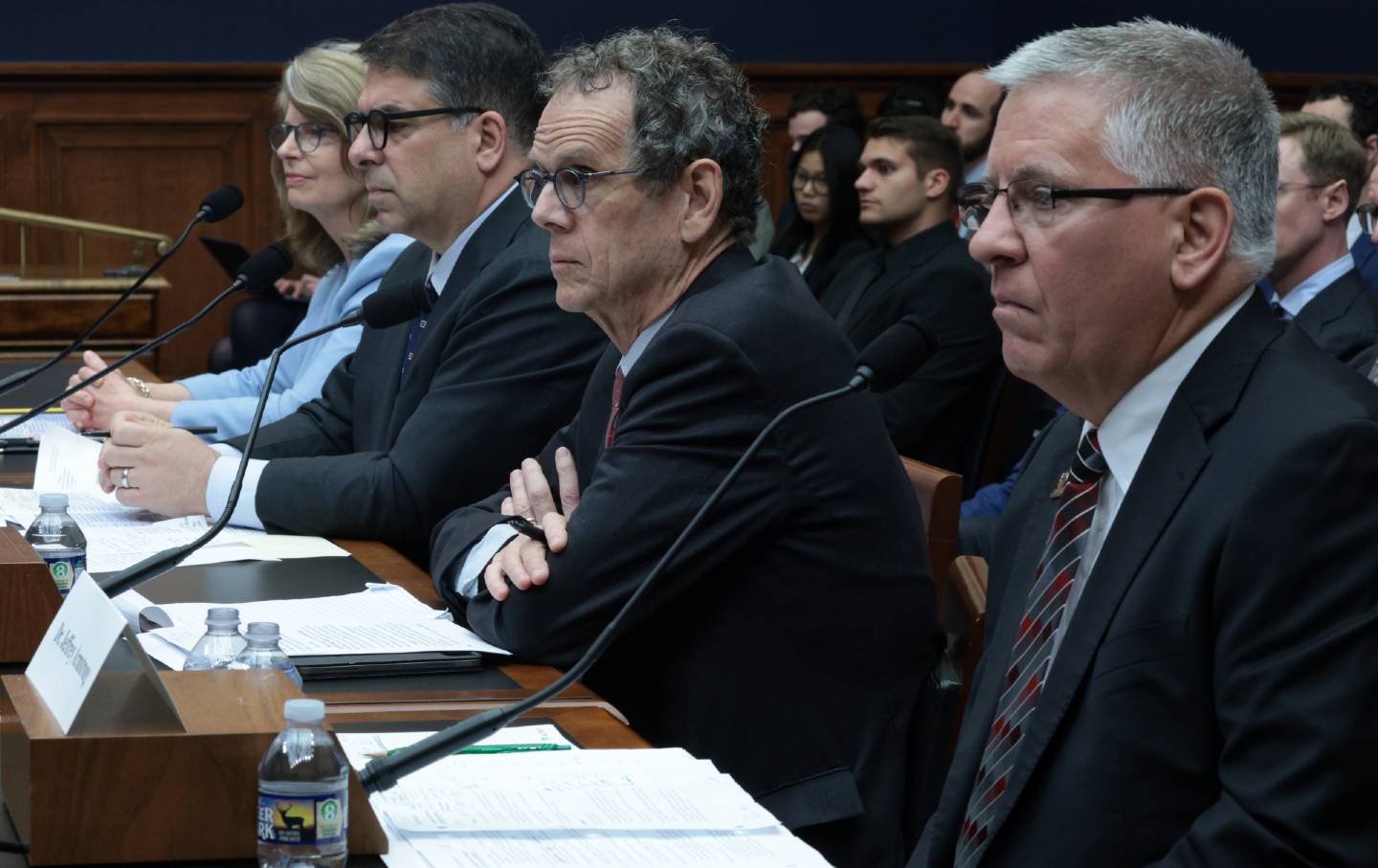
Earlier this month, I testified before the House Committee on Education and the Workforce on the subject of antisemitism on campus. This was the eighth such hearing the Republican-led committee has held in two years. The first, as many will recall, featured the presidents of Harvard, the University of Pennsylvania, and MIT—and ultimately led to the presidents of Harvard and Penn losing their jobs. The committee is still at it. But like a reality-television show that has gone on far too long, the hearings, never particularly edifying, are now dominated by tired tropes. The moment it became clear that the hearings had jumped the shark came when Representative Rick Allen (R-GA) offered a biblical exegesis:
“Jerusalem is the center of the universe. A lot of people think Washington is, but, uh, that’s where it’s gonna happen. Uh, and of course, uh, you know, for those who are familiar with the, the Bible, a book of, uh, of, uh, the word of God, uh, uh, Genesis 12:3 states, ‘I’ll bless those who bless you,’ talking about Israel and whoever curses you, I’ll, I’ll curse.… In fact, in John 4:22, Jesus said, salvation, even for Gentiles will come through the Jews. And so, Dr. Paul, you know, this is a serious, serious issue we’re talking about. In fact, it has eternal consequences.”
By “Dr. Paul,” he apparently meant the president of DePaul University, Robert Manuel. Dr. Manuel had been called, along with the presidents of Haverford College and California Polytechnic State University at San Luis Obispo, to testify about, in the committees’ words antisemitism “beyond the Ivy League.” I was invited by the Democrats to provide some legal perspective.
There is federal law on the subject, and I sought to offer it. But what became clear is that law does not matter to the Republicans on the committee. What matters, beyond eternal salvation for Representative Allen, is whether the members can out-Stefanik Elise Stefanik’s performance from the first hearing, in which she grilled the presidents on whether “calling for the genocide of Jews” violated campus policies on free speech and discrimination. At this hearing, members, including Stefanik herself, hurled similar questions—indeed in some instances the exact same questions—at the presidents, acting as self-satisfied prosecutors in full cross-examination mode. But this time, the presidents were better prepared to answer in ways that are unlikely to get them fired, and the hearing generated few headlines.
In my testimony, I explained that while antisemitism, like racism, sexism, and homophobia, should be condemned, the vast majority of antisemitic speech is constitutionally protected by the First Amendment—just as is most racist, sexist, and homophobic speech. The Supreme Court, for example, has protected the rights of Nazis to march in Skokie, of the Ku Klux Klan to chant racist and antisemitic slogans, and of the Westboro Baptist Church to display homophobic placards at a military funeral. That means that a school that honors the speech rights of its students cannot simply shut down speech because it is antisemitic.
Title VI of the Civil Rights Act does require schools receiving federal funds to respond to antisemitic discrimination, but speech rises to that level only if it constitutes harassment specifically targeted at an individual because he is Jewish, or, where the speech is not targeted, it is so “severe, pervasive, and objectively offensive” that it denies students equal access to an education because they are Jewish. These are very high standards, rarely met.
And because Title VI binds schools, not students, even if a student engages in discrimination, the school itself is liable only if it is “deliberately indifferent” to the issue. If school officials knew about an incident and ignored it, that would be deliberate indifference. But investigating complaints and responding less harshly than members of Congress might like is not deliberate indifference. Again, very few colleges have been found to have violated Title VI under this standard.
What does that mean for the issue of antisemitism on campus—the committee’s ostensible focus? It means that one must distinguish not just between anti-Zionism and antisemitism but also between antisemitic speech, which is constitutionally protected, and antisemitic discrimination, which is not. And that in turn requires a careful consideration of all the facts and circumstances of any given incident, hearing all sides, determining what actually happened, and responding in any of a wide range of reasonable ways. Colleges have committees that adjudicate such complaints. The Department of Education’s Office of Civil Rights (which Trump’s secretary has cut by half) is also tasked with that duty. And individuals unhappy with those venues can sue in federal court.
The House Committee on Education and Workforce, however, is evidently not a venue for assessing what actually happened in any particular incident. In none of the eight hearings has the committee brought in complainants and accused, or entertained conflicting testimony in an attempt to ascertain what happened and why—or even tried to draw the constitutional line between antisemitic speech and antisemitic discrimination.
Instead, the committee’s Republicans treat every allegation of antisemitism as if it’s proof of discrimination. These same members would be the first to insist, correctly, that an allegation of sexual harassment on campus can’t be presumed to constitute harassment; rather, the accused must be allowed a fair hearing to determine what actually happened and why. But when it comes to antisemitism, neither the facts nor the law matter. Any allegation of antisemitism is assumed true, even if on its face it shows little more than criticism of Israel.
So the chair of the committee, Tim Wahlberg (R-MI), asked whether the slogans, “Resistance is not terrorism” and “From Gaza to Lebanon. Israel will soon be gone,” were protected speech on Haverford’s campus. Representative Joe Wilson (R-SC), insisted that “‘Free Palestine from the river to the sea’ is a code for death to Israel, death to America. We know that anti-Zionism is antisemitism.” And Representative Allen, he of the biblical exegesis, condemned a faculty member for liking an Instagram post captioned, “From the river to the sea, Palestine will be free.”
All of these statements are presumptively protected speech. It is possible that if they were targeted at a particular student because he was Jewish to harass him, they might constitute discrimination. But liking an Instagram post is not targeted at anyone in particular. And if such statements were chanted at a rally protesting Israel’s conduct of the war in Gaza, they are not discrimination but protected speech on a matter of public concern. Nor is anti-Zionism necessarily antisemitic. Someone who is antisemitic might of course be critical of Zionism, but a critic of Zionism need not be antisemitic; many Jews are, after all. By the same token, those who criticize Hamas might be Islamophobic, but one can certainly criticize Hamas without being Islamophobic or anti-Palestinian. Again, many Palestinians do.
Those distinctions, however, were of no interest to the committee’s Republican members. What were they really concerned about? Several of the members said the quiet part out loud. Glenn Grothman (R-WI) wanted to know what percentage of faculty at each college voted for Donald Trump. Representative Joe Wilson criticized DEI at length and asked for “the percentage of conservatives” and “the percentage of Republicans” on the colleges’ faculties, “because I, I’m sadly, uh, concerned there are none or very few.” These hearings have never been about antisemitism; they are about attacking universities because Republican members deem them too liberal.
I suggested in my opening remarks that the closest precedent for these hearings were those of the House Un-American Activities Committee. That committee, too, targeted academia because it deemed it too liberal. And it, too, was not interested in the facts or the law, but in shaming witnesses, chilling speech, and grabbing headlines for partisan gain. Chairman Wahlberg rejected the analogy in his closing remarks, insisting that “any suggestion that this is McCarthy like is radically false.” I believe history will draw a different conclusion.
Become a Sustaining Donor This September
Between the reemergence of right-wing red-baiting and Donald Trump’s use of the chilling National Security Presidential Memorandum–7 to criminalize left political organizing, we’re seeing McCarthyism reborn before our eyes.
This assault on democracy cannot be ignored or wished away. Resisting it requires bravery in the face of threats and repression, a steadfast commitment to the truth, and the unwavering belief that we can—and will—overcome this darkness.
We must have an independent media that sets the record straight, unearths corruption and abuses of power, and advances a politics of justice and dignity for all if we’re to win this fight.
That’s why I’m writing to you today. This September, The Nation needs to add 100 monthly donors to sustain our progressive journalism. Your contribution makes the next investigative report, the next truth-speaking column, and the next pathbreaking essay all possible.
I hope you’ll support our work with a recurring donation today. If you donate $10 or more a month, we’ll send you a brand new “Hands Off the Free Press!” sticker to recognise your commitment to our cause. Please, donate today.
Onward,
Katrina vanden Heuvel
Editor and Publisher, The Nation
More from The Nation

How Trump’s Crackdown on Speech Has Damaged the Student Press How Trump’s Crackdown on Speech Has Damaged the Student Press
I serve as editor in chief and president of The Stanford Daily. Our newsroom has keenly felt the effects of Trump’s campus crackdown, which is why we sued the federal government.

Nationalize Spotify Nationalize Spotify
Music streaming platforms have way too much control over musicians and music lovers. It’s time to rein them in.
What’s the Matter With Effective Altruism? What’s the Matter With Effective Altruism?
President Trump has decried the techbro creed for indulging in AI doomerism, but its excesses are far worse than that.

As Morale Sags, More Military Service Members Are Having a Crisis of Conscience As Morale Sags, More Military Service Members Are Having a Crisis of Conscience
According to multiple GI rights organizations, service members are inquiring in unprecedented numbers about seeking conscientious objector status.
What Remains of Riis? What Remains of Riis?
A new members’ club has revived Riis Park’s long-vacant bathhouse, reopening old questions about whom the People’s Beach is really for.

When Texas Sex Ed Falls Short, Gen Z Women Turn to Social Media When Texas Sex Ed Falls Short, Gen Z Women Turn to Social Media
A 2025 study found that 70 percent of adolescents sought reproductive health information through social media platforms.

