
Journalism Schools Are Facing Dual Pressures Under Trump
The administration’s attacks on both news outlets and universities can place journalism schools—and their students—at an alarming intersection.
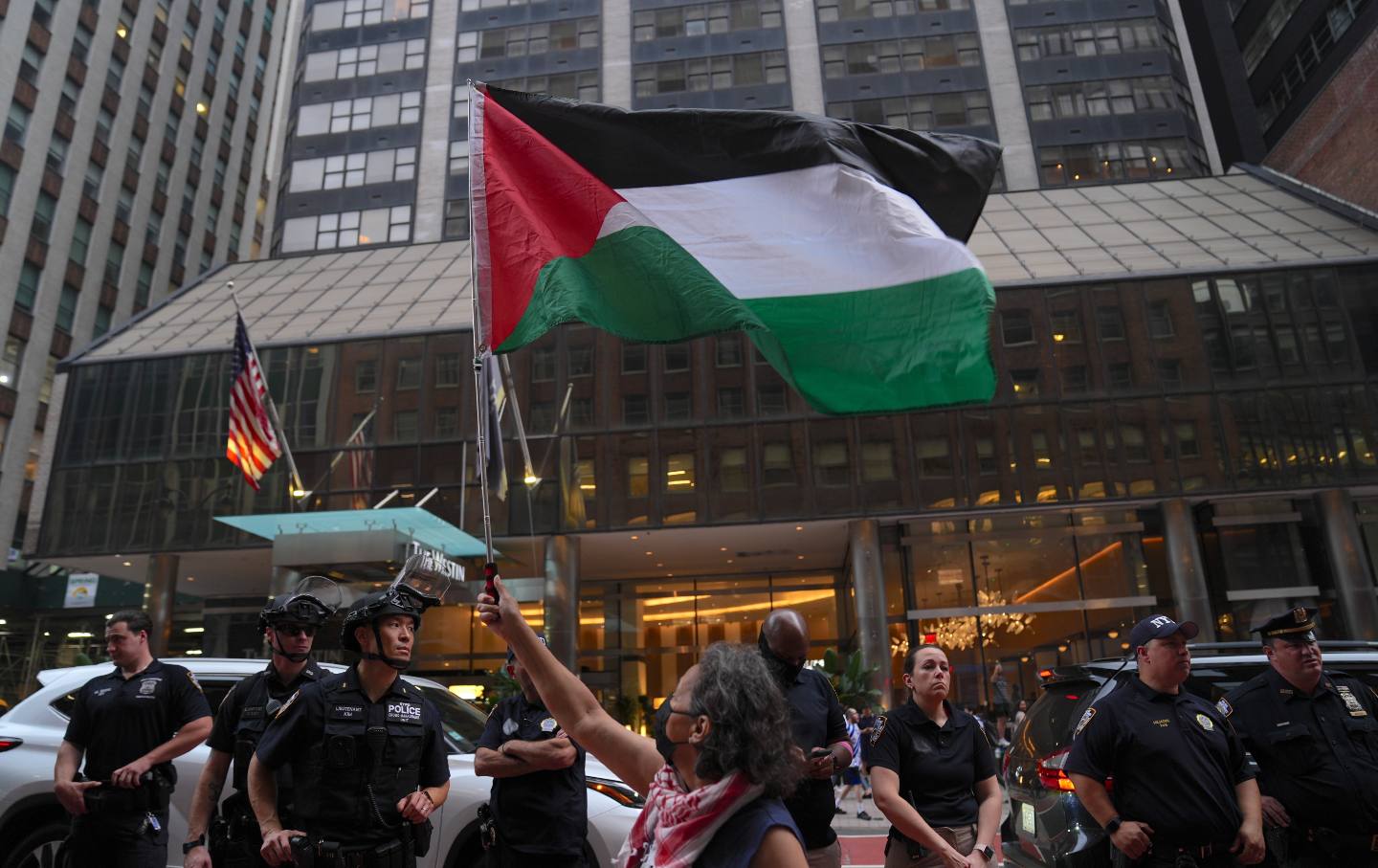
Pro-Palestinian protesters rally at the City University of New York Graduate Center.
(Selcuk Acar / Getty)President Trump has threatened colleges across the country with federal funding cuts. As a letter from the administration to Harvard University last month made clear, academic programs with supposed “records of antisemitism” are facing demands to curb “ideological capture”—seemingly to shut down open discussion about Israel and its treatment of Palestinians in classrooms.
At the same time, the White House escalated its war on the free press earlier this month with the announcement of cuts to public subsidies for PBS and NPR for spreading “radical, woke propaganda.” These attack lines of “radical” and “woke” are commonly wielded by Trump and his allies to undermine journalists. And as the March abduction of a Tufts international student by plainclothes ICE officers for criticizing Israel in an op-ed makes clear, for student journalists, this faultline is particularly dangerous.
The administration’s attacks on both news outlets and universities places journalism schools—and their students—at an alarming intersection. “I think the threat is very high for noncitizen student journalists covering anything to do with Palestine,” said Yemile Bucay, safety and security advisor at the Craig Newmark Graduate School of Journalism at CUNY. “The targeting of international students speaking out about Palestinian rights has sent a chill across all students.”
The City University of New York, with campuses spanning the five boroughs, has long been a center for pro-Palestinian student activism. Since Israel’s ongoing genocide in Gaza began, dozens of protesters have been arrested on CUNY campuses, including at a student encampent at City College that was shut down by NYPD officers last year.
Following pressure from Governor Kathy Hochul, CUNY has committed to centralizing its processes for stamping out antisemitism allegedly tolerated on its campuses with the launch of the Center for Inclusivity and Equal Opportunity. A CUNY spokesperson told The Nation that a top priority for the new initiative is to overhaul the university system’s discrimination and retaliation reporting portal, with a vendor already selected to assist the revamp that is scheduled to be ready this fall. They also said that CUNY has recently expanded its partnership with the Constructive Dialogue Institute that began last October in order to “drive a systemic culture shift across all 25 campuses.”
But some Jewish faculty members at Craig Newmark, the dedicated journalism graduate school of NYC’s public university system, aren’t buying that antisemitism is a serious problem on their campus in the first place. “Nothing comes to mind,” Peter Beinart, professor of national reporting and opinion writing, told The Nation when asked if he is aware of antisemitism perpetrated by students at Craig Newmark. “There’s a general understanding that one should not accept any form of bigotry. It’s possible there were instances, but I don’t think antisemitism has been an issue.”
The bigger threat, some Jewish faculty members argue, is the weaponization of antisemitism allegations by the Trump administration to crack down on students critical of Israel. “It is a total ruse,” said Emily Laber-Warren, professor of health and science journalism at Craig Newmark. “These campus protests were not antisemitic, they were anti-Zionist. They were trying to bring attention to what’s happening to Palestinians.”
Furthermore, some view the Trump administration’s battle with academia in the context of a wider assault on opponents of the president and his policies. “While there are certainly instances of antisemitism, as there are instances of hate for various groups, it is an excuse to attack higher education and people who in Trump’s view promote liberalism or are anti-Trump,” says Andrew Mendelson, a tenured professor and former associate dean at the journalism school. “And it’s not just higher ed. It’s also law firms that have represented clients he doesn’t care for. It’s part of that and antisemitism is a useful vehicle.”
Still, some Jewish faculty members acknowledge that a tense atmosphere can arise on campus. Bucay said that she had been uncomfortable with some students’ laptop stickers and shirts with certain slogans. But she also believes that it is healthy for faculty to be challenged by students and their views. “If anything it prompted me to ask myself why I felt that way,” said Bucay. “And I don’t think any were antisemitic.”
Craig Newmark is unique among American colleges in that it offers tuition-free education for most of its students—all while receiving relatively little direct assistance from federal funding. According to a statement by the journalism school to The Nation, the majority of Craig Newmark’s funding comes from New York State.
Many other universities are heavily dependent on support from the federal government to keep their campuses running. For example, roughly 55 percent of Columbia’s operating budget depends on federal funding or facilitation, according to a 2024 report by the Stand Columbia Society. This gave the Trump administration powerful sway over the Ivy League college, which quickly capitulated to the president’s demands to stifle political opposition to Israel on its campuses after $400 million in its federal funding was pulled.
For now, CUNY has avoided close scrutiny from the Trump administration. None of the colleges within the CUNY system made the list of 60 universities currently under investigation by the US Department of Education for “relentless antisemitic eruptions.”
Popular
“swipe left below to view more authors”Swipe →But while Craig Newmark may be less directly exposed to federal funding cuts than other colleges, the Trump administration still holds substantial leverage over the CUNY system more broadly. “If CUNY loses that funding and decides they need to reevaluate their budget, they could reallocate resources away from Newmark,” said Mendelson.
Nevertheless, Beinart has a clear message for students at CUNY’s journalism school: don’t stop reporting on the truth. “Trump’s disregard for the rule of law and his willingness to use the power of the state to clamp down on dissent makes the work of journalists even more important,” he said. “We need to shine a light on what people in power are up to.”
Disobey authoritarians, support The Nation
Over the past year you’ve read Nation writers like Elie Mystal, Kaveh Akbar, John Nichols, Joan Walsh, Bryce Covert, Dave Zirin, Jeet Heer, Michael T. Klare, Katha Pollitt, Amy Littlefield, Gregg Gonsalves, and Sasha Abramsky take on the Trump family’s corruption, set the record straight about Robert F. Kennedy Jr.’s catastrophic Make America Healthy Again movement, survey the fallout and human cost of the DOGE wrecking ball, anticipate the Supreme Court’s dangerous antidemocratic rulings, and amplify successful tactics of resistance on the streets and in Congress.
We publish these stories because when members of our communities are being abducted, household debt is climbing, and AI data centers are causing water and electricity shortages, we have a duty as journalists to do all we can to inform the public.
In 2026, our aim is to do more than ever before—but we need your support to make that happen.
Through December 31, a generous donor will match all donations up to $75,000. That means that your contribution will be doubled, dollar for dollar. If we hit the full match, we’ll be starting 2026 with $150,000 to invest in the stories that impact real people’s lives—the kinds of stories that billionaire-owned, corporate-backed outlets aren’t covering.
With your support, our team will publish major stories that the president and his allies won’t want you to read. We’ll cover the emerging military-tech industrial complex and matters of war, peace, and surveillance, as well as the affordability crisis, hunger, housing, healthcare, the environment, attacks on reproductive rights, and much more. At the same time, we’ll imagine alternatives to Trumpian rule and uplift efforts to create a better world, here and now.
While your gift has twice the impact, I’m asking you to support The Nation with a donation today. You’ll empower the journalists, editors, and fact-checkers best equipped to hold this authoritarian administration to account.
I hope you won’t miss this moment—donate to The Nation today.
Onward,
Katrina vanden Heuvel
Editor and publisher, The Nation
More from The Nation
The Fight to Keep New Orleans From Becoming “Everywhere Else” The Fight to Keep New Orleans From Becoming “Everywhere Else”
Twenty years after Katrina, the cultural workers who kept New Orleans alive are demanding not to be pushed aside.

Breaking the LAPD’s Choke Hold Breaking the LAPD’s Choke Hold
How the late-20th-century battles over race and policing in Los Angeles foreshadowed the Trump era.
The Remaking of Trump’s Washington, DC The Remaking of Trump’s Washington, DC
The ballroom and his other proposed building projects are many things, but they are not exactly works of architecture.
Organized Labor at a Crossroads Organized Labor at a Crossroads
How can unions adapt to a new landscape of work?
In America, Mass Shooting Survivors Can Never Know Peace In America, Mass Shooting Survivors Can Never Know Peace
A growing number of US residents have lived through more than one massacre.
What the Noam Chomsky–Jeffrey Epstein E-mails Tell Us What the Noam Chomsky–Jeffrey Epstein E-mails Tell Us
Chomsky has often suffered fools, knaves, and criminals too lightly. Epstein was one of them. But that doesn’t mean Chomsky was part of the “Epstein class.”

