Pope Leo XIV: A Less Reformist Version of Francis?
All signs point to the newly elected pontiff’s continuing in much the same vein as his predecessor, but with a more moderate approach.
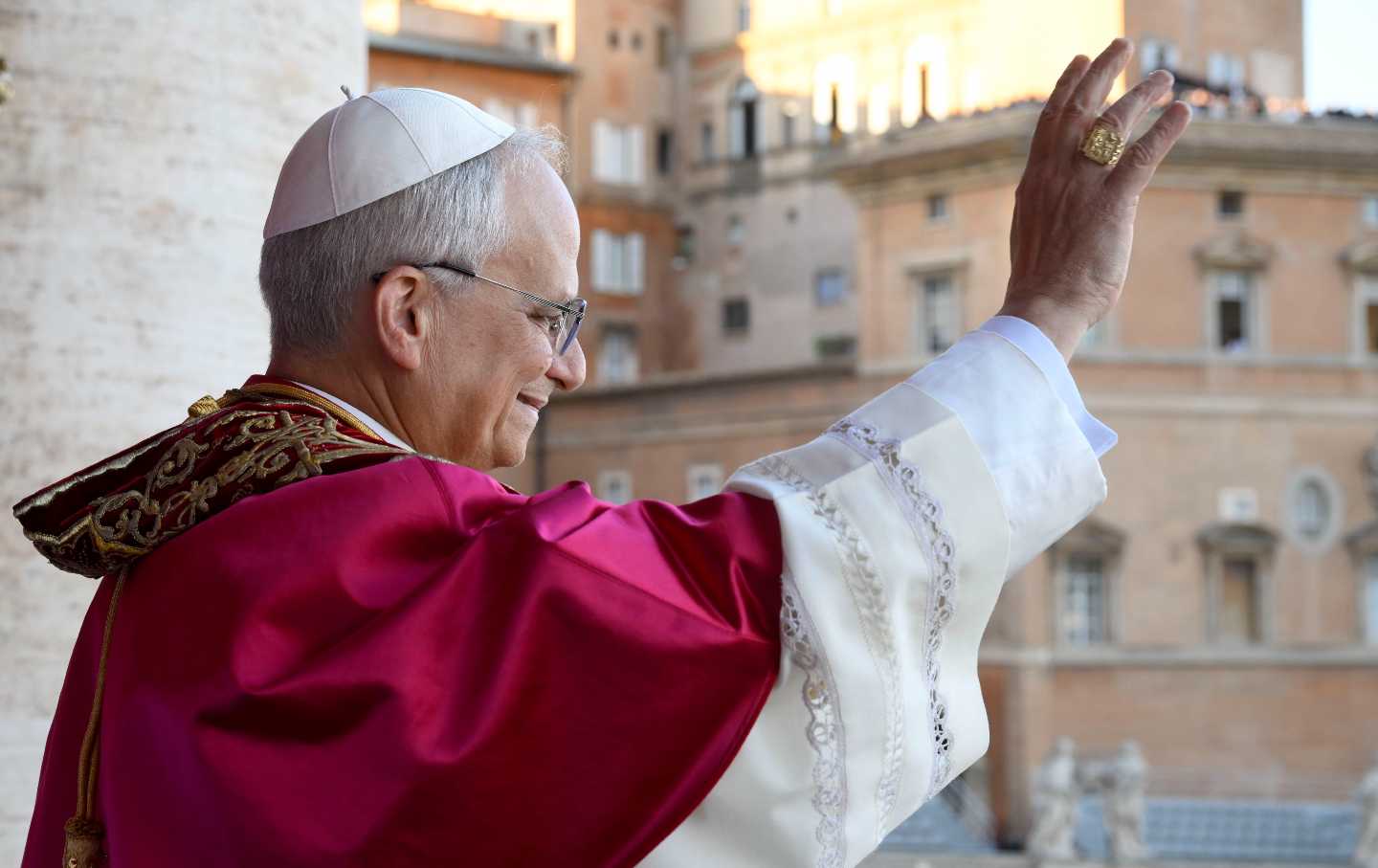
Newly elected Pope Leo XIV addresses the crowd on the main balcony overlooking St Peter’s Square.
(Francesco Sforza / Getty)American Cardinal Robert Francis Prevost, born in Chicago in 1955, was elected pope this Thursday, on the second day of the conclave convened in Vatican City following the death of Pope Francis. Prevost has taken the pontifical name Leo XIV and is the first pope in history from the United States. Many consider him an heir of the late Jorge Bergoglio, though more conservative on issues such as sexual and gender diversity, and more traditional in style than the Argentine pope.
His choice of the name Leo—one of the most frequently used by popes throughout history—seems like a nod to the slow-moving nature of the Catholic Church, a counterbalance to the abrupt wave of reforms driven by Francis. The new pope’s more conventional approach was evident from his very first appearance on the balcony of St. Peter’s, where he reinstated the traditional papal mozzetta, a symbol of authority that Francis had pointedly refused to wear.
A member of the mendicant Order of Saint Augustine who studied mathematics and theology, Prevost was, until now, prefect of the Dicastery for Bishops, the department responsible for preselecting bishops around the world. Francis entrusted him with this important responsibility in 2023, the same year he named him a cardinal. These two moves made it clear that Bergoglio considered him a leading candidate to succeed him, along with the Filipino Juan Antonio Tagle.
Unlike other papabile cardinals like the Italian Pietro Parolin, Prevost is not a man of the Curia—the Vatican bureaucracy that often showed hostility toward Francis. The new pope has spent most of his career in Peru, where he lived for over 30 years and holds citizenship. He arrived there as a missionary in 1985 and eventually became bishop of Chiclayo, a diocese he greeted in Spanish during his first speech as Leo XIV, when he did not say a word in English. Francis also appointed him president of the Pontifical Commission for Latin America, a region to which he remains closely connected.
Leo XIV’s missionary background suggests that social justice will be a priority of his papacy, as it was for Bergoglio. His name, while common among popes, is also likely a reference to Leo XIII (1878–1903), known for his encyclical Rerum Novarum (On New Realities), dedicated to the condition of the working class. Leo XIV is unlikely to be a disruptive pope like Francis, but he will continue to show concern for social justice. This is a break from Benedict XVI and John Paul II, who were more preoccupied with theology and the defense of ultraconservative sexual morality than with the church’s social doctrine.
Prevost also aligns with Francis in defending the rights of migrants, posting on X that “JD Vance is wrong. Jesus doesn’t ask us to rank our love for others.” It’s less clear whether he will be equally active regarding the climate crisis, one of the issues that received the most attention under Francis.
One of the key issues in this conclave was the global dimension of the Catholic Church. Francis was the first non-European pope in centuries and the first pope from the Americas in the church’s history. In recent weeks, three Italian cardinals were among the favorites to take Peter’s throne, a development that would have signaled a return to a church focused once again on Western Europe. To avoid this, Bergoglio built the most international College of Cardinals in history. Though American, Prevost has a clearly international profile, and in his first words as pontiff he made intentional reference to the “universality” of the church.
Francis brought a geopolitical shift to the Holy See. While his predecessors aligned Vatican foreign policy with Western capitals—especially John Paul II, a key Washington ally in the fight against communism—the Argentine pope leaned more toward the Global South. A clear example was the Vatican’s position on the Israeli genocide in Gaza: While most Western capitals remained silent or complicit in the extermination of the Palestinian people, Bergoglio harshly condemned the Israeli government’s crimes. This geopolitical realignment also included an agreement with China on the appointment of bishops, heavily criticized by conservative church factions and the US right wing.
Prevost’s position on this contentious agreement is not yet known. But, more generally, Leo XIV’s international profile and connection to Latin America suggest that he will continue Francis’s geopolitical direction. It is less likely, however, that will keep Francis’s traveling agenda; the late pope often visited more often distant and sparsely Catholic territories (e.g., Mongolia, South Sudan) than countries where the church holds more power. As a more customary kind of pope, Leo XIV will probably devote more attention to the countries that are central to the Catholic Church—including the United States, which supplies a great part of the Vatican’s funds.
A continuation is also expected when it comes to Francis’s major internal reforms: measures against sexual abuse and corruption, on one hand, and the democratization of the church, on the other. Francis was elected during a deep crisis caused by sex abuse and financial scandals, which Benedict XVI failed to stop. Bergoglio introduced strict rules to combat both problems, and it’s unlikely any pope would dare openly reverse them, but it remains uncertain how forcefully his successor will ensure that they are upheld. On the other hand, Prevost is known as a strong advocate of synodality—a model of church governance that gives greater participation to the grassroots faithful, which Francis supported.
There is more uncertainty about how far Leo XIV will go regarding the role of women within the church. The new pope expressed support for the appointment in women at the dicasteries (Vatican ministries) in the following terms: “I think their appointment is more than just a gesture on the part of the Pope to say that there are now women here, too. There is a real, genuine, and meaningful participation that they offer at our meetings.” However, Francis’s decision to assign such high-tier responsibility to women was a courageous challenge to deeply entrenched beliefs about the role of women, and it is not clear if Leon XIV will be so bold.
If there is a field in which the new pope seems to be clearly more conservative than his predecessor, it is sexual and gender diversity. Several trans people were among the group of 40 selected to give a final farewell to Francis at the funeral before his coffin was lowered into the ground. He was also the first pope to receive openly trans individuals in the Vatican, and slightly opened the door to the blessing of same-sex couples, which provoked an irate reaction from the most traditionalist cardinals. By contrast, the only known statement on the issue by Prevost goes in the opposite direction. In 2012, he criticized the media’s “sympathy” for the “homosexual lifestyle” and “alternative families formed by same-sex couples and their adopted children.” Statements like these have undoubtedly reassured the traditionalist sector of the College of Cardinals during the conclave.
But perhaps the most notable difference between Francis and Leo XIV is a matter of style: Prevost lacks the Argentine’s overwhelming charisma and is more pragmatic, making a less confrontational pope and more of a bridge builder (the word “pontiff” itself is derived from the Latin for bridge builder). This lower profile has probably helped the American cardinal to get the votes of his moderate and conservative peers in the conclave, without which he could not have been elected. It remains to be seen whether this conciliatory character will prevent him from continuing the reformist momentum initiated by Francis.
More from The Nation
Don’t Believe the Gadi Eisenkot Hype Don’t Believe the Gadi Eisenkot Hype
The former IDF leader is being touted as the “anti-Netanyahu” in Israel’s upcoming elections. But in the ways that matter most, he's more of the same.
The Anniversaries of Hiroshima and Nagasaki Have Special Meaning in a World Out of Control The Anniversaries of Hiroshima and Nagasaki Have Special Meaning in a World Out of Control
As the last US-Russia nuclear arms control treaty expires, the anniversaries of Hiroshima and Nagasaki carry renewed urgency for a world edging toward a new arms race.

The Makings of a Mass Crisis The Makings of a Mass Crisis
Unless Morocco’s government provides better jobs, education, healthcare, and human rights to young people, the crisis we witnessed this last week will happen again.
The Real Story Behind the Human Wave That Entered Ceuta The Real Story Behind the Human Wave That Entered Ceuta
Did the Israeli and US hostility toward Spain embolden Morocco to think it could get away with creating a border control crisis?
Trump’s Lethal Ad-Libbing in Iran Enters Its Most Dangerous Phase Trump’s Lethal Ad-Libbing in Iran Enters Its Most Dangerous Phase
A new round of US bombing will only reinforce the dynamics pointing to an American loss—but that wouldn't prevent the president from adopting still more destructive measures.
Russia, Ukraine, and the Danger of Escalation Russia, Ukraine, and the Danger of Escalation
How should the West respond?

