Democratic Donors Packed the House for an “Actual Billionaire”
J.B. Pritzker’s appearance at the Center for American Progress met with a resounding reception. But is his elevation to the national stage the way to reach working people?
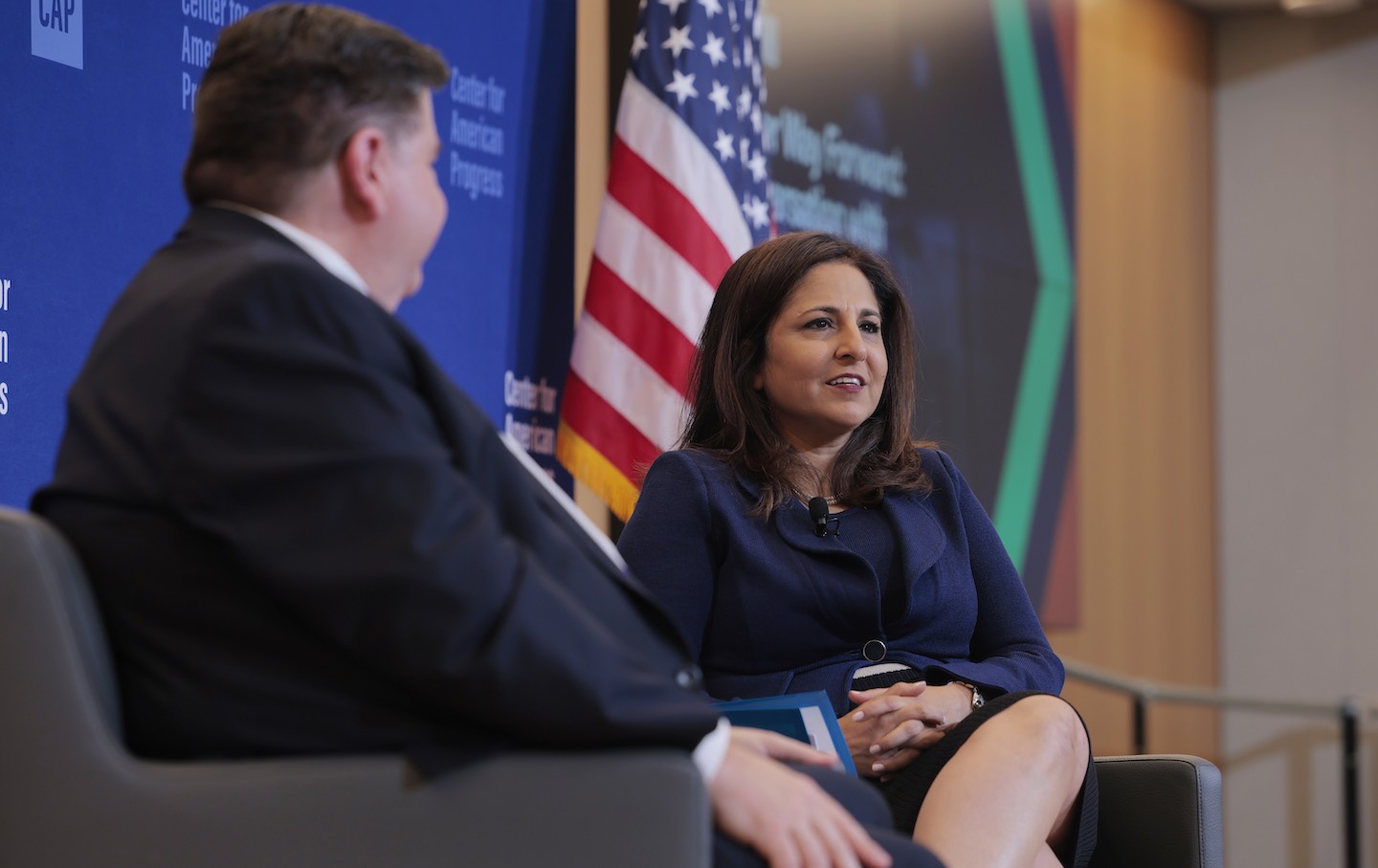
Illinois Governor J.B. Pritzker speaks alongside Neera Tanden, the president and CEO of the Center for American Progress (CAP) at the office of the CAP Action Fund on March 18, 2025, in Washington, DC.
(Anna Moneymaker / Getty Images)
As she introduced Illinois Governor J.B. Pritzker to launch a new speakers’ series for the Center for American Progress (CAP), Neera Tanden—the Democratic think tank’s CEO and president—marveled at the turnout. Peering up at the crowd in the palatial CAP gathering space, she exclaimed: “Look—three stories!”
The atrium hosting the gathering does indeed stretch up three stories in CAP’s generally palatial downtown DC headquarters—a gleaming, glass-fronted edifice bearing eloquent testimony to the reach of the Democratic Party’s big-money donor base—and guests had filled up all the available balcony space. Her sit-down conversation with Pritzker, Tanden enthused, was “one of our largest events,” counting both in-person and online registrations.
But the response was not so much in loving tribute to CAP as it was a reaction to its failed agenda. Even the publicity for Pritzker’s appearance bore grim testimony to the messaging failures of Democratic Party leaders. CAP’s own slogan is “Boldly Forward”—itself an unfortunate echo of one of the many dud campaign slogans adopted by Hillary Clinton in her 2016 presidential run. Yet Pritzker’s talk was titled “A Better Way Forward,” perhaps an inadvertent confession that precious few Democratic strategists and donors have the first clue about whatever direction might be forward in the republic’s current slough of authoritarian despond.
Pritzker, to his credit, began his remarks by subtly disavowing the banner under which CAP had called him forth. “I did not see that the title of my talk was a better way forward,” he said. “I think about that and I think the only way out is through.” His comments were gratifyingly plainspoken, in contrast to both the event’s confusing forward-speak, and the party’s broader propensity, in these days of untrammeled reaction, to be terrified by its own shadow. Pritzker spoke of how “Elon Musk and his fellow DOGE bags” are “ intentionally dismantling” the bulwarks of government and “giving themselves the authority to rebuild it in their own interests.” He spoke candidly of the leering cruelty of the Trump White House’s deportation raids and the DOGE assault on governance. “People’s lives are a game to them,” Pritzker said of “the memelords and minions of the White House.”
Such rhetoric bespoke another reason for the overflow turnout at the CAP event: Pritzker is already positioning himself as a likely contender for the Democratic presidential nomination for 2028. So in this sanctum of the Democratic donor class, the governor was test-driving key talking points and auditioning his statesmanlike gravitas.
And here again, the performance was closely calibrated to appeal to insider policy wonks and the big-ticket contributors who bankroll them. When Pritzker cited his record in Illinois of reducing college costs and securing reproductive freedom ahead of the Dobbs decision, the crowd broke out into eager applause; when he later asked, in his conversation with Tanden, “Why are we all not screaming about the $7.25 minimum wage in this county?” the response was decidedly more tepid.
This, too, is at least in part an optics problem. Pritzker is perhaps best known for his hometown 2024 Democratic National Convention speech, where he dressed down Donald Trump from the vantage point of an “actual billionaire.” An heir to the Hyatt hotel fortune, Pritzker is clearly in the camp of “good billionaires” recently hymned by new Democratic National Committee chair Ken Martin—but a billionaire crusading on behalf of struggling working families can give off a distinct Charles Foster Kaine vibe. To be sure, Trump, the pseudo-billionaire Pritzker castigates, uses an arsenal of demagogic bigotry to pose as a people’s tribune—but if Pritzker is going to be a populist leader of today’s Democrats, he needs to come off as a class traitor in the mold of Franklin Roosevelt, who famously thundered during the 1936 campaign that he welcomed the hatred of the nation’s financiers and owning class. The closest Pritzker came to voicing such sentiment was when he noted with chagrin that in a meeting of name-brand corporate CEO’s, the assembled fiduciary officers “essentially said that they’re afraid to raise their heads—that they will get shot at, so to speak, by the Trump administration.”
As he outlined an agenda for a revived Democratic Party, Pritzker underlined the need for party leaders to extoll the virtues of small business—both because they are the economic players absorbing much of the disabling costs of the Trump White House’s tariffs, and because major employers in Illinois, such as the heartland name brand John Deere, began as scrappy “start-ups.”
That aside hit home for me, but not in the way Pritzker intended. John Deere is headquartered in Moline, Illinois, across the Mississippi River from my hometown of Davenport, Iowa, and was far and away the largest employer there during my childhood. Davenport was so ravaged by the 1980s farm crisis—and the mass exodus of manufacturing jobs from outfits like Deere, Caterpillar, and the now-defunct International Harvester—that in 1998, Money magazine named it the worst city to live in. Last fall, Deere announced that it was offshoring hundreds more jobs from its Moline works and other facilities—but not under pressure from downtrending economic conditions. Rather, the company clocked $10 billion in profits during the 2023 fiscal year, which it promptly converted into $7.2 billion into stock buybacks and another $1.4 billion in shareholder dividends. The move indeed prompted Trump to threaten the company with 200 percent tariffs at the height of last year’s presidential campaign. While Pritzker did say much that needed saying before his full house at CAP, it’s hard not to think that anointing a billionaire as the guardian of a model democratic political economy is going boldly backward.
Disobey authoritarians, support The Nation
Over the past year you’ve read Nation writers like Elie Mystal, Kaveh Akbar, John Nichols, Joan Walsh, Bryce Covert, Dave Zirin, Jeet Heer, Michael T. Klare, Katha Pollitt, Amy Littlefield, Gregg Gonsalves, and Sasha Abramsky take on the Trump family’s corruption, set the record straight about Robert F. Kennedy Jr.’s catastrophic Make America Healthy Again movement, survey the fallout and human cost of the DOGE wrecking ball, anticipate the Supreme Court’s dangerous antidemocratic rulings, and amplify successful tactics of resistance on the streets and in Congress.
We publish these stories because when members of our communities are being abducted, household debt is climbing, and AI data centers are causing water and electricity shortages, we have a duty as journalists to do all we can to inform the public.
In 2026, our aim is to do more than ever before—but we need your support to make that happen.
Through December 31, a generous donor will match all donations up to $75,000. That means that your contribution will be doubled, dollar for dollar. If we hit the full match, we’ll be starting 2026 with $150,000 to invest in the stories that impact real people’s lives—the kinds of stories that billionaire-owned, corporate-backed outlets aren’t covering.
With your support, our team will publish major stories that the president and his allies won’t want you to read. We’ll cover the emerging military-tech industrial complex and matters of war, peace, and surveillance, as well as the affordability crisis, hunger, housing, healthcare, the environment, attacks on reproductive rights, and much more. At the same time, we’ll imagine alternatives to Trumpian rule and uplift efforts to create a better world, here and now.
While your gift has twice the impact, I’m asking you to support The Nation with a donation today. You’ll empower the journalists, editors, and fact-checkers best equipped to hold this authoritarian administration to account.
I hope you won’t miss this moment—donate to The Nation today.
Onward,
Katrina vanden Heuvel
Editor and publisher, The Nation