
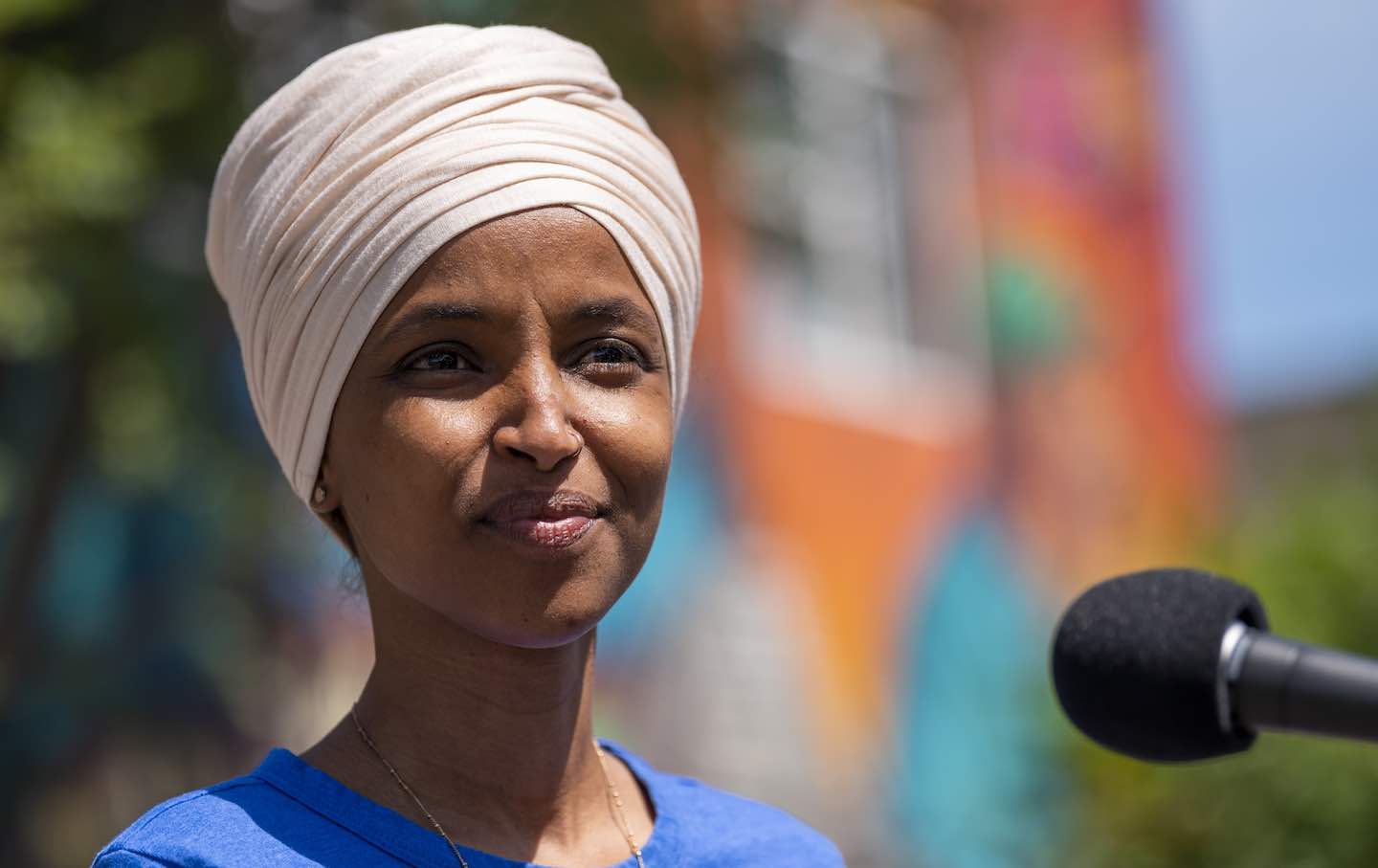
Representative Ilhan Omar (D-MN) speaks with reporters gathered outside Mercado Central on August 11, 2020, in Minneapolis, Minnesota.
(Stephen Maturen / Getty Images)
After four years living in a Kenyan refugee camp, where they had fled from the violence and oppression that had erupted in their native Somalia, members of the Omar family considered their options for making a new life in a distant land. Somali refugees were being resettled around the world in the mid-1990s, and the family had opportunities to go to Norway or perhaps another Scandinavian country, or to Canada. But the grandfather had other ideas. “He wanted to come to the United States because, he said, the United States is where you can eventually become American,” recalled his granddaughter decades later. “As somebody who was born into colonized Somalia, and lived through dictatorship, and never really got to fully experience democracy, he was very eager to live in what he called ‘a true democracy.’”
So it was that the immigration process began. The grandfather and granddaughter watched westerns featuring Clint Eastwood, and eventually traveled to Nairobi to view glossy travel films that featured images of an America with white-picket fences and happy children boarding school buses. Paperwork was completed. Plane reservations were made and, in March of 1995, 12-year-old Ilhan Abdullahi Omar arrived in the United States.
On the 30th anniversary of her arrival, Omar is one of the most well-recognized elected officials in her adopted country—a member of Congress who celebrates the rights outlined in the US Constitution with a level of knowledge and enthusiasm that few of her colleagues can muster. She’s been especially outspoken in recent months, as an advocate for immigrants and refugees who have been targeted by the second Trump administration; as one of the first members of the House to call for the release of Mahmoud Khalil after the Columbia University graduate was arrested, jailed, and targeted for deportation by the president and others because he dared to exercise his free speech rights as a critic of Israel’s assault on Gaza; and as the target of hateful attacks by Republicans such as Texas US Representative Brandon Gill, who, in a February fundraising letter, announced, “Friend, we should have never let Ilhan Omar into our country. And frankly, America would be a much better place if she were to be sent back to Somalia.”
The attacks on Omar from right-wing xenophobes are dishonest, and often vile. Yet they have never soured the Minnesotan on the land that welcomed her as a pre-teen refugee and that, outside the uglier corridors of official Washington, continues to embrace her with a warmth that she says reflects the real America.
It is an America she got to know, primarily, in Minnesota, where her family joined the large Somali community that had settled in the Twin Cities.
Though she had arrived in the United States with an English vocabulary that was limited to just a few words— “hello” and “shut up”—Omar mastered the language quickly by mimicking dialogue from shows she watched on television. Soon, she was talking politics.
Encouraged by her grandfather and father, who raised her after the death of her mother when Omar was 2, she took an almost immediate interest in the electoral processes of her new home. Again, her grandfather’s fascination with American democracy proved to be a catalyst. “He was taking English-language classes and citizenship classes and people were passing out letters inviting neighbors to attend the [Democratic Farmer-Labor Party, or DFL] caucuses. He wanted to go, but he didn’t speak English. So, at the age of 14, I was able to go with him. That was sort of my falling-in-love-with-democracy moment.”
Soon, she was swept into DFL politics as a teenage activist, inspired by the late Senator Paul Wellstone, a progressive who organized movement-style campaigns that twice won Minnesota Senate races in the 1990s.
“People were energized and mobilized and engaged because of Paul Wellstone,” recalls Omar. “He was the essence of grassroots mobilization. There wasn’t a community that he wasn’t willing to touch and engage with. A lot of my friends in the Somali community, who I came up with around political organizing, worked for him, and knew him deeply and got their start there.”
For her part, Omar started working at Target at age 16, and then on the night shift at the post office, where she worked with her father. The money she made went to buy a Chevy Cavalier—“a red two-door, really cool car…and it was American-made. Dad was really serious about that. We were only allowed to buy American-made cars.”
After she graduated from North Dakota State University—where the young woman who had been raised in East Africa scrambled to classes in minus-45-degree weather—she returned to Minneapolis and the rigors of DFL politics. A few years later, she beat a 44-year incumbent legislator in a 2016 party primary.
“It was the realization of the American Dream: Anything that you put your mind into can be achieved,” says Omar of that first bid for elected office. “I think that’s why it energized and mobilized so many young people, so many progressives, and why it did get not just the national but international attention.”
Popular
“swipe left below to view more authors”Swipe →Two years later, Omar was on her way to Congress, as one of the first two Muslim women—along with Michigan Democrat Rashida Tlaib—to be elected to the US House. Omar celebrated her November 2018 victory in the middle of Donald Trump’s refugee-targeting first term, by announcing, “Here in Minnesota, we don’t just welcome refugees and immigrants, we send them to Washington.”
Those were carefully chosen words, explains Omar, who says, “The biggest part of my story and my success is the enormous welcome and generosity of my Minnesota neighbors: my teachers, my employers, everyone who made sure that I was set up for success… this enormous community that said, ‘OK, here’s a kid. She has potential. Let’s make sure that she has the tools that she needs to make this country her home and succeed.’ That really is the only reason that I am able to do what I do.”
Her genuine humility, and love of place, has made Omar a popular figure in her home state. She’s won a dozen primary and general elections since 2016, and her town hall meetings are packed with constituents who cheer on her advocacy for economic, social, and racial justice, and her willingness to challenge corporate and political elites.
But Omar’s outspoken defenses of immigrants and refugees, and her frequent objections to US policies in the Middle East and elsewhere, have not always won her a warm welcome in Donald Trump’s Washington. After her 2018 election, Omar was almost immediately attacked by House Republicans, and, ultimately, by the president. “For Trump, I represented everything that he hated about Obama,” says Omar. Recalling Trump’s questioning of the former president’s citizenship, and suggestions that the Christian Obama was a Muslim, Omar notes, “I actually was an East-African refugee, and a very visibly Muslim immigrant in Congress, and a Black woman.” So she wasn’t exactly shocked when Trump attacked her, along with and other progressive women in the House, via a social post that asked, “Why don’t they go back and help fix the totally broken and crime infested places from which they came?”
Amid Trump’s “vitriolic reaction to my presence” in the House, Omar said, “I always held on to that sense of home and welcome and generosity that I knew existed within the American people. When he even said I should go back to where I came from, I went home to Minneapolis, Minnesota, and my neighbors showed up at the airport to welcome me. And, so, I’ve always held on to that America that I know, that I love, that does welcome refugees with open arms and makes sure that they are set up for success—to become American, as my grandfather believed would be possible. And it has been possible for me.”
The experience of serving in Congress has tested Omar. It was tough during Trump’s first term. And, in many senses, it is tougher now. Trump’s own rhetoric is more combative, and his supporters leave no doubt about their disdain for anyone who disagrees with the president. That’s been particularly true for Omar. During a recent Fox interview, singer Kid Rock reacted to Omar’s objections to Trump’s March 4 address to Congress by saying he thought she should “just collect your things from your office, put a basket on your head and walk back to where you came from.”
But Omar argues that what happens in Congress does not always reflect America. “I never received an outward racist reaction to me until I came to Congress. That still remains true for me,” she says.
“My journey to America, my life in America, has genuinely been through that lens of seeing Americans who have been generous with their time, with their knowledge, with their willingness [to be supportive]. I hold onto that because that was the promise that my grandfather knew—that we would eventually become Americans. That is the promise that has been fulfilled for me,” adds Omar. “I am American. I get to represent Americans. And not only do I get to live the American Dream, my kids get to live the American Dream.”
At the heart of that dream is a faith that Americans share more than the current discourse suggests. “My hope is that we do,” says Omar.
Recalling her youth in Somalia, she adds, “I am someone who has experienced the kind of divisiveness that brings a nation to its knees. My hope is that, as Americans, we open our eyes to that potential—and do whatever we can to keep that American exceptionalism alive, and that we continue to support the institutions that create stability, and have created stability for the United States, and that we hold on to the Constitution that binds us all.”
Become a Sustaining Donor This September
Between the reemergence of right-wing red-baiting and Donald Trump’s use of the chilling National Security Presidential Memorandum–7 to criminalize left political organizing, we’re seeing McCarthyism reborn before our eyes.
This assault on democracy cannot be ignored or wished away. Resisting it requires bravery in the face of threats and repression, a steadfast commitment to the truth, and the unwavering belief that we can—and will—overcome this darkness.
We must have an independent media that sets the record straight, unearths corruption and abuses of power, and advances a politics of justice and dignity for all if we’re to win this fight.
That’s why I’m writing to you today. This September, The Nation needs to add 100 monthly donors to sustain our progressive journalism. Your contribution makes the next investigative report, the next truth-speaking column, and the next pathbreaking essay all possible.
I hope you’ll support our work with a recurring donation today. If you donate $10 or more a month, we’ll send you a brand new “Hands Off the Free Press!” sticker to recognise your commitment to our cause. Please, donate today.
Onward,
Katrina vanden Heuvel
Editor and Publisher, The Nation
More from The Nation

The US Had a Choice After 9/11. It Chose Wrong. The US Had a Choice After 9/11. It Chose Wrong.
In this week’s Elie v. U.S., our justice correspondent reflects on September 11. Plus: the stupidity of the "Trump Dividend" and the threat of AI.


Trump Wants Voters to Pretend He’s on the Ballot Trump Wants Voters to Pretend He’s on the Ballot
But Republican midterm candidates are hoping everyone forgets he exists.

Remembrance: 25 Years Since the September 11 Attacks Remembrance: 25 Years Since the September 11 Attacks
On September 11, 2001, coordinated terrorist attacks carried out by the extremist group al-Qaeda killed 2,977 people and injured more than 6,000 others in the United States.

How The Nation Covered 9/11 How "The Nation" Covered 9/11
Our phone lines were down. People were weeping. But we got an issue out the door with morality, justice, and nuance.

How a 26-Year-Old Beat a 42-Year Incumbent—and What It Means for Democrats How a 26-Year-Old Beat a 42-Year Incumbent—and What It Means for Democrats
As the only undergraduate managing a primary campaign in the state, I helped a 26-year-old beat a 42-year incumbent. Here is what Democrats can learn from our win.

