How Covid Sickened the National Psyche
While the US was a troubled nation long before the coronavirus, our failure to treat the pandemic as an enduring emergency helped birth this nasty moment.
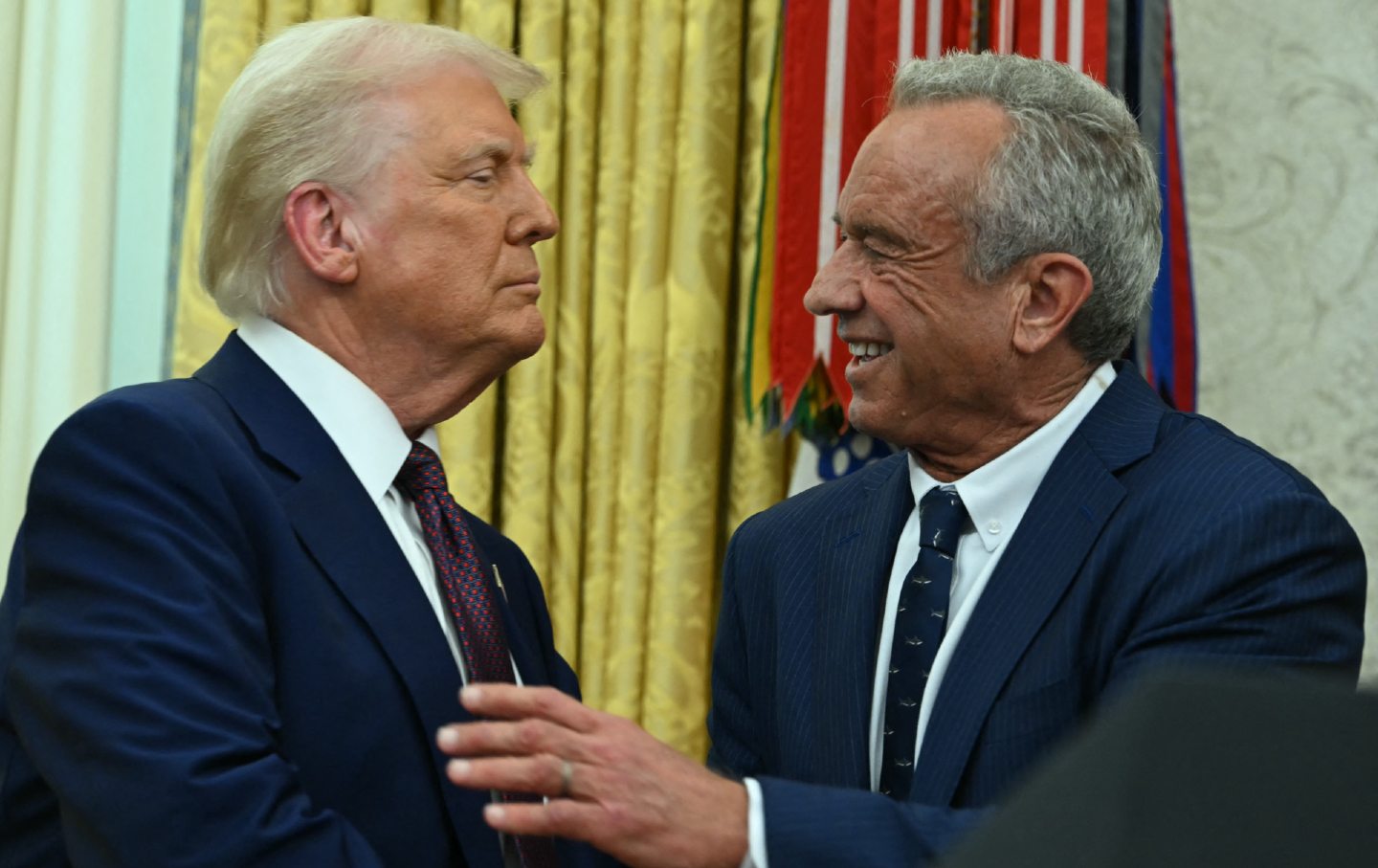
On February 13, 2020, the Centers for Disease Control and Prevention confirmed the 15th case of Covid-19 in the United States, an early sign that the pandemic was a spark on the verge of becoming a wildfire. Exactly five years later, the Senate confirmed Robert F. Kennedy Jr., a virulent foe of mainstream science, as secretary of health and human services.
Twelve days after that, RFK Jr., in keeping with his deep-seated anti-vaccination agenda, paused a Biden administration program to test a new Covid vaccine. At roughly the same time, his colleague Elon Musk, in his capacity as de facto head of Donald Trump’s so-called Department of Government Efficiency, gutted government funding for Ebola prevention in Africa.
RFK Jr. might be cavalier about the need to continue fighting Covid, but his accession to power is itself proof of how the pandemic has remade America and the world. The half-decade since Covid emerged as a pandemic has seen a remarkable boomerang effect, wherein scientific and public health success has provoked an anti-intellectual and antisocial backlash that threatens our ability to fight future pandemics—while empowering extreme right-wing politics. This historic whiplash came about because politicians across the spectrum treated Covid as a temporary emergency rather than a lasting challenge.
Covid hasn’t gone away. It’s become less virulent, but it’s still killing people. Seven million people have died, including a disproportionately large number of Americans (at least 1.2 million). Among the survivors, one study estimated, at least 14 percent of Americans have suffered at some point from long Covid, a complex mix of lingering ailments that include tiredness and brain fog. Harvard economist David Cutler estimates that in the US alone, the cumulative cost of long Covid over the lifetime of people who have it—in lost wages, medical expenses, and diminished quality of life—will be $3.7 trillion. That is the equivalent of the 2008 Great Recession, albeit spread over a longer period.
Worldwide, 400 million people have Long Covid, costing the global economy $1 trillion per year. One measure of the impact of long Covid is the fact that, in Germany, the average number of sick days taken annually by workers has increased by 40 per cent since 2021, from 11 to 15.
Beyond illness, there’s the persistent economic problem: inflation caused by supply-chain disruptions and ballooning deficits, now used to justify austerity. In commercial business districts in the United States, the value of property has fallen by 60 percent since 2019. Behind that statistic lies the story of increasing numbers of white-collar workers doing their jobs from home, leading to boarded-up businesses and restaurants, and testifying to a desolation of urban social life.
And not just urban social life. There is a robust international literature, some of it summarized in National Institutes of Health reports, showing loneliness increased during the pandemic. For Americans, the pandemic meant not just more loneliness but also less trust in the government. Among Republicans, there has also been a steep decline of trust in the scientific community. In late 2024, Pew reported: “In April 2020—the early days of COVID-19—87% of Americans had confidence in scientists to act in the public’s best interests. By fall of last year…the figure had dropped 14 percentage points to 73%. This was driven by a disproportionately steep loss of confidence among Republicans.”
In the wake of Covid, Americans have become more individualistic, more conspiracy-minded, and less committed to collective social effort. This new social Darwinism helped elect Donald Trump—and now it’s being put into practice by RFK Jr. and Elon Musk.
It didn’t have to be this way. The initial moment of Covid brought with it a utopian burst of collective effort: Donald Trump deserves credit for Operation Warp Speed (which created the first vaccine with remarkable alacrity) and for working with Democrats to pass the generous payments that helped Americans survive the lockdown. But once out of office, Trump found it easier to harness the anger of conspiracy theorists and cranks. The Trump of 2020 listened to Dr. Anthony Fauci; the Trump of 2025 removed Fauci’s security protection.
But Democrats share some blame for too quickly abandoning programs to fight Covid. In April 2023, Joe Biden declared the Covid emergency over. Well before then, economic relief for Covid had been scaled back. As the Columbia University economics historian Adam Tooze has noted, the Biden administration gave up on “supporting a generous extension of the American welfare state, which was in fact adopted during the crisis. Child tax benefits, for instance, halved American child poverty during the crisis.” Biden ended those benefits in January 2022, retrenching on commitments that were still needed by struggling Americans. This cutback, combined with the Federal Reserve’s decision to raise interest rates to fight inflation, created a nation of enraged and financially strapped Americans. A more equitable anti-inflation measure, controls on corporate price-gougers, was largely neglected.
In 2020, the world, and Americans, were unprepared for Covid; five years later, there has been the opposite of a learning process. The medical infrastructure and the social cohesion to deal with a pandemic have frayed rather than undergone repair. What remains is a selfish, antisocial mood that is perhaps the most pervasive feature of our time: the Covid Era.
Become a Sustaining Donor This September
Between the reemergence of right-wing red-baiting and Donald Trump’s use of the chilling National Security Presidential Memorandum–7 to criminalize left political organizing, we’re seeing McCarthyism reborn before our eyes.
This assault on democracy cannot be ignored or wished away. Resisting it requires bravery in the face of threats and repression, a steadfast commitment to the truth, and the unwavering belief that we can—and will—overcome this darkness.
We must have an independent media that sets the record straight, unearths corruption and abuses of power, and advances a politics of justice and dignity for all if we’re to win this fight.
That’s why I’m writing to you today. This September, The Nation needs to add 100 monthly donors to sustain our progressive journalism. Your contribution makes the next investigative report, the next truth-speaking column, and the next pathbreaking essay all possible.
I hope you’ll support our work with a recurring donation today. If you donate $10 or more a month, we’ll send you a brand new “Hands Off the Free Press!” sticker to recognise your commitment to our cause. Please, donate today.
Onward,
Katrina vanden Heuvel
Editor and Publisher, The Nation