Trump’s 51st-State Plan Would Be a Literal Death Sentence for Canadians
Canadians have a universal healthcare system and significantly longer life expectancy than Americans.
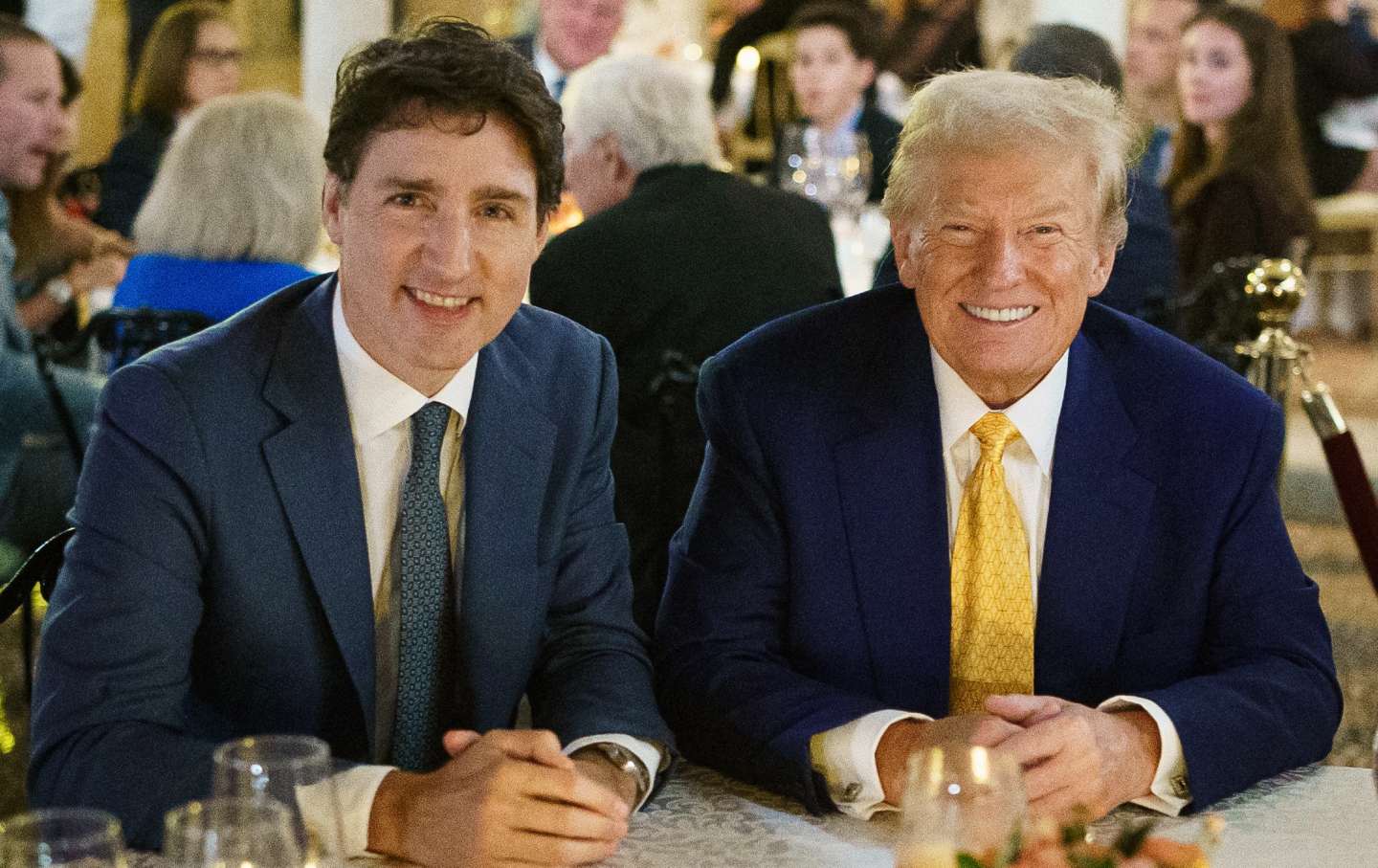
Justin Trudeau and Donald Trump at Mar-a-Lago on November 29, 2024.
(Justin Trudeau / X)Donald Trump thinks Canadians should become Americans. For weeks, he has called for Canada to become the 51st American state—one that would stretch from the Atlantic to the Pacific and as far north as the Arctic.
Trump seems serious about this idea. But Canadians are equally serious about rejecting it.
“The Angus Reid poll conducted a survey of both Canadians and Americans. For one question, Canadians were asked how they would vote in a referendum on whether Canada should become part of the U.S.,” the Canadian Broadcasting Corporation explained after Trump proposed the idea in January. “That survey found just a small minority, one out of 10 Canadians surveyed, would support the idea of Canada joining the U.S., but that the vast majority, 90 per cent, were opposed.”
“Canada Hates Trump!” social media spaces are also proliferating at a dramatic rate.
But Trump does not take “no” for an answer. In his Super Bowl Sunday interview with Fox News’s Bret Baier, the president was asked if his assertion that Canada should become the 51st state was “a real thing”— as Canadian Prime Minister Justin Trudeau warned after talking with the president. Trump said, “Yeah, it is.” And he did not stop there, saying, “I think Canada would be much better off being the 51st state.”
Then, Trump took his fantasy to even more ludicrous heights. He claimed that, as citizens of the US, “Canadian citizens would…have much better medical [care].”
Seriously?
Unlike the United States, where our for-profit healthcare system regularly fails to provide quality care for all Americans, Canada has a publicly funded healthcare system that provides “universal coverage for medically necessary healthcare services provided on the basis of need, rather than the ability to pay.”
According to an assessment of scholarly research on the healthcare systems in the US and Canada, which was produced by the group Physicians for a National Health Care Program, “The Canadian single payer healthcare system produces better health outcomes, with substantially lower administrative costs than the United States.”
At the heart of the Canadian system is its guarantee of universal coverage. That contrasts dramatically with the United States where, according to a 2024 study of “The State of Health Insurance Coverage in the U.S.” by the Commonwealth Fund, “Nine percent of adults were uninsured, 12 percent had a gap in coverage over the past year, and 23 percent were underinsured, meaning they had coverage for a full year that didn’t provide them with affordable access to health care.” And that’s even with the expansion of coverage under the Affordable Care Act.
The lack of affordable access to care in the United States has profound consequences that would undoubtedly shock Canadians.
For instance, according to the Commonwealth Fund, in the United States:
Nearly three of five (57%) underinsured adults said they avoided getting needed health care because of its cost; 44 percent said they had medical or dental debt they were paying off over time.
Delaying care has health consequences: two of five (41%) working-age adults who reported a cost-related delay in their care said a health problem had worsened because of it.
Nearly half of adults (48%) with medical debt are paying off $2,000 or more; half of those with debt said it stemmed from a hospital stay.
Popular
“swipe left below to view more authors”Swipe →But the starkest distinction between Canada and the United States involves the ultimate health outcome: life expectancy.
There are many groups that compare life-expectancy rates by country. All of them conclude that Canadians live longer than Americans—in some cases, a lot longer. The World Bank Group’s comprehensive survey found in 2022 that Canadian life expectancy was 81.3 years versus 77.4 for Americans. Other surveys, such as the CIA World Factbook (2024 estimate: 84.2 years for Canada versus 80.9 years for the Americans) describe slightly different gaps. But the bottom line is consistent: Canadians outlive Americans—and this pattern was especially evident during and after the period when the Covid-19 pandemic highlighted the life-and-death consequences of universal access to quality care.
There are, of course, many factors that can influence life expectancy—including wealth disparity, the relative development of broader social safety nets, and health and diseases patterns. But access to quality healthcare is widely accepted as a vital factor and, as Senator Bernie Sanders says, that has benefited Canadians—tremendously. “A single payer system does not mean having a lower quality system,” says the Vermont independent. “Canada has longer life expectancy than in the U.S. and better health outcomes.”
Indeed, when Trump spoke in January about making Canada a part of the United States—with a claim that “they’d have much better health coverage”—Sanders dismissed the scheme with a question and answer:
Better health coverage? If Canadians became US citizens they would lose their free health care, pay nearly three times more for their prescription drugs, and many of them wouldn’t be able to get coverage at all. Something tells me they won’t be interested.
Factor in the life-expectancy differential and, for Canadians, the whole 51st-state plan seems less like a promise and more like a threat.
More from The Nation

The Specter of Lepenism Looms Over France’s Social Crisis The Specter of Lepenism Looms Over France’s Social Crisis
Joining forces with the “yellow vests,” youth demonstrators are raising the alarm in a country falling to the far right.

Progressives Are Backing Puerto Rican Independence. It’s About Time. Progressives Are Backing Puerto Rican Independence. It’s About Time.
More and more leftists are concluding that statehood for the island is not enough.

The Saudi Phase of the Iran War Signals More Chaos to Come The Saudi Phase of the Iran War Signals More Chaos to Come
The conflict that Donald Trump has repeatedly proclaimed an unequivocal American victory keeps spiraling out of control.

Why Navi Pillay’s Receiving the Nobel Peace Prize Is So Important Why Navi Pillay’s Receiving the Nobel Peace Prize Is So Important
She believes that human rights and international law are universal principles that must be enforced regardless of violator’s ideology, ethnicity, or geostrategic alignment.
Andy Burnham’s Speech to the Labour Party Conference Could Be the Start of a Positive Social-Democratic Politics Andy Burnham’s Speech to the Labour Party Conference Could Be the Start of a Positive Social-Democratic Politics
But the autumn budget to be released at the end of October will offer needed details.