Elder Abuse Is No Way to Run a Government
The corridors of power increasingly resemble a nursing home—if not a hospice.
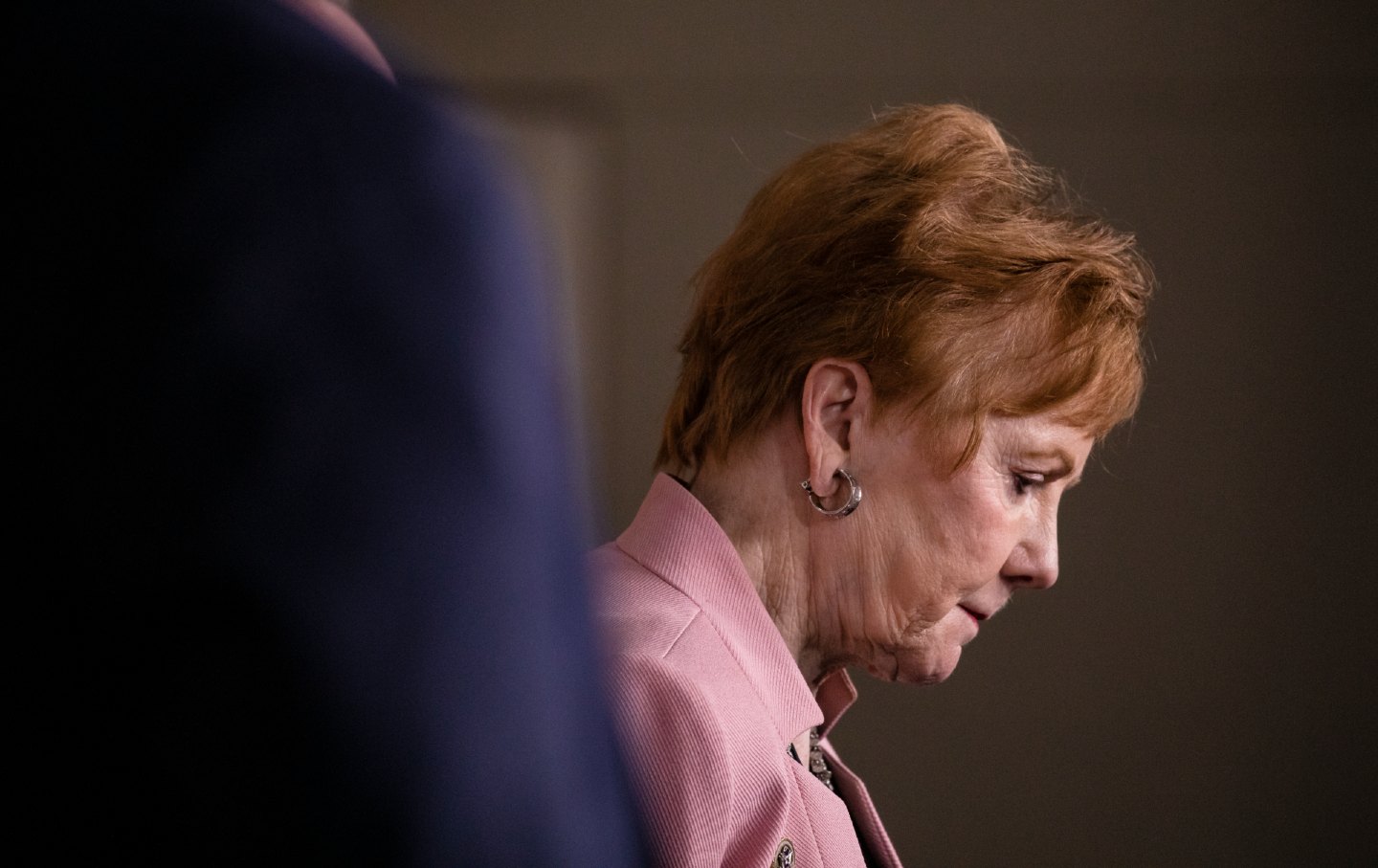
This year, two veteran members of Congress, Republican Representative Kay Granger from Texas and Democratic Representative Annie M. Kuster of New Hampshire, announced that they were retiring from public service, but the story of their last days played out very differently, illustrating the dangers of a political system that enables both gerontocracy and elder abuse.
In March, Granger, age 81, announced that she was stepping down from her powerful post as chair of the House Appropriation Committee and would not seek reelection, even though she would finish out her term. She cast her last vote on July 24, and has appeared in Washington only once since. For all intents and purposes, Granger had disappeared from public visibility.
On December 20, The Dallas Express, a conservative online publication, revealed that Granger had been living in an independent living facility. Prior to that discovery, Granger’s office was not returning phone calls to the Express or anyone else. Visiting her office, reporter Carl Turcios found “the door locked, the front door glass window covered, no one inside, and no sign of the office continuing to be occupied.”
Responding to these reports, the congresswoman’s son, Brandon Granger, stated that his mother suffered from “dementia,” a condition he claimed was diagnosed in September. Granger’s office shared a statement where she purportedly said that “since early September, my health challenges have progressed, making frequent travel to Washington both difficult and unpredictable. During this time, my staff has remained steadfast, continuing to deliver exceptional constituent services, as they have for the past 27 years.”
This version of Granger’s story, which places the onset of dementia in September, makes little sense, since, as Ken Klippenstein reports on his Substack, there is evidence that as early as March she had difficulty reading even from a prepared statement without painful effort. Further, she sold her home in early July, which indicates that her move to the independent living facility was already in the works at that time.
Granger eventually resigned her seat—but too late. If she had left public service a few years ago, she’d be remembered as a pioneer, the first Republican woman to lead the House Appropriations Committee. Now, there is a pall on her legacy since, as The New York Times reports, she has “brought renewed attention to how Capitol Hill is powered by a crop of septuagenarians and octogenarians, including some who refuse to relinquish power even far past their primes.”
Granger’s fellow congresswoman Annie M. Kuster, age 68, offers a telling contrast. In an interview with The Boston Globe, Kuster made clear that she is leaving Washington not just for personal reasons but also to show that lawmakers do in fact have the ability to reject gerontocracy. According to Kuster, “I’m trying to set a better example. I think there are colleagues—and some of whom are still very successful and very productive—but others who just stay forever.”
The Granger case, along with new reporting making clear that Joe Biden has served as a diminished president, is forcing gerontocracy onto the agenda in Washington. Aside from Biden and Granger, there are now increasing expressions of concerns about the advanced age and healthcare struggles of former House speaker Nancy Pelosi and outgoing Senate Republican leader Mitch McConnell (both of whom, despite formally giving up powerful posts, remain kingmakers in Washington). Questions have also been raised about Democratic Representative David Scott of Georgia, with even fellow Democrats expressing skepticism about his ability to serve. The decision to sideline young congresswoman Alexandria Ocasio-Cortez in the House Oversight Committee on behalf of Gerry Connolly, who is 74 and suffers from cancer, has been criticized even by centrist Democrats such as Jen Psaki as proof of entrenched gerontocracy.
This is a major shift from recent years, when a bipartisan code of silence protected elected officials and judges from being criticized even though there was ample evidence that age had made them incapable of serving.
Republican Representative Thomas Massie of Kentucky responded to the Granger story by tweeting, “I’m more concerned about the congressmen who have dementia and are still voting.”
Democratic Representative Ro Khanna of California tweeted:
Kay Granger’s long absence reveals the problem with a Congress that rewards seniority & relationships more than merit & ideas. We have a sclerotic gerontocracy. We need term limits. We need to get big money out of politics so a new generation of Americans can run and serve.
Khanna’s statement has the virtue of moving the discussion beyond just the individual choices of lawmakers and into the wider system that has made gerontocracy possible. Republican firebrand Kerri Lake, who rarely agrees with Khanna on anything—and is seldom a voice of reason—also offered a systemic analysis, tweeting, “Washington D.C. shouldn’t be a retirement home, but the entrenched forces there are so desperate to hold on to power that they will reject fresh voices while pulling stunts like this.”
Khanna and Lake are accurate in seeing the problem as entrenched systems. The rules of Congress reward seniority with more power, which also makes it logical for voters to keep voting for longtime lawmakers even past the decline in their capacity. Those lawmakers have staff who can make sure that the perks of power are still shared with constituents.
These staffers themselves constitute an important enabling force for gerontocracy. After all, a diminished political leader basically acts as a figurehead or puppet for staffers who can exercise real power behind the scenes. Joe Biden’s presidency may have been a tragedy for the Democrats, for America, and for the world—but for figures like national security adviser Jake Sullivan or chief of staff Jeff Zients (and his predecessor Ron Klain), it was a chance to pursue their vision of the world without the kind of impediment that might have been expected from a fully alert and cognizant president.
Popular
“swipe left below to view more authors”Swipe →In the past, I’ve worried about the United States becoming a gerontocracy. But it is now clear that gerontocracy is only half of the problem. The gerontocracy itself creates the conditions for a horrifying form of elder abuse, where aged and diminished leaders are used as puppets by unelected officials.
Democrats unsuccessfully tried to make Donald Trump’s threat to democracy a major campaign issue in the presidential election. One reason this gambit failed is that the Democrats painted too narrow and unconvincing a portrait of the threat. It’s true that Trump, an authoritarian demagogue, is a threat to democracy. But his rise is symptomatic of a larger breakdown in the system, which also includes the dangers of gerontocracy and elder abuse. Indeed, Trump, who is coming into office as the oldest elected president and is a weathervane easily shifted by his advisers, is an example of these problems as well.
Unfortunately, Democrats—because they themselves are guilty of gerontocracy and elder abuse—lack the credibility to claim support as the solution to this grave problem. Once again, Trump is able to triumph thanks to the fecklessness of the Democratic Party establishment.
More from The Nation

Even Republicans Are Waking Up to Trump's Corruption Even Republicans Are Waking Up to Trump's Corruption
And, somewhat shockingly, so are Democratic elites.


Mamdani Can No Longer Avoid the Issue of the NYPD Mamdani Can No Longer Avoid the Issue of the NYPD
The mayor has been able to put difficult questions about policing on the back burner—until now.

Why Democratic Leaders Keep Waging War on the Young Why Democratic Leaders Keep Waging War on the Young
The party's silver-haired establishment is caught up in an existential culture war.

The White Man Can Always Take What You Have The White Man Can Always Take What You Have
In this week's Elie v. US, our justice correspondent breaks down the real message of the attacks on Ilhan Omar. Plus: the anti-trans case that will come for us all.