Trump’s Pick for Labor Secretary Won’t Neutralize the Damage His Administration Will Inflict on Workers
Lori Chavez-DeRemer is as good a pick for labor secretary as one could’ve reasonably hoped for. It’s also, unfortunately, smart politics for Trump.
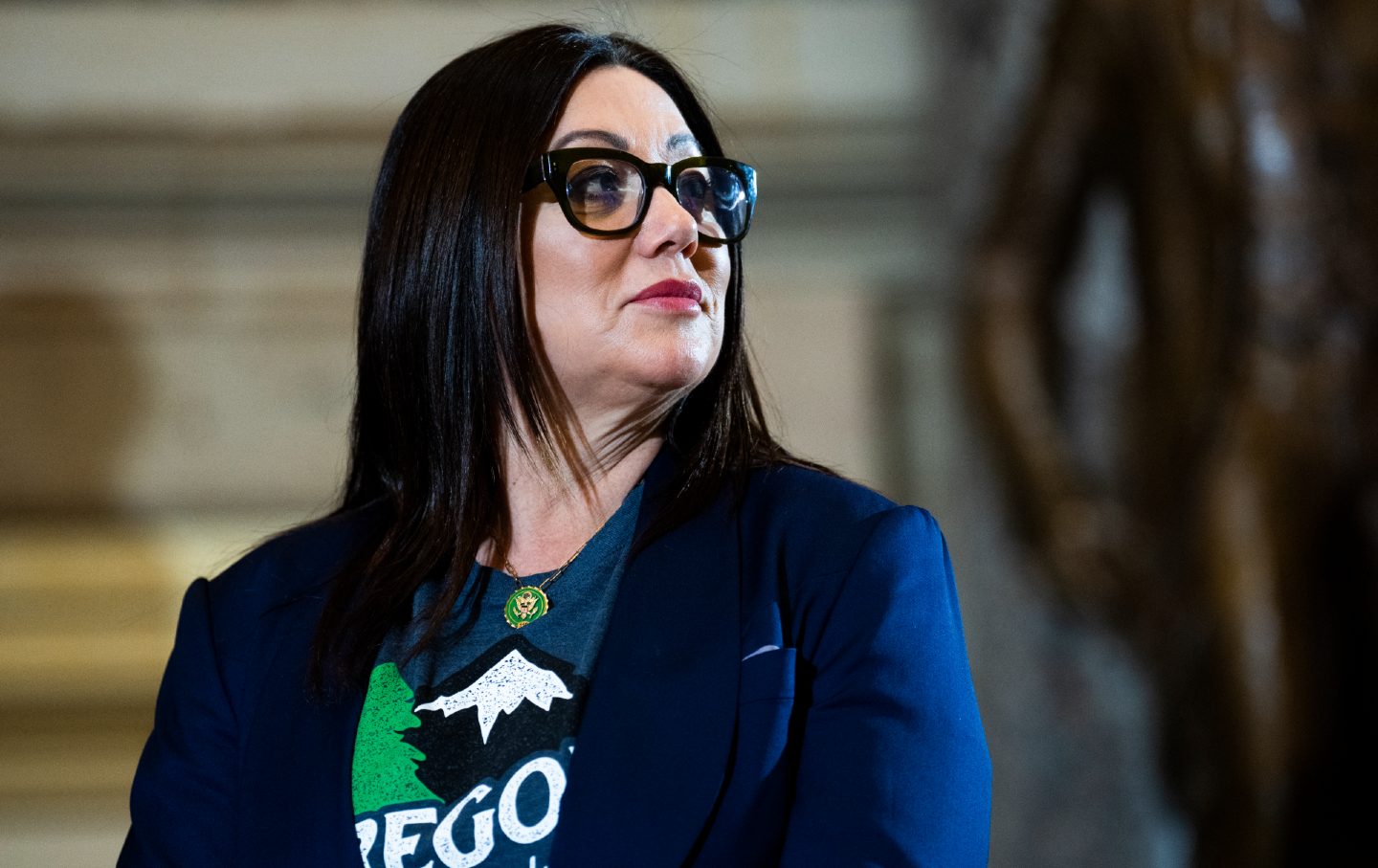
Representative Lori Chavez-DeRemer (R-OR) attends a signing ceremony in the US Capitol for a resolution that invalidates the District of Columbias Revised Criminal Code Act of 2022, on March 10, 2023.
(Tom Williams / CQ-Roll Call, Inc via Getty Images)
For three weeks, I have torn my hair out as Trump nominated one ill-qualified and/or maleficent nominee after the next. But one of the nominations stands out for its relative good sense: Lori Chavez-DeRemer, erstwhile GOP representative from Oregon and daughter of a Teamsters member, for labor secretary.
Chavez-DeRemer, who narrowly lost her reelection bid in a swing district in which it pays to be seen as being in favor of union rights, is one of only a few Republican members of the outgoing Congress to have supported labor over big business and to have positioned herself as pro-union. In her reelection campaign, she was backed by more unions than her Democratic opponent, Janelle Bynum. Given these stances, her nomination to a cabinet stacked full of anti-labor billionaires and hewing largely to Project 2025’s cartoonishly regressive policy stances is an odd fit.
Unions have praised the nomination, with particularly strong words of support coming from the Teamsters, the leadership of which made nice with Trump in the run-up to the election. The AFL-CIO released a statement touting the nominee’s record. Stalwart progressives in Congress such as Senator Elizabeth Warren have also expressed support.
Meanwhile, conservatives have raised eyebrows at the prospect of a GOP labor secretary who isn’t reliably sympathetic to right-to-work laws; supported the PRO Act, which was intended to make union organizing efforts easier; and seems to favor an increase in the minimum wage. National Review’s editors argued that the nomination made “no sense.” The Washington Examiner panned the choice. The right-leaning Coalition for a Democratic Workplace expressed its alarm. And several GOP senators have suggested that she might have an uphill battle securing confirmation.
What is going on here? Why would a man like Trump—who has built a fortune, in part, from stiffing workers; who boasts about shortchanging contractors; whose previous administration, with the strong backing of his three labor secretaries, rolled back overtime protections for workers; and who made small talk with Elon Musk about firing striking employees—nominate a pro-union figure to be his labor secretary?
The answer lies in the numbers. This past November, Trump received somewhere in the region of 45 percent of the votes of people living in union households. Well over 50 percent of Trump’s voters were blue-collar or service workers; for Harris, the equivalent number was slightly over 40 percent. Moreover, in heavily unionized West Coast cities, Democratic turnout plummeted. In Oregon’s Multnomah County, consisting of Portland and the surrounding region, for instance, the Democratic vote dropped by nearly 16 percent.
That depressed Democratic turnout was also true in the suburban areas around Los Angeles, San Francisco, Portland, and Seattle. And while it didn’t stop Harris from handily winning the Electoral College votes of California, Oregon, and Washington, it did provide a glimpse of a possible future in which Democratic control over these three states is no longer as guaranteed as it has been in recent decades.
Inland, it was also true in the union strongholds of Las Vegas and Phoenix, both of which saw lower Democratic numbers in 2024 than in 2020—and both of which, in consequence, helped doom Harris’s chances in the swing states of Nevada and Arizona.
All of this gives Trump an improbable opening, one that speaks to the scale of his ambition to remake the American political landscape not just for four years but for election cycles to come.
Trump, of course, isn’t genuinely pro-worker or pro-union. To suggest otherwise is to willfully ignore his dismal track record on labor policies and his predilection for surrounding himself with apostles of corporate greed. But, despite these realities, he has successfully carved out a perception of himself as a benefactor to, and protector of the values of, Blue Collar America, and this leaves the door ajar to a future in which Trump could create a Juan Perón–styled strongman regime backed by a few favored unions (high up on the list, the Teamsters) and their leadership.
This makes Chavez-DeRemer’s nomination smart politics. It provides an opportunity to chip away at the Democratic base in super-blue, union-heavy states up and down the West Coast, as well as in the swing states of Nevada and Arizona. And it provides an easy political sop to Teamsters president Sean O’Brien, who spoke at the GOP convention this summer, has dined with Trump at Mar-a-Lago, and who, in the weeks after the election, reportedly lobbied for Chavez-DeRemer to be the next labor secretary.
It’s also relatively low-hanging fruit, allowing Trump to appear pro-labor without actually shifting his policy agenda in a pro-union direction. As Dan La Bolz recently wrote in Counterpunch, having a mildly pro-labor labor secretary won’t neutralize the damage done by having a voraciously anti-union National Labor Relations Board as well as a raft of appointees hewing to Project 2025’s efforts to roll back overtime pay, workplace safety standards, and access to benefits such as healthcare and nutritional assistance programs.
Chavez-DeRemer is an unexpected choice, and her nomination is arguably a ray of sunshine in an otherwise bleak political landscape. But it would be foolish to get too giddy about what this nomination implies. Trump hasn’t had a come-to-Jesus moment on labor issues. Rather, he and his team, opportunists to the core, have concluded that there is hay to be made from playing nice with the Teamsters and elevating their choice candidate to be the next labor secretary.