Facing Far-Right Riots, Britain’s History—Good and Bad—Repeats Itself
Days of anti-immigrant violence across the United Kingdom were met with powerful anti-racist resistance after a tragedy left the country reeling.
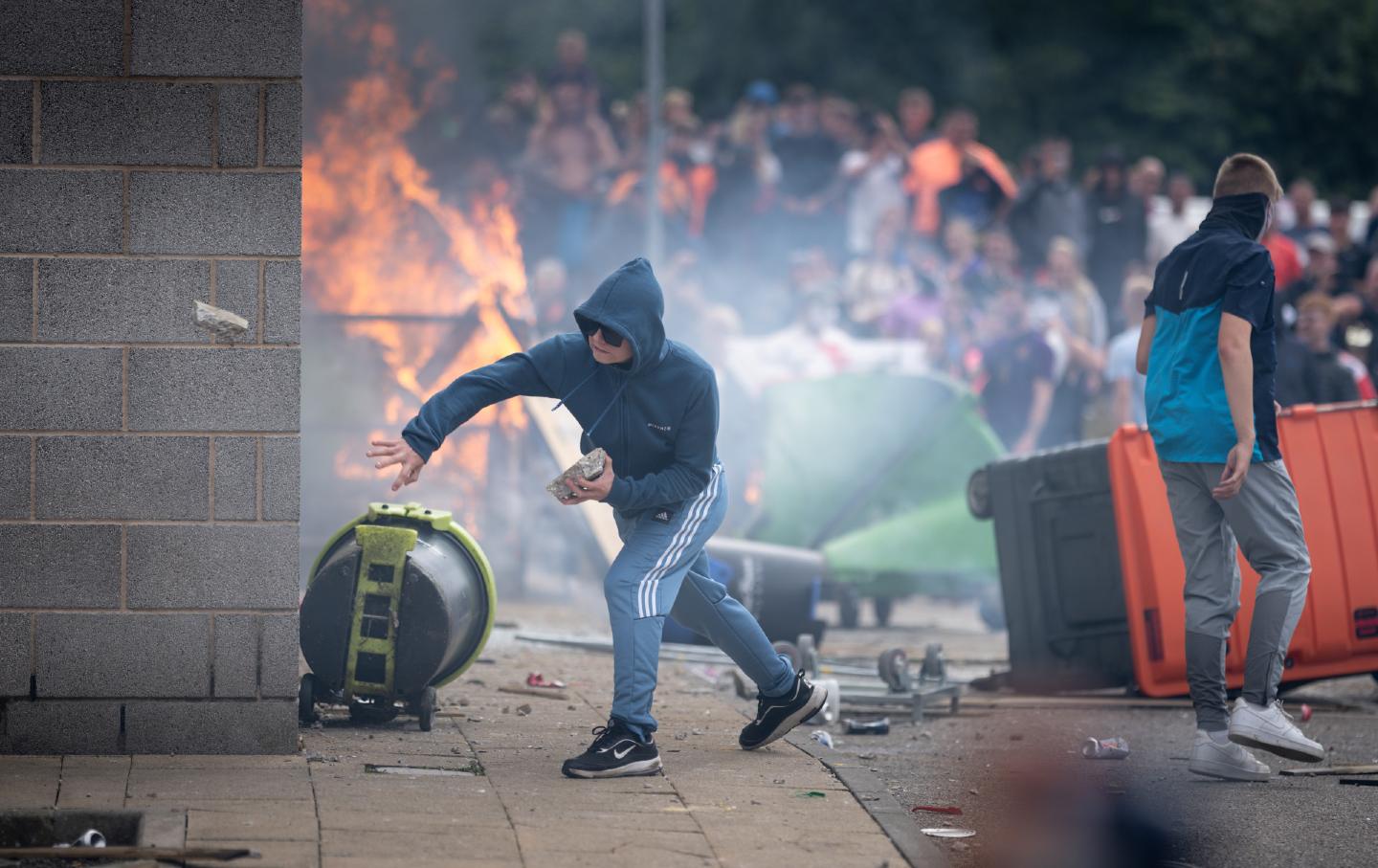
Anti-migration protesters throw chunks of concrete outside the Holiday Inn Express Hotel, which is housing asylum seekers on August 4, 2024 in Rotherham, United Kingdom.
(Christopher Furlong / Getty Images)
London—Last week, the British far right plunged the United Kingdom into violent turmoil by cynically capitalizing on a tragedy. On July 29, Bebe King, 6, Elsie Dot Stancombe, 7, and Alice da Silva Aguiar, 9, were stabbed to death in the northwestern city of Southport during a Taylor Swift dance class; eight other children and two adults were injured. Just hours after that attack, far-right violence spread through the mourning city’s streets. Rioters attacked a mosque, smashed up and looted local businesses, and set a van on fire.
Right-wing networks organized the Southport riots as a false claim spread online: that the 17-year-old attacker was a Muslim asylum seeker who’d recently arrived on Britain’s shores on a small boat across the English Channel. According to Reuters, the completely made-up story, repeated by the likes of popular far-right figures like Tommy Robinson and Andrew Tate, reached as many as 15.7 million social media accounts. Given that under UK law, suspects are not named before they are charged and minors are usually left unnamed, the fake name “Ali al-Shakati” was conjured. Used by an X/Twitter account called “Channel 3 Now,” which the Associated Press reports is linked to a website that “showed a mix of possibly AI-generated news and entertainment stories,” the false name spread through social media alongside the other lies at a shocking speed, raising newly urgent questions about social-media companies’ roles in the rise of the far right and spread of disinformation.
Axel Muganwa Rudakubana—whose name was released by a judge on August 1 declaring that he wanted to stop people “up to mischief [from continuing] to spread misinformation in a vacuum”—was born in Wales to Rwandan parents and is not Muslim. These facts have done little to stem the riots sweeping the country from Belfast to Bristol. In the days since white nationalists in Southport chanted, “Save our kids,” “We want our country back,” and “Stop the boats” (parroting former Prime Minister Rishi Sunak’s policy promise word for word), among other racist and homophobic slurs, over a dozen other British cities have been similarly besieged. White nationalists have targeted mosques and Muslim community centers across the country. Muslim graves were desecrated in the town of Burnley. And with hate crimes on the rise, people of color understandably fear for their safety.
The riots have also left a trail of destruction beyond their racially motivated targets. In the cities of Rotherham and Tamworth, rioters tried to set fire to hotels housing hundreds of refugees and asylum seekers. In Liverpool, rioters burned a library, and in Sunderland, a police station. In Middlesbrough, they hurled makeshift missiles and other projectiles at police near a war memorial and torched nearby cars.
Though quickly proven to be false, the claims spread online mirrored racist, xenophobic narratives promoted by right-wing anti-immigrant media and politicians such as sitting member of Parliament and Reform Party leader Nigel Farage, former conservative prime ministers Boris Johnson and Rishi Sunak, among many others. As a number of Britons have pointed out, the same politicians who systematically defunded public services over more than a decade of austerity cuts have blamed immigrants for the dire state of the nation. They have also, at best, turned a blind eye to the rise of white nationalism, and at worst, stoked its deadly flames.
Worryingly, the racist scapegoating seems to have worked. Amid a cost-of-living crisis, a common accusation from right-wing Britons is that the government prioritizes the well-being of immigrants while “leaving us behind.” A staggering 70 percent of Britons surveyed by Ipsos in recent months said they “believe that immigration puts extra pressure on the [National Health Service],” and a number of rioters have cited long NHS waiting lists as one of the reasons they are anti-immigrant.
As countries around the world, including Australia, India, and Nigeria, issued official warnings to their citizens to avoid travel to the UK, newly elected Labour Prime Minister Keir Starmer called the riots “far-right thuggery” and condemned the Islamophobia behind attacks on Muslims. The former chief prosecutor turned Labour leader has taken a “law and order” approach to the riots, with police arresting more than 400 people involved in the disturbances. The courts have already begun to charge suspects with everything from causing disorder to terrorism offenses.
Starmer’s approach has been met with both obstacles and criticism. The Tory legacy of public spending cuts has left British prisons overflowing, making it difficult to deal with the onslaught of arrests. Meanwhile, a snap YouGov poll revealed this week that nearly half the country thinks Starmer’s handling of the riots has been “poor.” The British left has criticized the heavy-handed policing and also the government’s discouragement of counterprotests, including reportedly advising Labour representatives not to take part in anti-racist demonstrations.
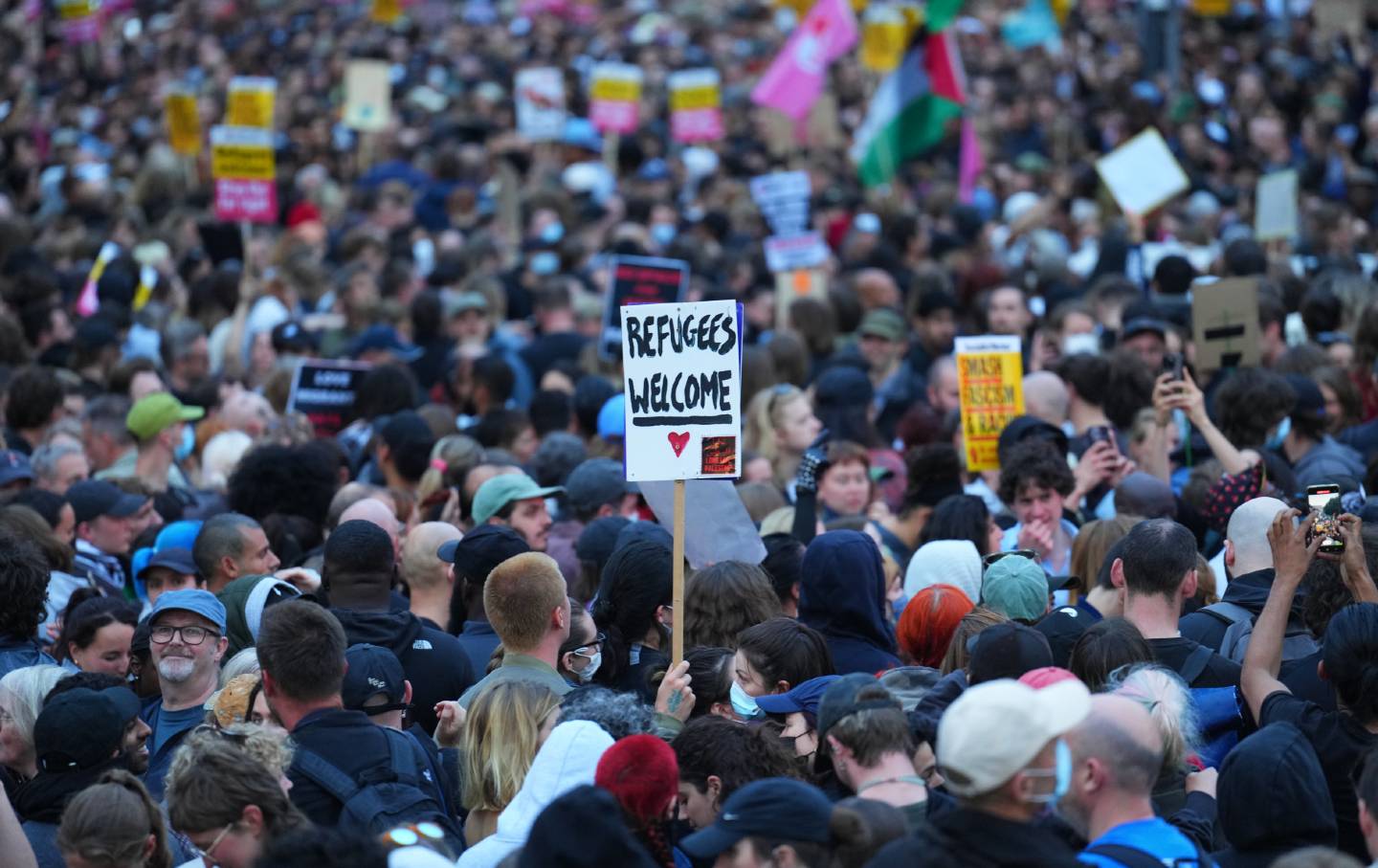
On Wednesday, many Britons refused to listen to their prime minister’s warnings about counter-rallies. News spread that over a hundred far-right rallies were planned throughout the country, many of which were expected to target refugee centers and immigration lawyers’ offices. The police dispatched 6,000 riot-trained officers—the largest law-enforcement mobilization in Britain in more than a decade—but rather than far-right riots, the police were met with something altogether unexpected. Thousands of anti-racist marchers came out in cities like Liverpool, Brighton, London, Bristol, and Birmingham with signs that read “Refugees Welcome” and “Reject Racism, Try Therapy.” They chanted, “Off our streets, Nazi scum!” On a night when much of the country had braced for a continuation of the violence, the peaceful anti-racists outnumbered the far-right demonstrators to such an extent that few “thugs,” as their prime minister called them, could even be spotted on Britain’s streets.
The scenes of civil solidarity were reminiscent of another moment in British history: the 1936 Battle of Cable Street, when a local community took on Oswald Mosley and his Nazi-sympathizing brown shirts on the streets of East London. Wednesday’s grassroots resistance serves as a powerful reminder that, just as the United Kingdom has faced the pernicious rise of far-right nationalism before, it’s also not the first time the threat has been fended off by ordinary people who’ve mobilized to protect their communities. While it remains to be seen where the British far right will go from here, anti-racists have sent a clear message this week: Yet again, they shall not let them pass.
Become a Sustaining Donor This September
Between the reemergence of right-wing red-baiting and Donald Trump’s use of the chilling National Security Presidential Memorandum–7 to criminalize left political organizing, we’re seeing McCarthyism reborn before our eyes.
This assault on democracy cannot be ignored or wished away. Resisting it requires bravery in the face of threats and repression, a steadfast commitment to the truth, and the unwavering belief that we can—and will—overcome this darkness.
We must have an independent media that sets the record straight, unearths corruption and abuses of power, and advances a politics of justice and dignity for all if we’re to win this fight.
That’s why I’m writing to you today. This September, The Nation needs to add 100 monthly donors to sustain our progressive journalism. Your contribution makes the next investigative report, the next truth-speaking column, and the next pathbreaking essay all possible.
I hope you’ll support our work with a recurring donation today. If you donate $10 or more a month, we’ll send you a brand new “Hands Off the Free Press!” sticker to recognise your commitment to our cause. Please, donate today.
Onward,
Katrina vanden Heuvel
Editor and Publisher, The Nation