Reg-GIE! Reg-GIE! Reg-GIE!
Baseball legend Reggie Jackson tells the Fox Sports audience the truth about playing baseball in the 1960s in the South.
Reggie Jackson Speaks the Ugly Truth About Baseball’s Past
The baseball legend tells the Fox Sports audience what it was like playing baseball in the 1960s in the South.
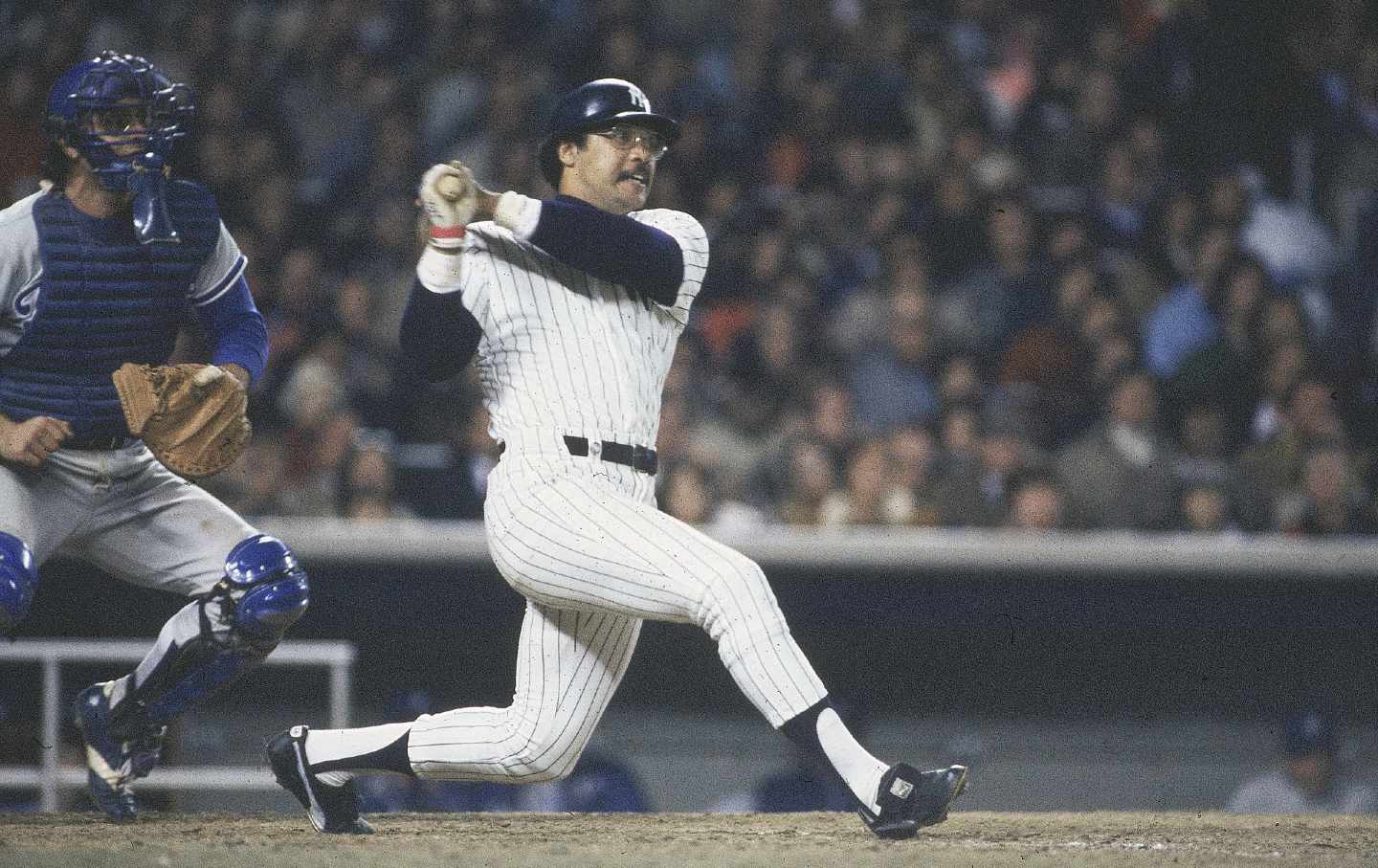
The Yankees’ Reggie Jackson hits one of three home runs against the Los Angeles Dodgers in a 1977 World Series game.
(Walter Iooss Jr./Sports Illustrated via Getty)
Major League Baseball and its partners at Fox were trying to turn a celebration of the Negro Leagues into a Disneyfied narrative of triumph in the face of “adversity,” which was left vague and undefined. MLB Commissioner Rob Manfred and the geniuses he employs thought that staging a feel-good game at Rickwood Field in Birmingham, Alabama, with little historical context was the best way to commemorate the Black baseball experience. Fortunately, legendary 78-year-old Hall of Famer Reggie Jackson was having none of it. One of many Black American baseball veterans in attendance, Jackson was brought onto the MLB on Fox set to talk about his memories as a minor-league prospect for the Birmingham A’s. Instead of playing nice, Jackson swung for the fences.
When asked what it was like to play in Alabama in 1967, Jackson said bluntly, “I wouldn’t wish it on anyone.” He then spoke for several minutes about being treated like something less than human. “I would never want to do it again,” he said, “I walked into restaurants, and they would point at me and say, ‘That n—— can’t eat here.’”
He recalled his allies on the team. “Fortunately I had a manager, Johnny McNamara. If I couldn’t eat in a place, nobody would eat…. If I couldn’t stay in a hotel, they’d drive to the next hotel and find a place where I could stay,” he said. “Had it not been for Rollie Fingers, Johnny McNamara, Dave Duncan, Joe and Sharon Rudi, I slept on their couch three, four nights a week for about a month and a half. Finally, they were threatened that they would burn our apartment complex down unless I got out.”
He then supplied some context for what it meant to be a young Black man in Birmingham for the Fox audience. “The year I came here, Bull Connor was the sheriff the year before.” He said how just a few years earlier, in 1963 and not far from Rickwood Stadium, the KKK bombed the 16th Street Baptist Church, killing four girls: Addie Mae Collins, Cynthia Wesley, Carole Robertson, and Carol Denise McNair.
“At the same time,” Reggie said, “had it not been for my white friends, had it not been for a white manager, and Rudi, Fingers, and Duncan and Lee Meyers, I would have never made it.”
He also said that as a young man in 1967, he was not ready to turn the other cheek: “I was too physically violent. I was ready to physically fight somebody. I would have got killed here, because I would have beat someone’s ass, and you would’ve saw me [hanging from] an oak tree somewhere.”
Jackson’s breakdown of this history, as the Fox studio hosts stared at him, their jaws agape, matters amid the battle to preserve the history of the Black American ballplayer, not merely the gauzy, palatable one served to us by Manfred. Recognizing Negro League records is a welcome start, but it cannot be the end. Currently the numbers of Black Americans playing Major League Baseball is at a historic low. Manfred seems to think he can solve this crisis in part by presenting a history of triumph and excellence against all odds while ignoring the toll it took on generations of Black American players.
Luke Epplin, author of the brilliant book Our Team, about the Cleveland Indians of the late 1940s, a squad that included Negro League legend Satchel Paige and trailblazer Larry Doby, said it well: “I just keep thinking about what Reggie Jackson said last night and how important it was. It cuts against the narrative formed by MLB, which focuses exclusively on Jackie Robinson and makes it seem that he shouldered the burden and then opened the doors [in 1947]. Jackson undercuts that. His amazing impromptu speech positioned racism as ongoing into the late ’60s for Black ballplayers, long beyond the integration era. It wasn’t a problem to be solved but a structural reality that plagued players for decades afterward.”
It is important to hear for reasons far greater than baseball. There is a rising Black Republican star, Representative Byron Donalds, who is rewriting history when he waxes nostalgic about the Jim Crow era to please his white benefactors and curry favor with Donald Trump. Hearing Jackson’s lived experiences safeguards what we can quaintly call “the facts.” The facts are that Jim Crow was terrorism; terrorism that in myriad ways shortened the lives of generations of Black families. Byron Donalds is just 45 years old and would do well to listen to some elders about the reality of Jim Crow—elders like the great Reggie Jackson. The tragedy is that it benefits Donalds to close his ears, sneer, and turn away.
But people like Donalds look extremely small when stacked up against Jackson’s testimony of truth. Jackson should be commended for his bravery, telling moving truths the audience was not expecting to hear. After Jackson’s words and after the Fox Crew caught their breath, you could almost hear that chant of the 1970s in the thick, humid Alabama air: “Reg-GIE! Reg-GIE! Reg-GIE!”