As Columbia Alumni Returned to Campus, So Did the Encampment
Columbia students continue to mobilize through the summer in support of Palestine—organizing in tandem with alumni and applying financial pressure on the university
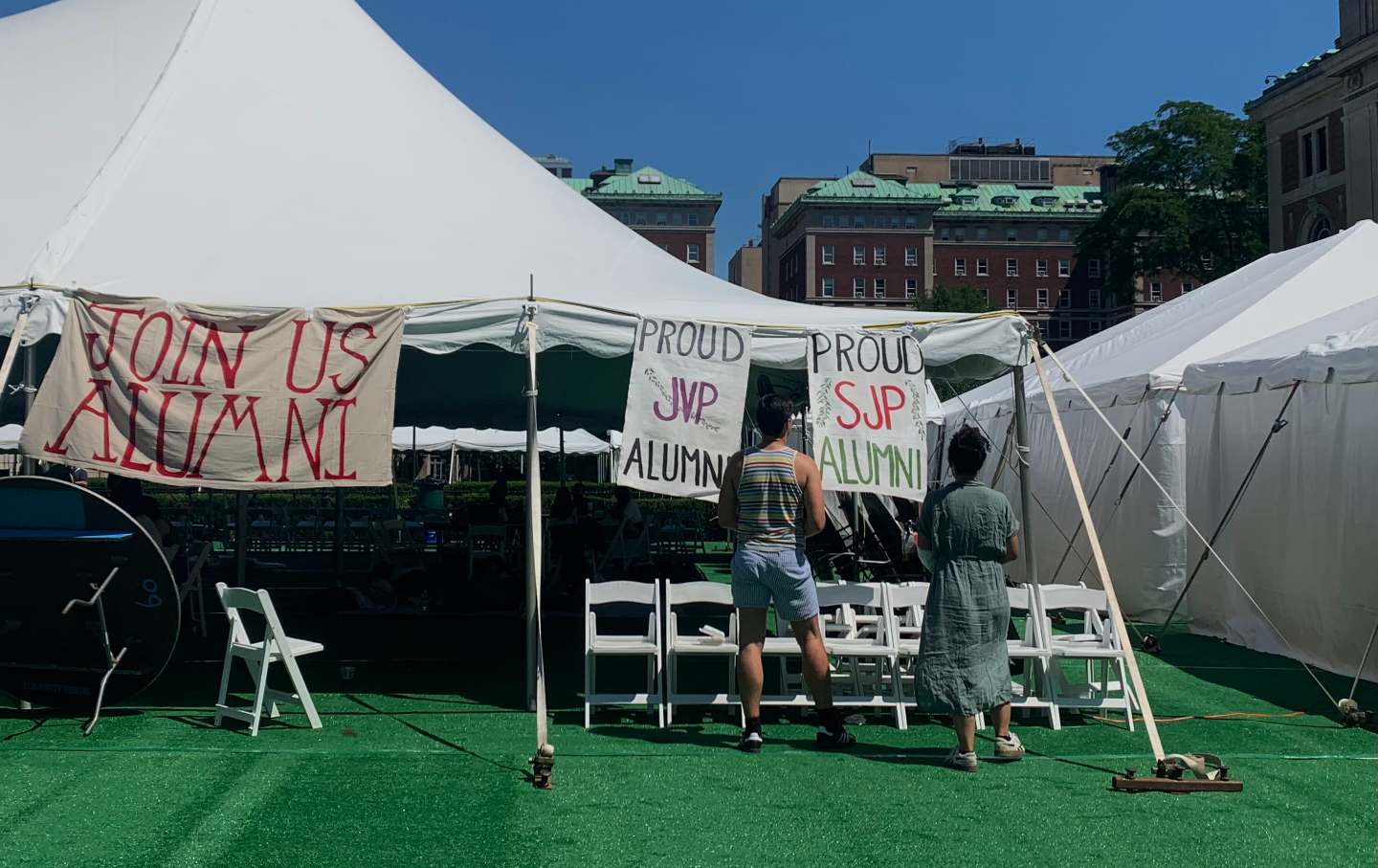
The latest protest in support of Gaza during Columbia University’s alumni reunion weekend.
(Lara-Nour Walton)Almost a month after the NYPD raided Columbia’s Hamilton Hall—throwing stun grenades, breaking bones, and arresting 109 people—Columbia student organizer Zaid had a message for the world: “We’re back, bitches.”
On May 31, students affiliated with Jafra, an autonomous coalition of Palestinian students supported by Columbia University Apartheid Divest, established the university’s third Butler Lawn encampment since April 17. The administration sent an e-mail on June 1 asserting that the re-occupation “violates University rules.”
While student activists assiduously rebuilt their Butler Lawn encampment, another group was concurrently returning to campus: the alumni.
Alumni of all ages each paid around $150 to $400 to attend the first reunion weekend since the anti-war protests polarized the campus. Between festivities, many lingered outside the newly erected encampment, which organizers dubbed “Revolt4Rafah Installation 1” in response to Israel’s massacre of displaced Gazans in western Rafah’s Tel al-Sultan refugee camp on May 26.
“The fact that we’re back means that the genocide hasn’t stopped and has only gotten worse,” said Basil, a member of Jafra. “The images and the videos that we are seeing come out of Rafah are horrifying,” added organizer Layla Saliba. “Burnt tents, charred bodies; it’s unimaginable what people are going through.”
Some alumni outside of the newly erected tent city jeered at students. “Who’s on financial aid? Do you want to lose your financial aid?” one alumnus bellowed after rushing down from the campus sundial and toward the gates of West Butler Lawn. Others stood in clusters eyeing students painting protest banners and calling it “performance art” in disapproving tones. On the evening of June 1, alumna Irish Tudtud approached the tent city to accuse the pro-Palestine students inside of being “rapists” and tell a Palestinian student and organizer, “I hope you get raped.”
Amid this hostility, many alumni expressed curiosity about and even outward support of the encampment. One of them, a Palestinian from the class of 2009 who wore a floral skirt, knelt next to a circle of protesters folding pamphlets. “Columbia is about critical thinking; it is about activism,” she said. “We can’t now punish them for that.”
Students at the latest encampment urged alumni to refrain from donating to the university. A petition started by CU Alumni 4 Palestine to this end has now garnered over 4,600 alumni signatures. “Columbia operates like a business. This place is a hedge fund that does education on the side. The only way to make this institution listen is for them to face economic consequences, because they do not have morals or empathy for students,” said Saliba. Organizers are hoping that applying financial pressure on the university via alumni will help force it to seriously consider their central demands of divestment and disclosure.
The Palestinian alumna was among those who pledged to withhold donations in light of the university-sanctioned repression of students advocating for an end to the war on Gaza, in which Israel has now killed more than 40,000 Palestinians. She told The Nation that most other alumni who refused to give money did not end up attending the reunion weekend. “Nobody wanted to show up this year,” she said, referring to the friends with whom she graduated. “I’ve been to [reunions] before, and there’s far fewer people of color than ever before.”
One of the only Black alumni who attended from the class of 1994 for their 30-year reunion was Stephen Fischer. He attributes the lack of POC alumni to the current repression and discrimination of Palestinian students and their allies. “They see history repeating itself,” said Fischer, alluding to Columbia’s stringent crackdowns on student social justice and anti-apartheid movements of the past. “The administration really needs to do some soul-searching and decide if [they] want to be, again, on the wrong side of history.”
Greg, who opted to use a pseudonym, was a freshman during the massive Columbia protests of 1968. Like Fischer, he noticed historical parallels. “In 1968, if you had long hair and were protesting the war in Vietnam, immediately, people screamed, ‘You’re un-American’ in the same way that people are saying, if you’re objecting to what’s going on in Gaza, ‘You’re antisemitic.’”
Greg lives locally and decided to come to campus to see if he could “run into anyone from my years past,” but didn’t join any of the reunion festivities. “I don’t have a whole lot of discretionary income to donate, but I’m more inclined to give it to my high school, which I don’t have any ambiguous feelings about,” he said.
Even for alumni who have been regular supporters of Columbia, recent campus events have thrown their loyalty into question. One alumnus stopped by the encampment to chat with organizers about their movement. The alumnus, who asked to remain anonymous, has been donating to Columbia for the last 50 years. Since witnessing the school’s treatment of students, he is considering withholding his money for the first time.
Outside the campus gates, alumni stood definitively with Palestine. In the late afternoon of June 1, over two dozen alumni from Columbia’s class of 2009 picketed in front of the university’s main entrance in solidarity with students. They stated that “Columbia alumni understand that we are a core part of the university’s marketing and fundraising strategies and we refuse to be complicit.”
Meanwhile, on Amsterdam Avenue, the “alternative reunion” took shape. Julie Slotnick, class of 2014, organized the event for alumni who were “unable to reconcile the University’s recent actions with the values and principles that defined our education at Columbia and Barnard.” Programming included a party at the downtown bar Brass Monkey on May 31 and a dinner and reception on 111 and Amsterdam Avenue the next day. The gatherings saw approximately 500 and 300 attendees, respectively.
Slotnick explained that she had enjoyed her five-year alumni weekend and longed to recapture that sense of community for her 10-year reunion. However, when the university suspended Columbia’s chapters of Students for Justice in Palestine and Jewish Voice for Peace, she began to feel apprehensive about supporting Columbia. “Once the encampments came and they summoned the NYPD, I just knew there’s no way that I’m gonna be able to attend this reunion and put the money into endorsing it.”
Popular
“swipe left below to view more authors”Swipe →As a result, Slotnick planned the alternative reunion and sent out a letter to alumni asking them to “call upon the University to meet the demands of student protestors for divestment from companies supporting Israel’s government, disclosure of those investments, full amnesty for students and professors unfairly disciplined for exercising their free speech in calling for freedom, safety, and self-determination for the Palestinian people.”
Alternative-reunion attendees were encouraged to redirect what they would have paid to attend alumni weekend to UNRWA, World Central Kitchen, Palestine Children’s Relief Fund, Freedom Bakeries, and Emergency Tent Support by Translating Palestine. From the three alternative reunion campaigns with donation trackers, The Nation determined that the event had raised at least $10,600.
With school out of session, many wondered what would become of the pro-Palestine movement that blossomed on campus in the spring. One protester, Sueda Polat, predicts a summer without rest. “So long as a genocide rages on, students will be learning together, educating, agitating, and organizing,” she said. While “Revolt4Rafah Installation 1” was voluntarily dismantled on June 2 after a “successful disruption of alumni weekend,” activists seek to “continue strategic, targeted attacks on all aspects of university life contributing to the normalization of [Palestinian] slaughter.” They also promised “more installations to come.”
“When Minouche Shafik called the NYPD, that was a grave mistake,” said Greg, “she lost face with an awful lot of people—not just students here.”
More from The Nation
How Occupy Wall Street Still Explains Politics Today How Occupy Wall Street Still Explains Politics Today
It sowed the seeds for a new era of social movements—but its politics of powerlessness should act as a cautionary tale.
Abdul El-Sayed’s Win Is a Landmark. But the Fight Is Far From Over. Abdul El-Sayed’s Win Is a Landmark. But the Fight Is Far From Over.
Even though the Palestine movement is on the march, we can’t afford any complacency.
Mamdani’s Team Redefined Political Video. Now They’re Betting on Short Films. Mamdani’s Team Redefined Political Video. Now They’re Betting on Short Films.
Premiering exclusively in The Nation, a new short film produced by City Hall and narrated by Morgan Spector highlights the efforts of the biggest tenant-led union in New York City...
The Weapons Manufacturer Next Door The Weapons Manufacturer Next Door
It’s been six years since I began attending pro-Palestine demonstrations. The most recent campaign at the Brooklyn Navy Yard feels different.
Slavery’s Musical Threads Slavery’s Musical Threads
As ICE violence resurges in the US, the musical history of black Brazil offers lessons in resistance.
The Police Shootings Haunting New York’s South Asian Community The Police Shootings Haunting New York’s South Asian Community
Two young Bangladeshi American men were shot by the NYPD. One of them died. Their families are demanding justice and reform.

